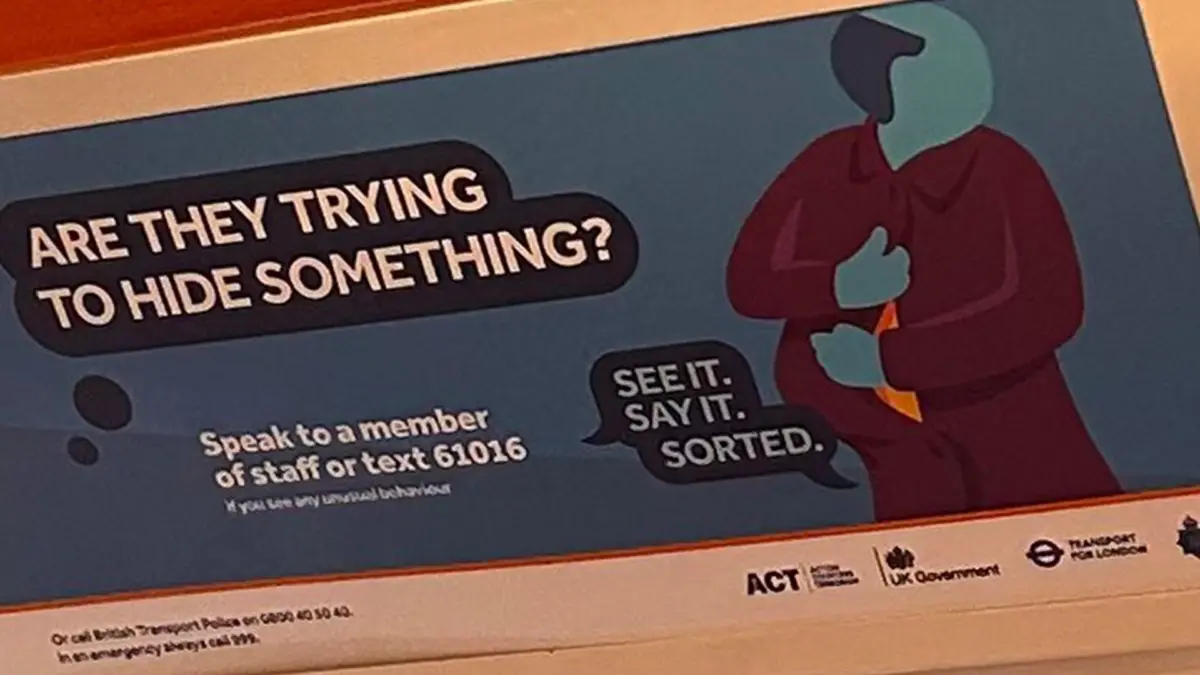
Transport for London (TfL) has found itself engulfed in a swift and intense public relations controversy following the appearance of a deeply polarizing public safety advertisement across its transit network. The poster in question, which pairs a stark and potentially paranoia-inducing tagline—"Are they trying to hide something?"—with a featureless vector illustration, caused immediate confusion and widespread outrage among commuters. To many passengers traveling on London’s transit system, the abstract graphic appeared to depict a woman wearing a hijab, transforming what was intended as a routine safety reminder into a message widely perceived as promoting religious profiling, suspicion, and ethnic hostility.
The controversial advertisement highlights the subtle complexities of visual communication in crowded public spaces, illustrating how abstract design choices can drastically backfire when applied to sensitive subjects. The graphic at the center of the storm relies heavily on the "Corporate Memphis" art style, a ubiquitous modern design aesthetic characterized by flat colors, simplified human shapes, non-standard body proportions, and a complete lack of distinct facial features. While the intended subject of the illustration was actually a balding man looking back over his shoulder, the deliberate minimalism of the Corporate Memphis style created a major optical ambiguity. Viewers reading the poster from a distance or at a quick glance overwhelmingly interpreted the smooth curves of the back of the man’s head and shoulders as the silhouette of a Muslim woman dressed in a traditional hijab.
When combined with bold copy questioning whether the figure was "trying to hide something," the ambiguous visual was met with swift condemnation on social media. Commuters and online commentators expressed horror at what they interpreted as a dangerous and divisive public service announcement officially displayed across public transport. On the social media platform X (formerly Twitter), users shared photographs of the poster and voiced their dismay over the campaign’s framing and messaging choices. One user posted an image of the ad alongside a caption declaring, "Disgusting insinuation in this campaign. Absolutely appalling," while directly tagging the Mayor of London, Transport for London, and national action channels.
The outrage quickly broadened into a larger discussion regarding public trust, state-sponsored vigilance, and the societal impact of fear-driven advertising. Another X user commented on the unsettling tone of the messaging, writing, "Suspicion, paranoia and ethnically ambiguous abstract art – 1984 is here in full force." Others marveled at how profoundly the visual presentation had failed its intended communicative purpose, describing the advertisement as a surreal perceptual test. "This is a wonderful Rorschach test," one user remarked, noting how the graphic allowed different viewers to project vastly different visual interpretations onto the exact same set of flat lines and featureless vector shapes.
As awareness of the intended subject matter spread across social media, the conversation shifted toward the sheer bizarre nature of the design oversight. Once observers realized the image was not a woman wearing a hijab but rather a silhouette of a balding man turning his head around, many expressed disbelief at how such an easily misconstrued graphic passed through initial design and review processes. "It took me ages to see the balding man. TfL accidentally created its own version of this image," noted one commentator, comparing the advertisement to famous optical illusions where a single drawing can be interpreted as two entirely different subjects depending on the viewer’s focus.
As public pressure mounted and online criticism intensified, Transport for London responded to the original social media poster who had brought the advertisement to light, stating that the situation was being officially investigated. However, TfL’s subsequent public communications only added further confusion and skepticism to the ongoing controversy. In a public statement posted to X—which was subsequently deleted—TfL attempted to distance itself completely from the poster, claiming that the artwork had not been approved or officially deployed by the transit authority.
In the deleted post, TfL asserted that the advertisement was an illegal posting that had been placed on the transport network without authorization. "Our media partner, our teams and contractors have been instructed to inspect trains and remove any unauthorised posters that are found on our network," TfL stated in the post. The transit authority went on to declare that the matter was being treated as a criminal offense, adding, "The incident has been reported to [British Transport Police] as flyposting is an illegal activity."
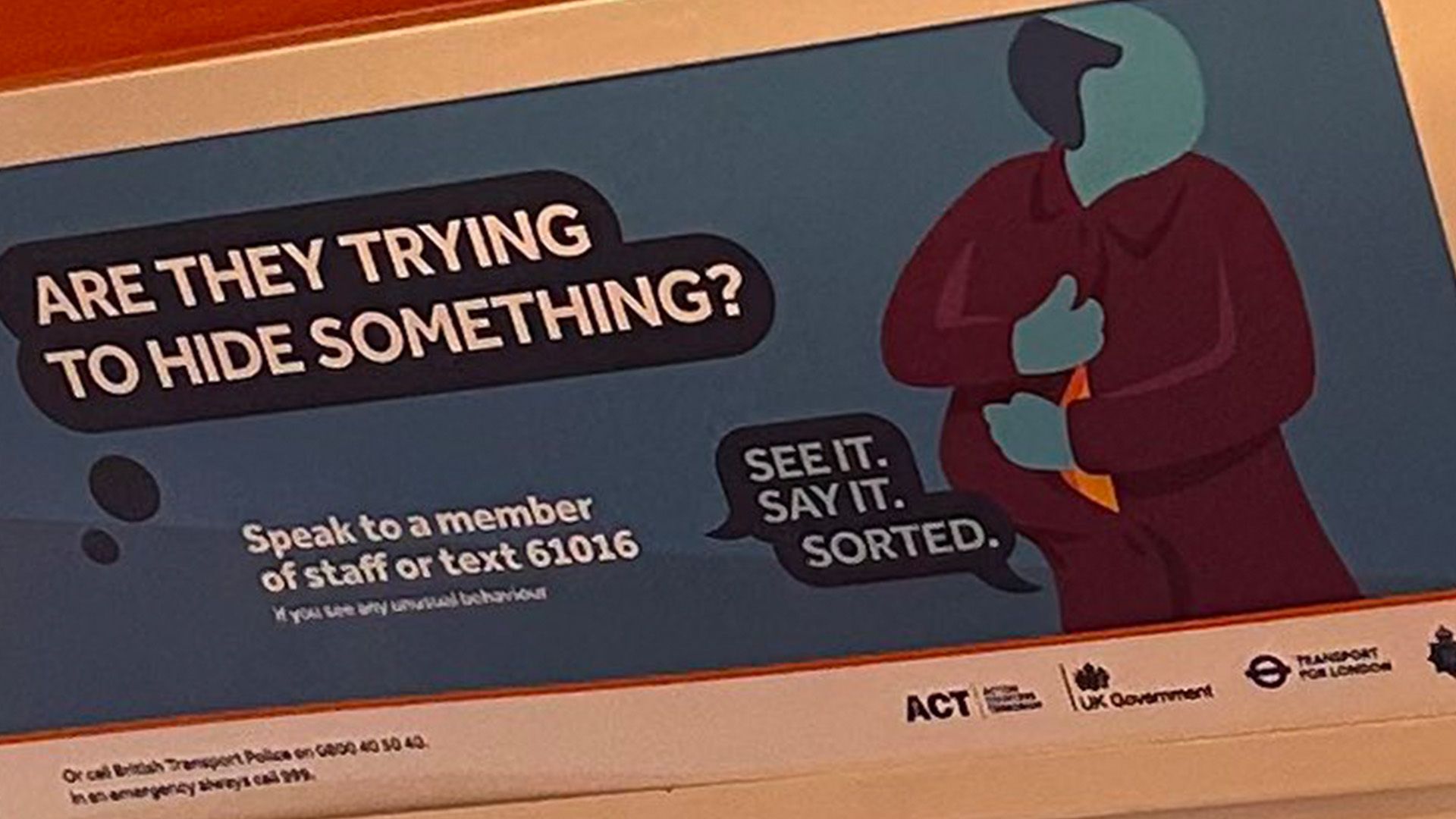
This explanation immediately sparked widespread skepticism among members of the public and media observers, who raised significant questions regarding the validity of TfL’s defense. On social media, users quickly pointed out obvious logical flaws and contradictions in TfL’s claim that the poster was simply an unauthorized piece of flyposting created and installed by an unknown third party. Commuters and commentators noted that official news sources had previously reported on the rollout of this exact public safety campaign, complete with news coverage detailing the launch and displaying variants of the exact same poster art and copy across the transport system.
Even more damningly, critics highlighted a massive contradiction surrounding the involvement of law enforcement. While TfL claimed in its statement that it had reported the illegal flyposting incident to the British Transport Police (BTP), observers noted that the British Transport Police themselves appeared to have been the very entity running or partnering on the campaign. The revelation that the poster was part of an official, previously publicized public safety initiative rendered TfL’s official explanation—that it was an unauthorized, illegal installation—highly suspect, leading many to view the response as a hasty and poorly managed attempt to avoid public fallout for a high-profile marketing misstep.
The controversy has sparked broader discussions within the marketing, advertising, and graphic design communities regarding the appropriateness of specific aesthetic styles for sensitive public messaging. The Corporate Memphis illustration style, which gained widespread popularity over the past decade across corporate branding, tech platforms, and digital applications, is often chosen for its friendly, neutral, and easily scalable visual qualities. Because it deliberately abstracts human features—frequently featuring featureless faces, unnatural skin tones, and simplified clothing—it is often viewed by design teams as a safe choice for universal visual representation.
However, the TfL incident illustrates how the abstraction inherent to Corporate Memphis can prove disastrous in the context of public safety announcements and law enforcement messaging. Public service campaigns aimed at encouraging vigilance, reporting suspicious activity, or warning against crime require visual precision and absolute clarity. When featureless, abstract figures are combined with copy that encourages suspicion—such as asking whether a person is "trying to hide something"—the lack of facial definition or clear context creates a dangerous visual vacuum. Rather than conveying a clear safety message, the abstract design allows the audience’s biases, fears, or visual pattern-recognition tendencies to fill in the missing details, resulting in accidental profiling and intense public backlash.
Creating the right linguistic tone and visual harmony is critical to the success of any public-facing campaign, particularly when deployed in high-density environments like a major metropolitan transport network. In this case, whether caused by an oversight in the design approval process or an unvetted deployment, the combination of paranoia-inducing copy and ambiguous artwork created a recipe for disaster. The resulting public fallout has left TfL dealing with a severe messaging crisis that touches on sensitive issues of religion, state surveillance, public trust, and institutional transparency.
This incident occurs within a broader cultural climate of heightened public scrutiny surrounding commercial and public sector communications. The modern advertising landscape has seen a noticeable surge in campaigns facing immediate cancellation, severe backlash, or public fallout due to tone-deaf messaging, visual missteps, or unintended cultural friction. From high-profile commercial advertisements sparking intense culture wars to public service campaigns being pulled shortly after launch, brands and public institutions are finding that audiences are increasingly sensitive to visual nuance and rapid to mobilize against poor messaging choices.
For Transport for London, the fallout serves as a stark reminder of the risks involved in public safety communications. As the transit authority, its media contractors, and transport police navigate the public relations aftermath, the incident remains a textbook case study in how visual ambiguity, troubling language, and contradictory crisis management can combine to sink an entire public campaign.