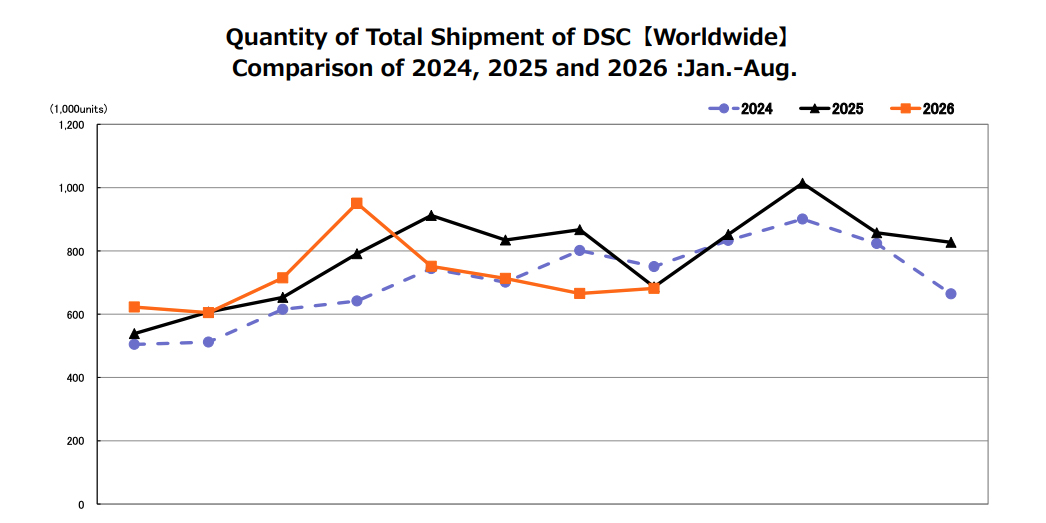
Global camera shipments have experienced a notable cooling period, dipping below last year’s figures for four consecutive months. According to the latest data released by the Camera and Imaging Products Association (CIPA), camera shipments for the first eight months of the year stand at 96.8 percent of the totals recorded during the same period in 2025.
The August 2026 data illustrates a broader downward trend in international camera shipments when compared directly against the previous year. While the industry enjoyed a robust recovery and high demand throughout much of 2024 and 2025, shipments have consistently trailed behind last year’s markers from May through August. However, looking at month-to-month performance, August did demonstrate a slight recovery, achieving 102.5 percent of the volume recorded in July.

A closer examination of individual categories reveals a stark divergence in consumer demand across different equipment types. Mirrorless camera shipments, which have long served as the primary growth engine for major manufacturers, saw a drop during the first eight months of 2026, settling at 93.8 percent of last year’s volume. In contrast, fixed-lens cameras—a category encompassing both traditional point-and-shoots and long-zoom bridge cameras—bucked the wider market trend, climbing to 115.3 percent of the previous year’s figures.
Meanwhile, the DSLR market continued its long-term contraction as camera brands concentrate their research, development, and marketing efforts squarely on mirrorless ecosystems. DSLR sales fell to 65 percent of the previous year’s cumulative numbers. Interestingly, August brought a surprising monthly bump for the format, with shipments doubling compared to July’s low point. The vast majority of these DSLR shipments were destined for the Americas, though regions such as China and Europe also recorded unusually high volumes for the month. Industry analysts note that while these sporadic monthly spikes occur, they do not reverse the overarching downward trajectory for DSLR shipments in 2026.

When analyzing the market through the lens of sensor size, compact and crop-sensor models demonstrated resilience. Cameras equipped with sensors smaller than full-frame saw a slight growth spurt in August, reaching 103.6 percent of the previous year’s tally for that month. Conversely, full-frame and larger format cameras experienced a softer month, registering at 89.4 percent of the August 2025 benchmark.
Beyond shipping logistics, manufacturing metrics offer a different perspective on supply and demand dynamics. Production numbers for compact cameras soared to 125.7 percent during the first eight months of the year compared to the same timeframe in 2025. This aggressive manufacturing push directly addresses persistent supply chain shortages that have left many viral and trendy compact camera models chronically out of stock across retail channels.
The ongoing resurgence in compact cameras began building momentum in 2024, driven by a cultural shift among younger photographers seeking distinct aesthetic qualities, tactile controls, and pocketable convenience away from smartphone photography. This sustained demand has strained inventory levels, prompting manufacturers to react. Canon, for instance, confirmed that it will ramp up compact camera production further during the second half of 2026 to meet consumer appetite, proving that the enthusiasm extends well beyond isolated viral hits.
In contrast, production figures for mirrorless cameras mirror the cooling shipment trends, sitting at approximately 93.1 percent of 2025 production levels as of August.
Despite the minor year-over-year dip in overall shipments to 96.8 percent, industry observers emphasize the broader context. Last year represented the most lucrative and high-volume period for the digital photography market since 2019. Furthermore, total worldwide shipments for the first eight months of 2026 remain ahead of the figures recorded in 2024, indicating that the market is stabilizing at a healthy baseline rather than entering a severe downturn.
CIPA data remains one of the most reliable barometers for the global imaging industry, capturing official shipment and production metrics reported by participating manufacturers based in Japan. This roster includes prominent household names such as Canon, Sony, Nikon, Fujifilm, OM System, Panasonic, and Ricoh. However, because the organization’s reporting pool is tied to Japanese headquarters, the statistics exclude non-Japanese entities like Leica and Hasselblad, mass-market novelty point-and-shoots like Kodak-branded units, and specialized action camera leaders including GoPro, Insta360, and DJI.