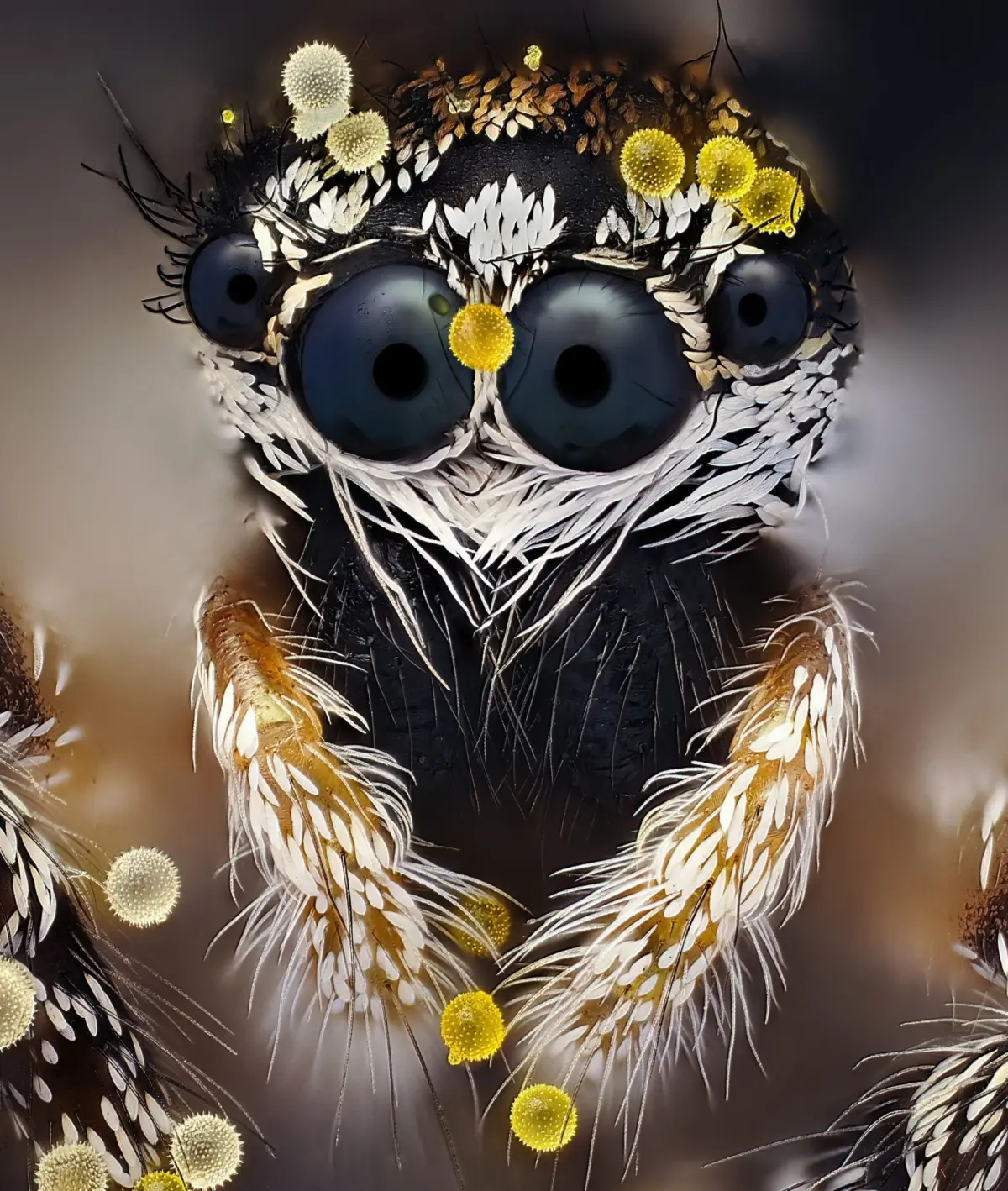
For most people, the word "spider" evokes a sense of caution, fear, or revulsion rather than endearment. However, a striking macro photograph captured by German photographer John-Oliver Dum is challenging those deeply ingrained prejudices, revealing an unexpectedly charming side to arachnid life through the lens of high-magnification photomicrography.
The image, which depicts a common European jumping spider adorned with brilliant specks of pollen, has captured second place in the prestigious Nikon Small World Photomicrography Competition. Featuring two huge, glossy black eyes and a face delicately fringed with fluffy white scales, the tiny subject bears a striking resemblance to an animated character from a major family film.
The subject of the acclaimed photograph is Salticus scenicus, a species of jumping spider widely distributed across Europe. Typically measuring between 5 millimeters and 9 millimeters in length—rendering them smaller than the average human fingernail—these spiders are known for their remarkable agility, excellent vision, and active hunting behavior rather than spinning traditional webs to catch prey.
In Dum’s prize-winning frame, the spider has been magnified 20 times its actual size. This extreme close-up transforms microscopic grains of pollen—which are normally completely invisible to the naked eye—into luminous, jewel-like adornments. The visual effect is remarkably regal, with clusters of pollen resting atop the spider’s head like a glittering crown, while an individual grain sits precisely between its two primary eyes like a delicate pendant.
How the Shot Was Achieved
Capturing an image of this caliber requires far more than simply pointing a camera at a tiny creature. At a magnification level of 20x, optical physics presents a severe challenge: the depth of field becomes extraordinarily shallow, meaning only an razor-thin slice of the subject will ever appear in sharp focus at any single moment.
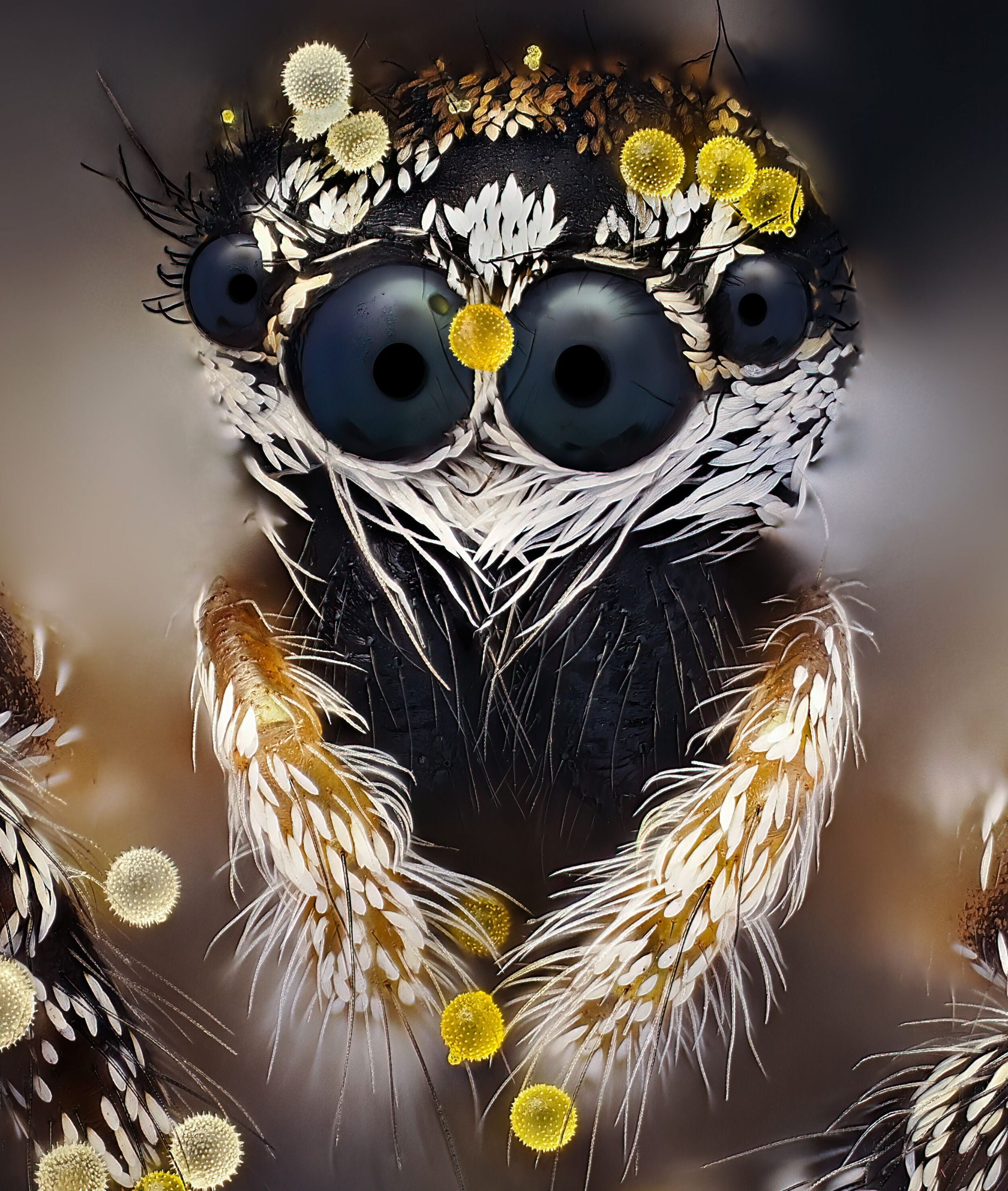
To overcome this optical hurdle, Dum relied on a specialized technique known as focus stacking. Rather than capturing a single exposure, the photographer generated the final image by combining dozens—and sometimes more than 100—individual frames. Each frame is captured at a microscopic variation in focus distance, scanning systematically across the depth of the subject. These individual captures are then meticulously merged using specialized software to ensure that every visible detail, from the spider’s facial features to the individual textures of the pollen grains, remains pin-sharp.
Based in Bendorf, Germany, Dum specializes in high-magnification macro photography, routinely working at scales ranging from 1x to 100x. His specialized professional equipment setup includes a Sony Alpha 1 camera body, an MJKZZ macro rail designed for executing ultra-precise focus increments, and high-grade microscope optics sourced from manufacturers such as Mitutoyo, Nikon, Olympus, and Carl Zeiss Jena. His work has previously gained international recognition, earning exhibition space at prominent institutions including the Tokyo Photographic Art Museum and ARTIS-Micropia in Amsterdam.
A Hidden World Revealed
What elevates the photograph beyond a mere technical achievement is the astonishing level of clarity captured within the frame. Despite the subject’s minute proportions, the image clearly delineates the individual scales on the spider’s face, the fine, bristling hairs covering its legs, and the intricate surface textures of every pollen grain clinging to its body.
While traditional photography often documents the familiar world from fresh artistic viewpoints, photomicrography ventures into entirely unseen realms that are completely inaccessible to the unaided human eye. This capability to visualize hidden biological landscapes is precisely what the Nikon Small World competition aims to celebrate.
Now in its multi-decade history, the Nikon Small World competition showcases the beauty, structural complexity, and scientific wonder of life captured through light microscopes, remaining open to any individual with a passion for microscopy across both photography and video entries.
The competition highlights a diverse array of microscopic subjects each year. Alongside Dum’s celebrated jumping spider, the broader exhibition includes remarkable works such as the overall competition winner by Ole Bielfeldt, which revealed an unprecedented view of an inkjet printer operating at a microscopic level. All winning and commended entries from the competition are available for public viewing on the official Nikon Small World website.