For generations, human ingenuity has found ways to mark the things we are most afraid of losing in the pitch black. Watch hands, emergency exit signs, stair edges, residential light switches, and those familiar plastic glowing stars adhered to children’s bedroom ceilings all received the memo decades ago. Yet, remarkably, the carabiner—an object whose entire functional purpose revolves around securely holding onto critical items in low-light environments—somehow missed it entirely. It has sat there for years, smug in its anodized aluminum finish, practically daring campers and hikers to find it in the dark. According to camping gear enthusiasts, that oversight stands as one of the most baffling design omissions of the century, a claim easily defended around any campfire when fumbling for dropped equipment at midnight.
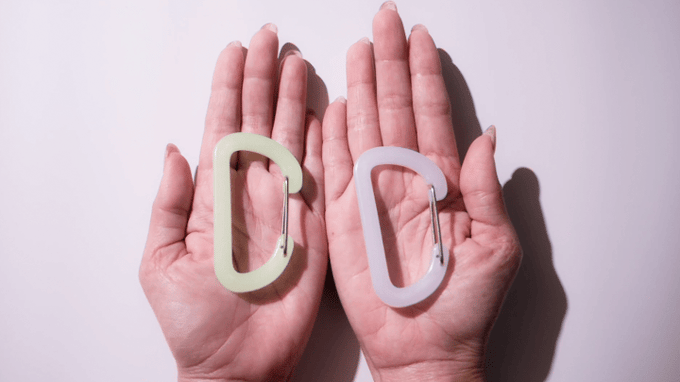
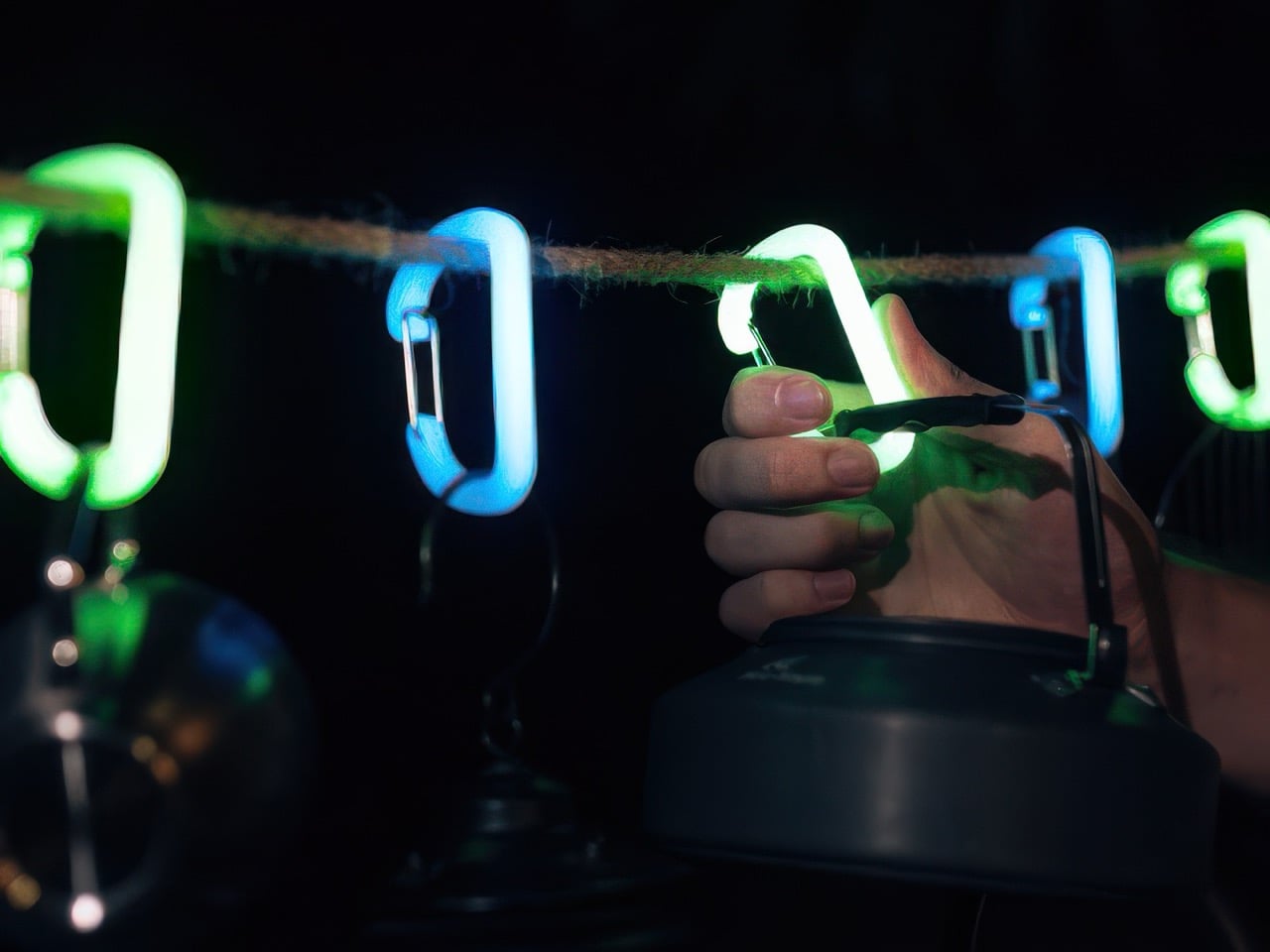
Enter the OBORO, a clever new solution developed by Maruhachi Kasei, a specialized plastics manufacturing firm located in Nagoya, Japan, that has been expertly molding resin products since 1974. This innovative piece of gear effectively closes the loop on nighttime visibility. The large D-shaped carabiner is constructed from a glow-infused polycarbonate material, measuring approximately 3 by 1.7 inches while maintaining an exceptionally lightweight profile of just 0.42 ounces, yet it is rated for a working load of 66 pounds. By simply leaving the accessory exposed to sunlight or an ordinary indoor lamp for a brief period, it absorbs ambient light and shines brightly for hours afterward. Best of all, it requires no batteries, no electronic charging cables, and no companion smartphone apps to function.
Accompanying the main carabiner is a convenient one-handed clip designed specifically for securing towels, tarps, and other floppy camp gear. Rated for 55 pounds, both items are made available in a vibrant, classic green or a cooler, understated blue hue. Designed strictly as accessory gear rather than life-saving climbing equipment, outdoor enthusiasts are advised to keep their heavy rope work and vertical ascents restricted to certified climbing hardware.
The Glow Is Baked Into the Plastic Itself
The secret behind the OBORO’s sustained illumination lies in its manufacturing process, where the glow pigment is thoroughly mixed directly into the polycarbonate resin itself. Because the pigment is fully integrated, the entire body of the hardware serves as a uniform light source. There is no fragile paint layer to chip, flake, or wear away over time—a critical engineering factor for an object that inevitably spends its operational life aggressively banging against rocky outcrops, metal tent zippers, and various other pieces of outdoor gear.
Furthermore, polycarbonate belongs to the same elite family of high-performance plastics utilized in the production of bulletproof glazing. The manufacturer notes that this material offers up to five times the impact resistance of standard ABS plastic and approximately 250 times the impact resistance of ordinary glass. It also handles extreme weather conditions and elevated heat significantly better than most conventional plastics. The only metallic component is the nickel-plated metal wire gate, representing the singular part of the structure that must flex thousands of times during regular use, making it a logical choice to remain metal rather than resin.
During internal testing conducted by the manufacturer, exposing the polycarbonate to a blacklight for just twenty minutes yielded roughly three hours of distinct, visible glow. As is characteristic of all phosphorescent materials, brightness peaks sharply during the initial ten to twenty-minute window before gradually tapering off over time. The hardware can be recharged infinitely using natural sunlight or ordinary indoor LED room lighting.
This technology traces its deep lineage back to a major 1993 scientific breakthrough at Japan’s Nemoto & Co., the foundational research behind the famous Super-LumiNova coatings utilized on high-end Swiss watch dials, though the specific proprietary pigment used here remains unannounced. Water represents the primary limitation of the material; according to the maker, wet pigment temporarily loses its charging capability and the surface can develop a cloudy appearance, meaning these carabiners belong securely inside the tent or under shelter rather than exposed directly to heavy rain.
A Bigger Gate, Beefier Numbers, and a Clip for Towels
Measuring approximately 3 by 1.7 inches with a thickness of 0.28 inches, the large D-carabiner is engineered to be roughly 30 percent larger than a standard utility carabiner. That expanded physical footprint is the central objective of the redesign. The gate opens wide enough to easily accommodate thick camp ropes, meaning everyday items like camping mugs, cooking kettles, and lanterns can be hung simultaneously without awkward maneuvering.
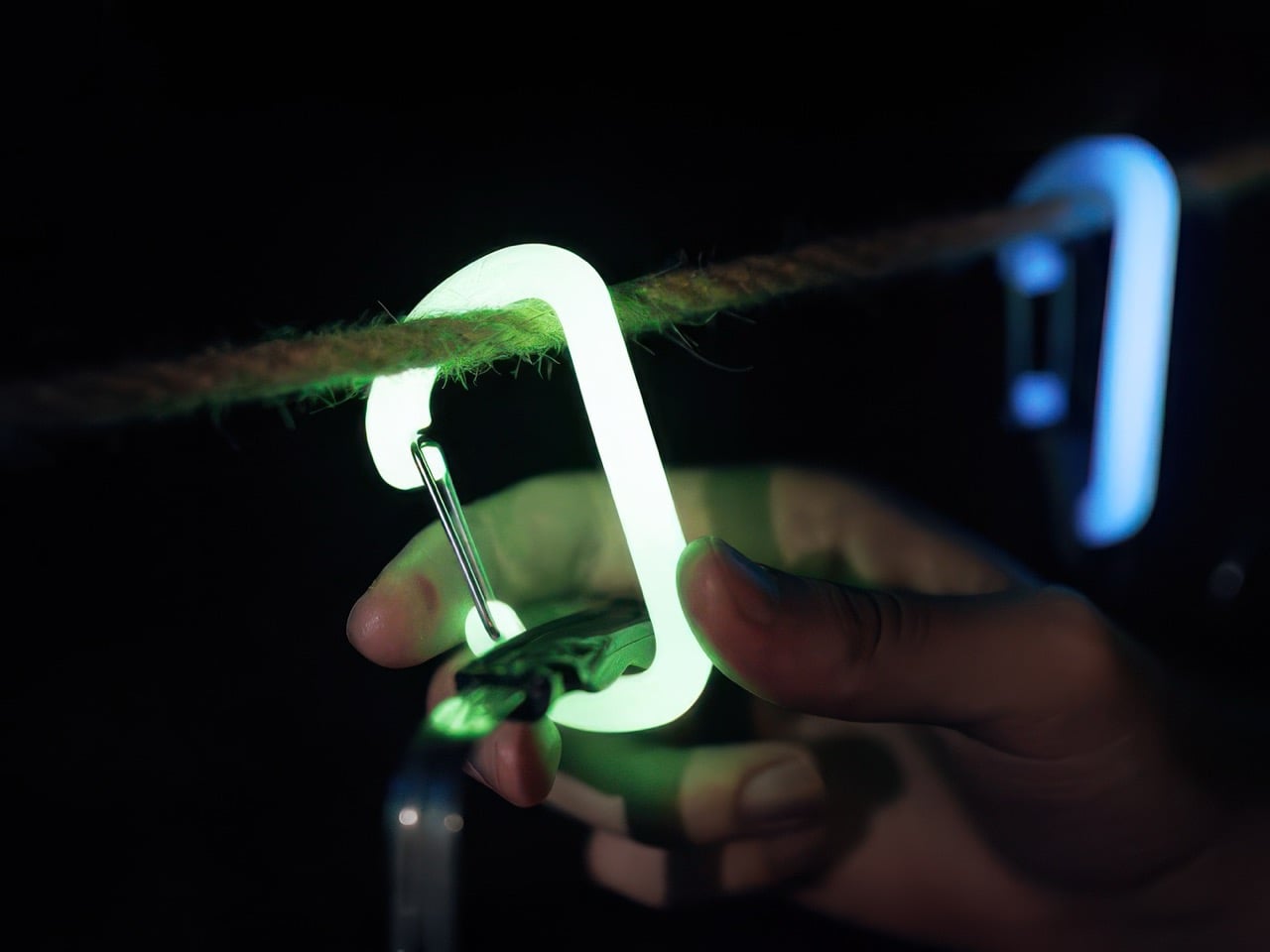
While the working load limit is officially rated at a reliable 66 pounds, pull tests conducted by the maker reportedly concluded at an impressive 213 kilograms, translating to roughly 470 pounds before failure. This substantial gap is entirely intentional, ensuring the operational rating sits safely near 15 percent of the ultimate breaking load. At a mere 0.42 ounces, the hardware is light enough that users will likely forget it is attached to their pack until darkness falls and its luminous property becomes essential.
Meanwhile, the specialized clip is purpose-built for flat, pliable items such as camp towels and tarps. It operates smoothly with a single hand, utilizing serrated internal jaws and a sliding block equipped with a secure toothed lock. A thin metal loop integrated at the top allows it to hang effortlessly from a suspension line or a backpack strap. The wide mouth easily swallows thick fabric in scenarios where a traditional spring-loaded clothespin would typically fail. Its 55-pound load rating sits just slightly below that of the larger D-carabiner, providing more than enough strength to support a thoroughly soaked camp towel. Pairing two of these clips with a paracord strung between two trees creates an instantly visible clothesline that campers can easily locate in the middle of the night.
Two Colors, Endless Things to Hang, and Roughly $6 a Piece
In terms of aesthetics, green stands out as the classic and noticeably brighter choice between the two available options, while blue offers a rarer, cooler visual tone that many users find more appealing during daylight hours. By day, neither option resembles its nighttime appearance; the green variant reads as a pale yellow-green, while the blue variant takes on a milky white coloration. The blue model exhibits a slightly dimmer glow after dark, a trade-off many consider fair for its distinct daytime look.
The practical applications become immediately apparent once integrated into a daily routine. They serve exceptionally well for securing tent guy lines, marking go-bag handles, improving visibility on children’s school backpacks, attaching to a dog’s nighttime leash, or functioning as an easy-to-spot key hook mounted right by the front door.
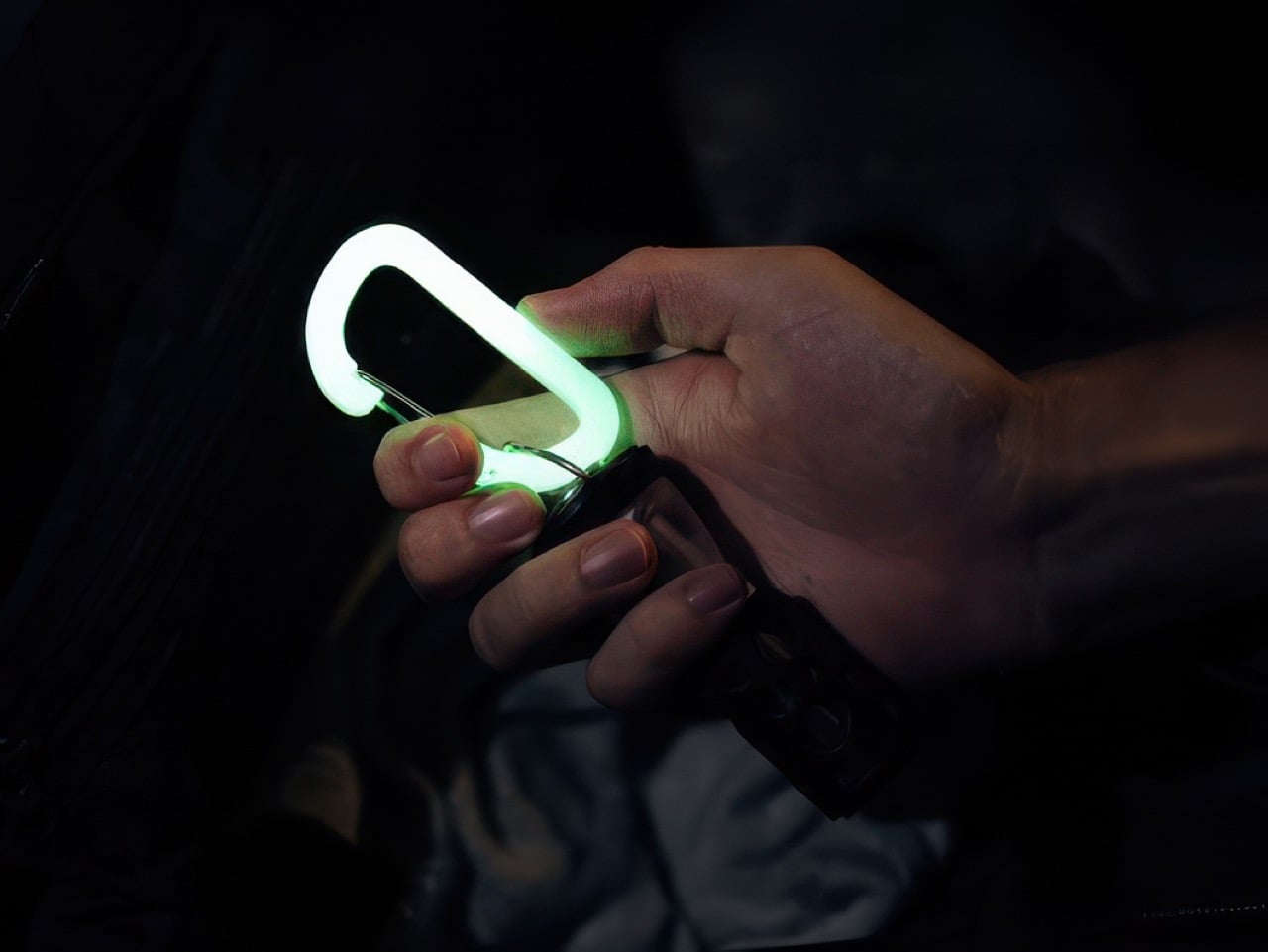
A complete 12-piece set, which includes six large D-carabiners and six utility clips, is currently priced through crowdfunding campaigns at ¥11,616—approximately $73—compared to a standard retail price of ¥14,520, or roughly $91, breaking down to about $6 per individual piece. Individual units are also available separately, with single D-carabiners running about $6 and clips priced around $7. Additional variations, including pink editions, specialized three-packs of Suncheck glow carabiners, and earlier Ouroboros Carabiner Clip designs, are offered as supplementary options. Global shipping is currently underway, with worldwide delivery estimates projected for January 2027.