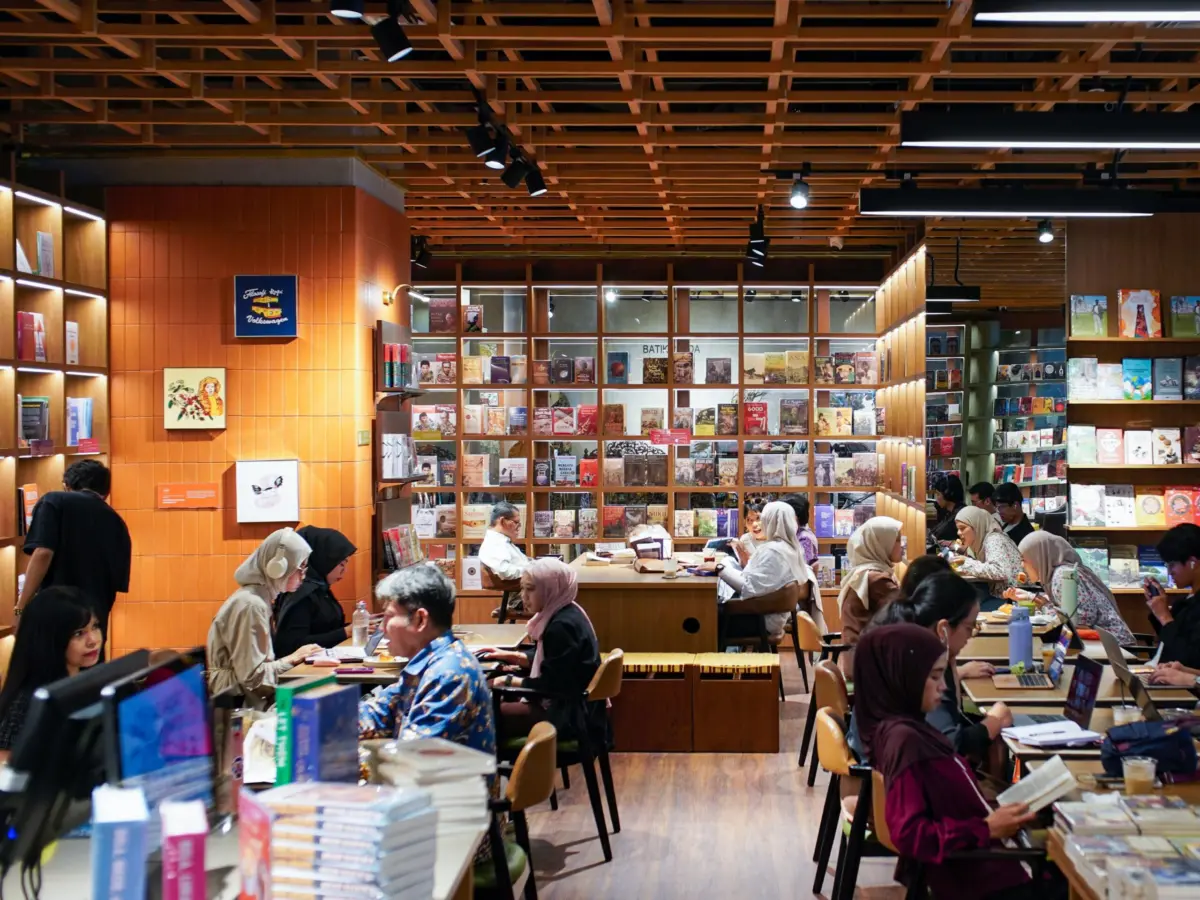
Bookshops are once again flourishing in the Indonesian capital, but the business of selling books is only part of the story behind this welcome revival. In Jakarta’s publishing sphere, a vibrant creative community is finding fresh ways to celebrate the written word and to support local writers. These efforts are keeping the art of print alive while bringing readers together in physical spaces, fostering a renewed sense of connection in an increasingly digital world. Offering insight into the city’s burgeoning literary scene, five of its leading figures share how independent booksellers, celebrated authors, major book fairs, community-led libraries, and creative cultural producers are shaping the future of Indonesian literature.
1. The Bookseller: Judo Suwidji, Co-founder of Periplus
Judo Suwidji has been drawn to books since childhood. Growing up, he became captivated by a map that his father owned, an early fascination that would eventually blossom into a lifelong passion for illustrated books and publishing. Now 62, Suwidji serves as a co-founder of Periplus, one of Indonesia’s largest bookselling chains. The enterprise has grown to encompass 57 well-stocked outposts nationwide, including a prominent and heavily frequented location nestled within Terminal 3 of the Jakarta International Airport.
Suwidji’s overarching vision remains remarkably simple: to introduce as many people as possible to the distinct pleasures of reading and, with a touch of good fortune, even inspire some of them to pick up a pen and start writing. Although Periplus was originally founded in 1985 primarily to import foreign titles and international magazines, Suwidji has increasingly shifted his focus toward championing domestic voices, aiming to feature more books about Indonesia on his shelves.
"What I really hope is that at Periplus, we can introduce talented young writers," he explains. "Whether they write in Indonesian or in English, it does not matter. They are welcome. What matters is that they write well. After that, we will bring in publishers from across the world."
To appeal to an evolving generation of younger readers, Periplus is deliberately investing in the architectural and aesthetic appeal of its physical shops. The company recently unveiled fresh, modern interiors featuring lighter natural woods and brighter, more inviting lighting at its branches inside Plaza Indonesia and Plaza Senayan, two of Jakarta’s premier shopping destinations. "A bookshop shouldn’t be intimidating," Suwidji notes, emphasizing the importance of creating accessible, welcoming environments for casual browsers and dedicated bibliophiles alike.
2. The Writer: Ratih Kumala, Author of Gadis Kretek (Cigarette Girl) and Koloni (Colony)
Ratih Kumala is one half of an Indonesian literary power couple—her husband is the celebrated novelist Eka Kurniawan—yet she is quick to point out that familial prestige does not make the demanding craft of writing any easier. "Survival as a writer demands agility," she observes, speaking after participating in an engaging public discussion concerning one of her short-story collections just outside Jakarta. Kumala initially established her literary career through shorter works before publishing Gadis Kretek (Cigarette Girl), a sweeping historical novel that subsequently achieved international acclaim and was adapted into a major series by Netflix in 2023.
Her latest literary release, Koloni (Colony), takes the distinctive form of a fable centered around ants, utilizing the microscopic insect society to explore complex themes of social hierarchy and gender equality. Penguin Books published the English translation, translated by Dalih Sembiring, in August. "My goal when I write a book is simply to entertain. Even now, if my readers feel entertained, then I’ve done my job," she says, offering practical advice to aspiring young writers to become their own sternest critics and to maintain the courage to completely start over when a draft demands it.
For Kumala, fiction offers a much-needed escape from the relentless cycle of daily news, though she stresses that it should never be dismissed as mere escapism. Instead, she intricately weaves her own personal life experiences together with significant historical events, feminism, and biting satire. A writer, she argues, must master the delicate art of evoking the real within the unreal.
"Indonesia needs fiction writers who are both critical and sensitive," Kumala reflects. She points to the words of renowned author Seno Gumira Ajidarma, who once famously noted that when journalism is silenced, literature becomes the vital path to speak out. "When we are not allowed to report the truth, fiction becomes a way to express what truly matters, in a more humane and emotionally resonant way."
3. The Book-Fair Chief: Wedha Stratesti Yudha, Committee Chair of the Indonesia International Book Fair
Book-related cultural events are currently experiencing an unprecedented boom across Jakarta, and none command a larger stage than the Indonesia International Book Fair (IIBF). The latest edition of this annual landmark event, which unfolded at the Jakarta International Convention Center in early October, drew a staggering crowd of more than 250,000 visitors. The fair proved particularly popular with younger demographics and children, who could be seen eagerly exploring the lower ground floor in search of vividly illustrated picture books and engaging comics. Among the attendees was Vica Lietha, author of Eat My Belly, who joined a dedicated pitching session and noted to observers that the event served as an invaluable professional opportunity for domestic creators.
The IIBF has a rich history dating back to its establishment in 1980. Today, it is overseen by Wedha Stratesti Yudha in her capacity as committee chair for the Indonesian Publishers Association. An industry veteran with decades of experience, Yudha harbors a clear ambition: to ensure that publishers operating from across the vast, scattered Indonesian archipelago are afforded the same lucrative opportunities traditionally enjoyed by their international peers and centralized counterparts in Jakarta.
"Not every author can be found in a designated bookshop, and some publishers face similar challenges when it comes to distribution," Yudha explains while sipping coffee in the historic Kompas Gramedia building on Palmerah Street, a media hub that houses prominent national publications including Kompas, The Jakarta Post, and Tempo.
The IIBF actively encourages other regional cities to host similar cultural events to raise public awareness regarding unequal access to publications across the archipelago, where more remote islands frequently contend with higher book prices and lower literacy rates. Yudha’s overarching goal is to transform the IIBF into a central literary nexus where readers, publishers, and writers can regularly gather to exchange ideas and forge collaborative partnerships. "The publishing industry cannot develop in isolation," she asserts. "It is interconnected with other industries."
4. The Librarian: Sheilla Njoto, Co-founder of Margin
When Sheilla Njoto returned to Indonesia after completing a significant portion of her education in Australia, she was immediately struck by a glaring deficiency within the urban landscape of Jakarta: a notable shortage of accessible public libraries. "Indonesia’s literacy rate is high, but many people read words without truly grasping their meaning," Njoto observes. Channelling this professional frustration into constructive action, she decided to address the shortfall directly. In 2025, alongside two friends, Agatha Tika and Reisky Handika, she established Margin, an independent library located in the Pejaten neighborhood of South Jakarta. The space was explicitly designed as a sanctuary to encourage genuine literary exploration, removing the commercial pressure of having to purchase a book before reading it.
Njoto, who trained as an art graduate, utilized her design background to curate a warm, inviting environment that actively encourages members to settle in for extended reading sessions. Furthermore, she is dedicated to ensuring the library serves as a dynamic venue for hosting public discussions covering diverse subjects, ranging from poetry and contemporary art to broad political discourse. "Books have the power to ignite empathy," she remarks.
At just 30 years of age, Njoto originates from Surabaya, Indonesia’s second-largest city, situated on the opposite end of Java from Jakarta. Having spent time as a writer herself, she intimately understands the critical importance of supporting emerging literary voices. Consequently, Margin features a dedicated physical space for showcasing and selling fiction and non-fiction titles produced by local independent writers. "We have a special consignment system," she explains. "The writers place their books on our shelves, and we only charge a bank transaction fee. It’s a fair arrangement for everyone involved."
5. The Producer: Handoko Hendroyono, Owner of Filosofi Literasi
Filosofi Literasi recently opened its doors in August inside Sarinah, a rejuvenated 1960s shopping center situated in the heart of Central Jakarta. Conceived as a traditional literary cafe, the venue is the passion project of veteran film producer Handoko Hendroyono. The 63-year-old has previously established a proven reputation for transforming historic urban buildings into vibrant cultural hangouts through his placemaking initiative, M Bloc Group.
Giving a tour of Filosofi Literasi, Hendroyono highlights foundational literary works displayed on the shelves, such as Mustikarasa, an extensive cookbook containing the favorite traditional dishes compiled by Indonesia’s first president, Sukarno, and Atheis, Achdiat K. Mihardja’s seminal 1940s novel exploring a young Muslim’s complex relationship with religion. Alongside these historical milestones sit prominent contemporary releases, including Dee Lestari’s Perahu Kertas and Andrea Hirata’s beloved Laskar Pelangi. For Hendroyono, modern technology cannot possibly replicate the warmth of the human touch; he remains a firm believer in cultivating physical spaces where face-to-face conversation can spark genuinely new creative ideas.
The coffee served at the cafe is also taken seriously, reflecting Indonesia’s status as a producer of some of the world’s finest coffee beans. Hendroyono’s involvement in the culinary and cultural crossover spans more than a decade, beginning in 2015 when he adapted a bestselling book set inside a coffee shop into a feature film. Following the film’s success, he and a close friend opened a physical coffee shop bearing the same name. Now, with Filosofi Literasi, he aims to complete the conceptual circle by leveraging cafe culture to directly support and promote Indonesian literature and cinema.
"Films depend on books, and books need writers who can build universes worth adapting," Hendroyono concludes. "We built Filosofi Literasi because good source material leads to good scripts."