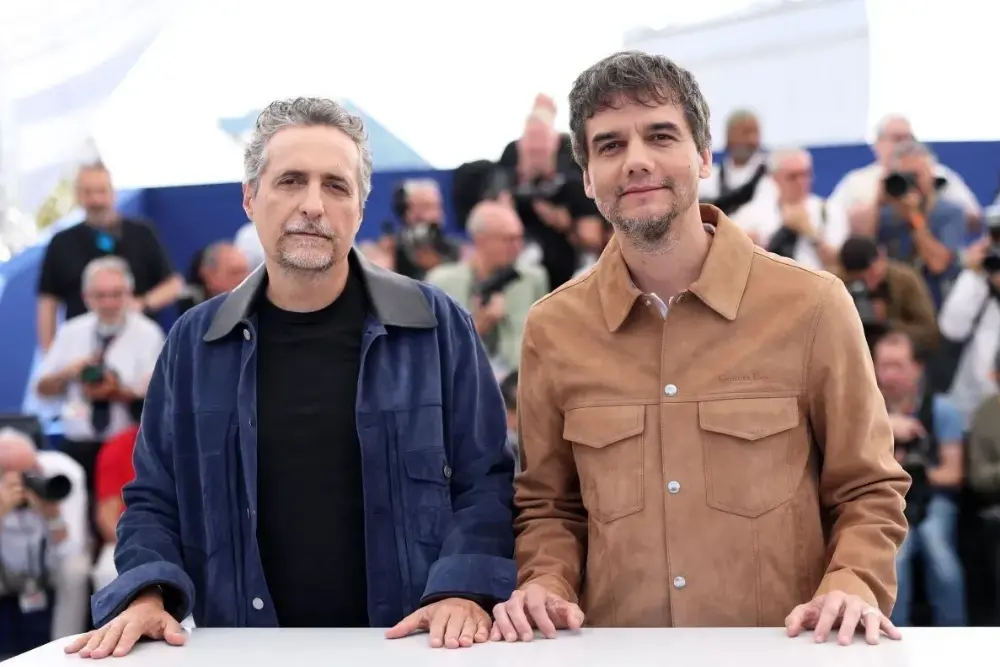
A powerful coalition of Brazil’s most celebrated cinematic voices—including Oscar nominees Kleber Mendonça Filho, Wagner Moura, Walter Salles, and Petra Costa, alongside Academy Award-winning producer Rodrigo Teixeira—has released a sweeping open letter urging the international community to closely monitor the upcoming second round of Brazil’s presidential elections. Scheduled for October 25, the fiercely contested runoff pits incumbent president Luiz Inácio Lula da Silva against far-right candidate Flávio Bolsonaro.
Flávio Bolsonaro is the son of former right-wing president Jair Bolsonaro, who is currently serving a 27-year and three-month sentence under house arrest following his conviction for orchestrating a failed coup d’état after his defeat in the 2022 presidential election. The high-profile intervention by Hollywood Academy members and renowned international film creators underscores the profound anxieties gripping Brazil’s cultural sector. It follows closely on the heels of extensive industry reporting detailing how the previous Bolsonaro administration systematically dismantled the nation’s robust audiovisual sector—a cautionary precedent that artists fear could repeat itself should Flávio Bolsonaro capture the presidency.
The list of signatories reads as a who’s who of contemporary Latin American cinema, featuring legendary and internationally acclaimed talents such as Alice Braga, Karim Aïnouz, Sônia Braga, Gabriel Mascaro, Carolina Markowicz, Anita Rocha da Silveira, Anna Muylaert, Laís Bodanzky, and Rio Film Festival director Ilda Santiago. Together, these cultural figures are sounding the alarm over what they characterize as an escalating threat to democratic governance, institutional stability, and freedom of expression within the South American nation.
An International Appeal and Scrutiny of Electoral Integrity
In their open letter, the filmmakers emphasize that the razor-thin margin separating the two candidates in the first round—just 1.87 percentage points—demonstrates that Brazil remains a deeply polarized society. Against this tense backdrop, the signatories point to troubling indicators of democratic erosion, including documented instances of potential foreign interference that they argue demand immediate, transparent investigation and rigorous international oversight.
The letter explicitly highlights recent investigative reporting by The Guardian, which revealed that the United States government allocated approximately $1 million from a State Department human rights fund toward an initiative entitled "Countering Lawfare and Censorship in Brazil." This revelation has intensified local debates regarding the propriety and impact of foreign financial involvement in domestic political ecosystems.
Concurrently, media watchdogs and civil society organizations have raised urgent concerns regarding algorithmic irregularities and potential distortions in the reach of political content across Meta’s social media platforms. Independent observers have called for formal inquiries into reported anomalies, including instances where the official Instagram accounts of President Luiz Inácio Lula da Silva allegedly experienced unexplained declines in visibility, search result suppression, and restrictions preventing the promotion of posts through paid advertising.
Further compounding the volatility of the electoral cycle, investigators have trained their sights on other questionable campaign tactics. These include a U.S.-based website reportedly offering donors the chance to purchase advertisements supporting Flávio Bolsonaro in exchange for cryptocurrency tokens under the guise of charitable aid for underprivileged children in Uganda. Meanwhile, Brazil’s Federal Police have launched active investigations into persistent suspicions of cash-for-votes schemes operating within rural voting districts.
Constitutional Reform, Historical Context, and the Shadow of the Bolsonaro Legacy
Beyond immediate electoral mechanics, the open letter directs intense scrutiny toward Flávio Bolsonaro’s core policy proposals. Most notably, the candidate has pledged to rewrite Brazil’s foundational 1988 Constitution—the historical document that formally signaled the end of the nation’s 21-year military dictatorship and re-established constitutional democracy. Flávio Bolsonaro has indicated that this sweeping rewriting process would be steered by a Congress currently dominated by a far-right legislative majority.
For Brazil’s creative community, this proposal carries ominous undertones. The prospect of a constitutional overhaul is viewed with acute alarm given the attempted coup orchestrated by the candidate’s father, Jair Bolsonaro. Federal investigations into the 2022 conspiracy revealed detailed blueprints aimed at overturning the democratic transition, which included assassination plots targeting both President Lula da Silva and Vice President Geraldo Alckmin. While the elder Bolsonaro serves his lengthy sentence in connection with these treasonous acts, Flávio Bolsonaro has publicly promised to grant his father a full presidential pardon as his very first official act if elected.
The signatories express deep frustration with how segments of Brazil’s mainstream media have allegedly normalized these unprecedented developments, often failing to afford the gravity warranted by the criminal indictments facing Flávio and the historical record of his father’s administration. Beyond the coup plot, Jair Bolsonaro faced a formal complaint filed with the International Criminal Court in The Hague regarding his government’s handling of the COVID-19 pandemic. That complaint argued that more than half of the over 600,000 Brazilian lives lost to the virus could have been prevented through competent public health measures rather than the administration’s active obstruction and policy omissions.
Furthermore, critics note that the previous administration oversaw Brazil’s troubling resurgence onto the United Nations’ Hunger Map. In a continuation of these economic philosophies, Flávio Bolsonaro has campaigned on promises of severe social security cuts and austerity measures closely modeled on the controversial free-market policies implemented by Javier Milei’s administration in neighboring Argentina. The open letter warns that downplaying or omitting these severe historical realities actively misinforms the electorate and weakens the collective defense of democratic institutions.
Defending Culture and Democracy
For Brazil’s cinematic community, the political stakes are intensely personal as well as systemic. Cultural professionals intimately recall the heavy toll exacted by the prior administration’s hostile posture toward the arts. During Jair Bolsonaro’s tenure, the national Ministry of Culture was systematically dismantled, the vital Audiovisual Sector Fund was frozen, cultural oversight bodies were marginalized, and state-sanctioned censorship crept into public artistic funding. The industry’s leading figures make it clear that safeguarding creative freedom and ensuring the long-term financial viability of Brazilian filmmaking cannot be separated from the broader defense of the nation’s democratic fabric.
Framing the current domestic crisis as part of a wider, troubling pattern of political interference and democratic backsliding across Latin America, the authors of the letter assert that the preservation of Brazilian democracy relies not only on the resilience of ordinary citizens exercising their right to vote in free and fair elections, but also on the active vigilance of the global community.
The letter concludes with a direct call to action, urging international journalists to provide rigorous, unflinching coverage of the electoral endgame, calling upon the global film community to amplify the debate, and demanding that relevant international and domestic institutions independently investigate all allegations of electoral interference.
The full open letter carries the signatures of a broad coalition of Brazil’s cinematic elite, including Adrian Teijido, Alê Abreu, Alice Braga, Andrea Barata Ribeiro, Anita Rocha da Silveira, Anna Muylaert, Anna Van Steen, Bernardo Uzeda, Carlos Segundo, Carolina Markowicz, Claudia Kopke, Daniel Filho, Daniel Rezende, Daniela Thomas, Eduardo Serrano, Eliza Capai, Emilie Lesclaux, Emilio Domingos, Fernando Meirelles, Flávia Amon, Flávia de Souza, Gabriel Domingues, Gabriel Mascaro, Helena Solberg, Heloisa Passos, Ilda Santiago, Jefferson De, Jorge Bodanzky, José Joffily, Juliana Rojas, Karen Akerman, Karen Harley, Karim Ainouz, Kleber Mendonça Filho, Lais Bodanzky, Lucy Barreto, Maeve Jinkings, Marcelo Caetano, Maria Augusta Ramos, Mariana Oliva, Matheus Farias, Miriam Biderman, Otto Guerra, Paula Barreto, Pedro Kos, Petra Costa, Plínio Profeta, Renata Almeida Magalhães, Rodrigo Teixeira, Sara Silveira, Sônia Braga, Tatiana Leite, Thales Junqueira, Vânia Catani, Vera Hamburger, Wagner Moura, Waldir Xavier, and Wilssa Esser.