ABU DHABI — In the shifting landscape of modern international media and geopolitics, few figures command as much polarizing attention as Tucker Carlson. Once the undisputed king of prime-time cable news at Fox News before his high-profile departure in 2023, Carlson has successfully reinvented himself as an independent digital broadcaster. Operating The Tucker Carlson Show across platforms such as YouTube and X, he continues to court controversy and captivate millions, whether he is interviewing Russian President Vladimir Putin, controversial figures like white nationalist Nick Fuentes, or dispensing provocative takes on global affairs.
Yet reducing Carlson to a simple right-wing firebrand overlooks the complexities—and contradictions—of his current worldview. Today, the prominent commentator no longer supports Donald Trump, vocally opposes military intervention in Iran, and has even crossed partisan lines to praise left-wing Democratic Senate contender Abdul el-Sayed.
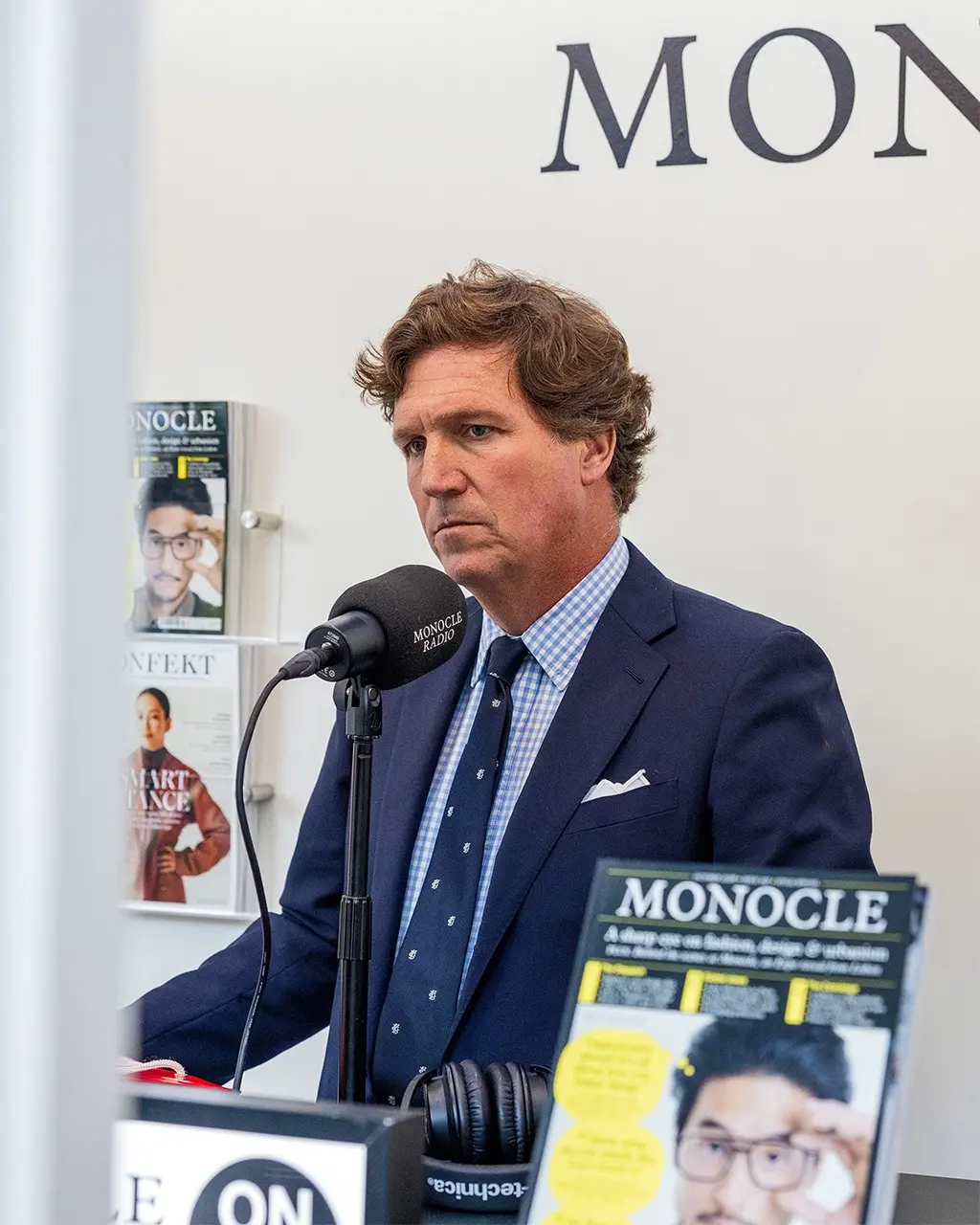
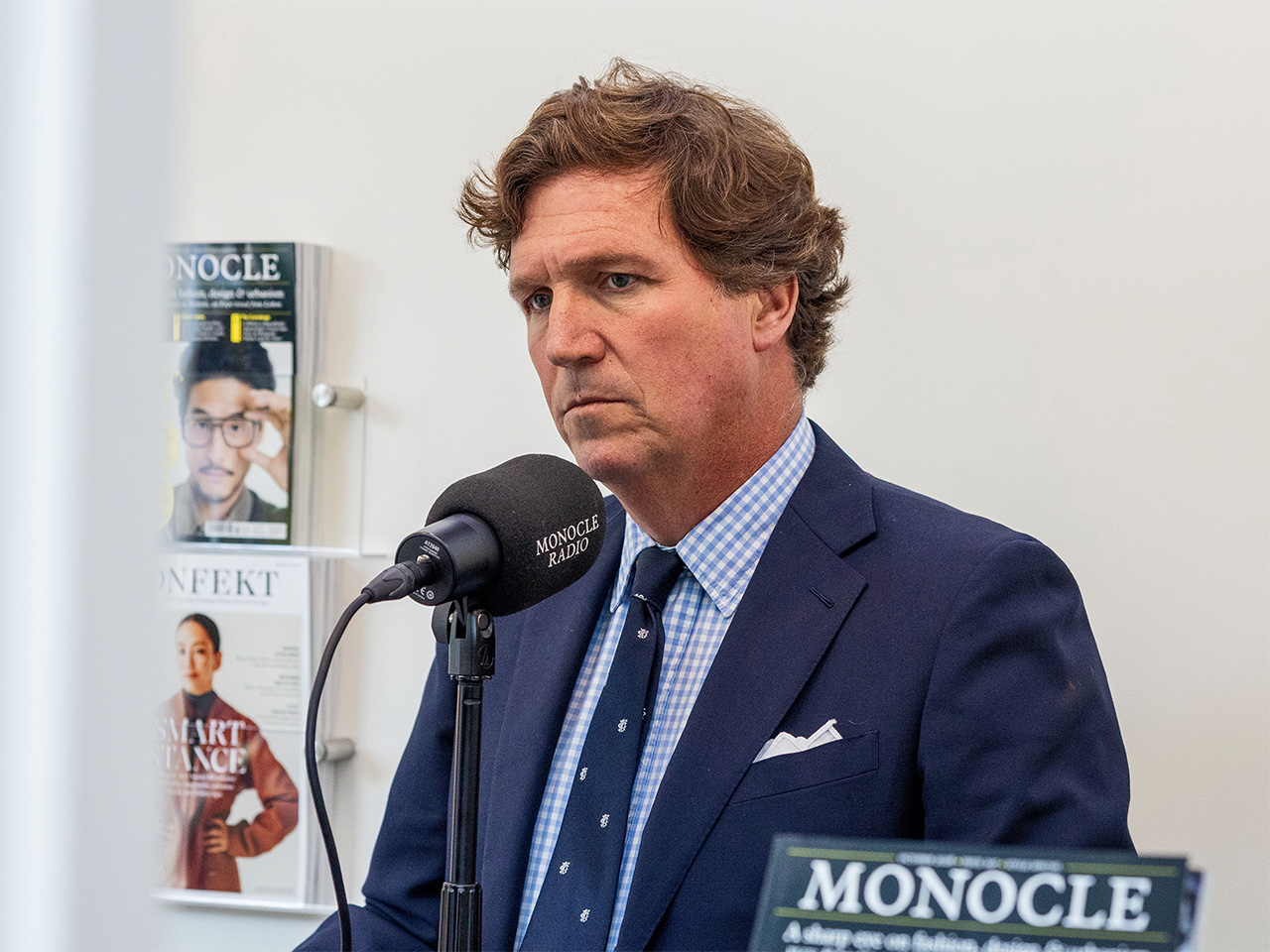
Amid this ongoing evolution, Monocle caught up with Carlson at the Livex Liveability and Investment Exhibition in Abu Dhabi to discuss the changing nature of political influence, the shifting media ecosystem, the perils of the upcoming midterms, and his deep-seated fears regarding Western self-destruction.
The Attraction of the Gulf and the Governance Debate
Carlson’s presence in the United Arab Emirates highlights a long-standing fascination with the region, one that contrasts sharply with his grim outlook on Western capitals. Having visited the Gulf regularly for a quarter of a century, he views the rapid modernization and economic dynamism of the UAE through a lens of profound administrative curiosity.
"I’ve been coming here regularly for 25 years and have seen it become one of the most vibrant places in the world," Carlson reflects. "I’m fascinated by the governance of it. How is it that these countries have leaders at the ministerial level who are young, patriotic, and totally committed to the country, but also open-minded, international in their outlook, and nationalist at the same time?"
That conversation about leadership and regional stability takes on an urgent edge in light of recent global escalations. Following his appearance at the World Government Summit in Dubai—an event that preceded a dramatic worsening of Middle Eastern tensions—Carlson has been an outspoken critic of American foreign policy, particularly regarding what he views as an unnecessary and dangerous conflict with Iran.
Asked whether he came to the Gulf to continue those debates in person, Carlson notes a distinct reluctance among regional players to dwell on the matter. "Nobody here wants to have that conversation because they’re exposed and they’re living the consequences," he explains.
Instead, it is a conversation he finds himself having primarily back home in the United States and across Europe, where he frequently spends time and maintains family ties. It is Europe, he warns, that stands to bear the brunt of these geopolitical fractures. "I don’t think that Europeans understand that quite yet," he says.
Warnings of Western Self-Harm and Historical Parallels
Carlson’s critique extends beyond a single theater of war, binding together conflicts in the Middle East and Eastern Europe as manifestations of a broader, self-inflicted civilizational malaise. He views these confrontations not merely as strategic miscalculations, but as symptoms of a profound institutional madness gripping Western leadership.
"I’m worried that the most beautiful, open-minded, and productive countries in the world are at risk of being destroyed through self-harm," Carlson warns. "These are wars that the world didn’t need, that Western leaders have insisted on. It’s a form of suicide. I don’t understand why it’s happening, but I’m determined to do whatever I can with the limited power that I have—which is really no power at all—to stop it."
Pressed on the unifying themes connecting these conflicts, Carlson doubles down on his assessment, characterizing them as fundamentally "deranged." He draws a chilling historical parallel to the catastrophic collapse of the European order a century ago, pointing to the legacy of the First World War as a warning sign for the modern era.
"More than 100 years after the First World War, people who are interested in history are still debating why it happened," Carlson notes. "It destroyed the UK’s leadership class—and the country has never recovered. It’s the most unbelievable thing that has ever happened in history: Europe’s self-destruction from 1914 to 1918, which [contemporaries thought] could never happen again. But we’re seeing something similar happen right now. I’m determined to make that point again and again, and I have never been warmly received for making it. No one good is going to win from this."
The Fracture of the Traditional Media Landscape
As the United States approaches the midterm elections, the role of information and media dissemination has undergone a profound transformation. The once-monolithic influence of legacy cable networks like Fox News and CNN—institutions that historically guided public opinion through electoral cycles—has splintered into a decentralized, fragmented digital marketplace.
Reflecting on this shifting paradigm and his own place within it, Carlson strikes a surprisingly modest, almost fatalistic tone regarding his political footprint, while unleashing a scathing indictment of his former employers.
"It became clear to me that I have no power at all," Carlson admits. "I marshalled every resource that I had to try and stop the current war, and I failed. But CNN and Fox have even less power, and they frittered away their influence by lying on behalf of various administrations."
For Carlson, the foundational currency of the media industry is trust between the broadcaster and the audience—a currency he believes mainstream networks have utterly squandered. Having spent a decade at CNN and 15 years at Fox News, he pulls no punches regarding their current standing.
"They’ll be gone in my lifetime, and I won’t miss them," he says. "They have no credibility left at all. They’re despised, and rightly so. Will they be replaced by something better? I sure hope so."
The Burden of Trust and Admitting Past Mistakes
For an independent media creator whose enterprise relies entirely on a dedicated digital audience, maintaining credibility is paramount. Without the institutional backing of a major network, a government agency, or a military force, Carlson views audience trust as his sole asset.
"It’s all we have. I don’t command an army. I don’t have government agencies. I’ve got 50 employees, as opposed to the US government’s five million, so I have no real power," he explains. "The only thing that anyone in the media has is the trust of their audience, which can evaporate instantly if you’re caught lying."
Crucially, Carlson acknowledges that maintaining this trust requires a willingness to confront past errors. His own ideological journey has included sharp turns, notably his early support for the 2003 invasion of Iraq—a policy he now views as a disaster.
"My perspective changes constantly as the evidence comes in," Carlson reflects. "A lot of the ideas that I had 10 years ago turned out to be absurd. I was wrong—not just wrong, but probably wrong. I advocated for things that were disasters, including the Iraq War, so the only recourse that I have is honesty. In fact, I think it increases your credibility when you admit that you have limits to your insight and that you’re an absurd person, because we’re all absurd on some basic level. We’re not gods."
Midterms, Executive Overreach, and the Threat of Escalation
Looking ahead to the upcoming midterm elections, Carlson expresses deep concern over the trajectory of American foreign policy, particularly in an environment where he believes executive authority operates largely unchecked by legislative oversight.
"I think that the president acts with unrestrained authority, in violation of our constitution, on foreign policy, but that’s a long-standing tradition in the US," Carlson says. "The president can do whatever he wants abroad without Congress reining him in."
This concentration of power, combined with impending domestic political shifts, sets the stage for what he perceives as a terrifying window of vulnerability.
"Once the Republicans lose the midterms in November, the only things that the president can achieve are in foreign policy," Carlson warns. "Because of that, I worry that the US will accelerate its conflict with Iran—and by accelerate, I mean using weapons of mass destruction. I think that it will be the most dangerous moment of our lifetimes. I hope that I’m wrong. I’ve been wrong many times."
When asked whether any institutional forces or political leaders within the current administration possess the capacity to check such a catastrophic trajectory, Carlson remains deeply pessimistic. He points to the architects of the push toward conflict with Iran—framed around regional dynamics involving Israel—and the simultaneous escalation in Eastern Europe at the direct expense of European stability.
Singling out the United Kingdom, Carlson offers a stark assessment of its geopolitical vulnerability, arguing that the British public remains largely oblivious to the perils surrounding them.
"I think that the UK is the most imperilled that it has been since 1066, and I don’t think that your average Brit understands that at all," he asserts. "The frustration that Brits feel about the failure of their government to raise their standard of living has been successfully siphoned off into hate against Putin, as if he has anything to do with this, which he doesn’t. The failures of the British government are the failures of the British government."
Concluding his broader diagnosis of Western stability, Carlson reiterates his warnings about institutional decay on both sides of the Atlantic.
"I think that the UK has gone insane, as the US has gone insane, and insane countries don’t thrive. They tend to be destroyed," Carlson says. "So it’s time to wake up and realise that the Anglo-American alliance doesn’t control the world by itself any longer, that it’s going to have to share its power with emerging nations. I would like it if the Brits and the Americans still ran the world and did a good job of it, but that’s not the reality that we’re facing."
Despite managing his own independent media production company and navigating the turbulent waters of modern commentary, Carlson maintains a characteristically cynical view of his administrative responsibilities as a business owner. When asked if he enjoys running his own media outfit, his response is swift and characteristically deadpan.
"No. Honestly, I enjoy not working for anybody," Carlson admits. "I’ve been fired many times. In fact, I’ve been fired from every job I’ve ever had, and every time it has been such a blessing. But unfortunately, I can’t be fired anymore."