Canon’s mirrorless cameras have long been celebrated for their thoughtful ergonomics, featuring deep, well-contoured grips designed to sit comfortably in the hand during long shoots. However, a newly published patent application suggests that the imaging giant is exploring how to transform that familiar physical design into an active security and user-identification interface.
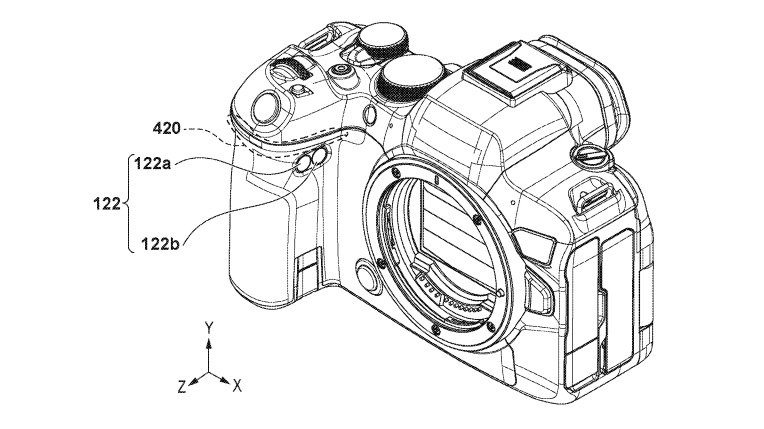
The patent, which was officially published in the United States on September 17 under patent application number 0279095, details three distinct design configurations that would integrate biometric fingerprint sensors directly into the structural grip of a mirrorless camera. Rather than treating biometric security as an afterthought or an external attachment, Canon’s engineers are looking at ways to embed the technology seamlessly into the exact places where a photographer’s hand naturally rests during standard operation.
The filing outlines three primary methods for positioning these sensors. The first design proposes placing a primary fingerprint reader directly on the front portion of the camera’s handgrip, paired with a dedicated thumbprint reader positioned on the thumb rest located at the rear of the camera body. The second approach incorporates two separate fingerprint sensors on the front grip itself, a configuration intended to improve reading accuracy and accommodate varying hand sizes or finger placements among different users. The third design similarly utilizes two front-facing sensors, but alters the physical orientation of the second sensor relative to the first to achieve more reliable biometric captures across diverse gripping styles.
The core objective behind the patent appears to be modernizing earlier concepts of camera-based biometric authentication. Previous explorations often required awkward hand adjustments or non-standard holds. Canon’s latest designs prioritize ergonomics, ensuring that the biometric verification process occurs passively as the photographer picks up and holds the camera in their standard shooting stance, without requiring any deliberate shift in posture.

While the patent document meticulously describes the physical integration of these fingerprint readers and how they interact with the camera’s exterior chassis, it remains silent on the exact application software or specific features that the biometric data would control. However, this filing does not represent Canon’s first foray into biometric technology for imaging devices. The company has a documented history of researching fingerprint integration that stretches back several years, providing valuable context regarding what future implementations might achieve.
Back in 2018, Canon filed an earlier patent detailing a system that placed fingerprint sensors on both the camera body’s front grip and the exterior barrel of interchangeable lenses. At that time, documentation suggested the system could be deployed for basic hardware security—preventing unauthorized use—or configured to allow photographers to trigger different custom shortcuts and menu functions simply by pressing the sensor with a specific finger.
A few years later, in 2020, Canon pursued another related concept in Japan, filing a patent for a screenless selfie-oriented camera system that leveraged fingerprints to automatically identify individual users, save personalized user profiles, and manage sharing preferences or follow networks.
The introduction of these new patent applications arrives at a time when digital camera security is undergoing significant regulatory and structural changes. Fingerprint scanners have been ubiquitous on smartphones for more than a decade, utilized primarily to safeguard personal data, authenticate mobile payments, and deter device theft. While modern smartphones have increasingly shifted toward under-display optical sensors or sophisticated facial recognition systems, dedicated cameras have historically relied on physical possession and open operating systems.

Implementing a fingerprint sensor on a camera grip could introduce similar protective capabilities, preventing unauthorized individuals from operating the camera, capturing images, or altering sensitive network and transmission settings. The need for enhanced camera security is no longer purely theoretical. In response to evolving European Union regulations requiring all internet-connected devices to incorporate robust cybersecurity measures, Canon recently rolled out firmware updates for its professional cinema and mirrorless camera lineups. These updates introduced a mandatory or optional PIN code feature, requiring operators to unlock the device with a numerical code before use, mirroring the security protocols common on modern mobile phones.
While security features like PIN codes are effective for compliance, they can introduce friction into fast-paced professional workflows. The requirement to manually punch in a numerical code every time a camera wakes from sleep can be cumbersome for photojournalists, event shooters, and wildlife photographers who need to react instantly to fleeting moments. A built-in fingerprint sensor integrated directly into the grip could serve as a frictionless alternative to traditional PIN entry, allowing the camera to verify the user’s identity instantaneously the moment they grasp the body. Such a system could automatically lift restrictions on Wi-Fi and network configuration settings, unlock image playback features, or secure sensitive corporate assets stored on the memory cards.
Beyond security and anti-theft measures, biometric authentication on a camera grip opens up practical workflows for collaborative environments. In professional production studios, newsrooms, and multi-shooter media teams, multiple photographers frequently share the same camera bodies throughout a work week. A fingerprint scanner could instantly recognize which operator is holding the device, automatically loading their customized user profile, button assignments, autofocus preferences, and color profiles without requiring manual navigation through complex menu systems.
Despite the intriguing possibilities highlighted by the patent documentation, significant practical questions remain regarding whether such a feature will transition from theoretical research into commercial production. Incorporating biometric hardware into a camera body involves considerable engineering hurdles, including manufacturing costs, power consumption considerations, and potential compromises to the camera’s physical weather-sealing capabilities. Maintaining rigorous weather resistance against dust and moisture is a vital requirement for high-end mirrorless and cinema cameras, and embedding sensitive electronic sensors into the exterior grip could complicate environmental sealing.
Canon is one of the most prolific corporate patent filers in the world, consistently investing heavily in research and development across its imaging and optical divisions. In 2025 alone, the imaging giant filed thousands of patents in the United States. Because companies often patent experimental concepts to protect intellectual property long before commercial viability is determined, many published designs never materialize in actual consumer products. Nevertheless, tracking these patent publications provides a revealing glimpse into the long-term research and technological directions being explored behind closed doors at Canon’s research facilities.