For more than two decades, truck driver Joe Macken spent his quiet hours, weekends, and stolen moments of free time engaged in a colossal, deeply personal project: building a massive, highly detailed scale model of his native New York City entirely out of balsa wood and foam board. What began as a private obsession born of nostalgia eventually transformed into a viral internet phenomenon, thrusting the unassuming builder from relative obscurity into the bright lights of a prominent Manhattan museum exhibition.
When Macken finally declared his sprawling basement creation finished, his daughter convinced him to share his work with the world by posting video clips on TikTok. The response was immediate and overwhelming. Within just one week, the videos showcasing the intricate, sprawling metropolis accrued more than 10 million views, captivating social media users across the globe who were mesmerized by the sheer scale and precision of the miniature city.
The digital momentum quickly caught the attention of cultural institutions in the city Macken had spent a lifetime replicating. Curators at the Museum of the City of New York reached out to him after witnessing the viral surge. The result is “He Built This City,” a dedicated exhibition that opened in February along Manhattan’s bustling museum row near Central Park, giving the public a rare, ground-level and bird’s-eye look at a lifetime of painstaking craftsmanship. The exhibit is scheduled to run through October 12.
Standing inside the museum gallery during a recent visit, Macken reflected on the journey that led his basement project to the heart of Manhattan. “I never really thought about finishing it because I had so much fun building it,” he said.
Elisabeth Sherman, the museum’s chief curator, noted that Macken’s model occupies a unique space, possessing an uncanny ability to bridge the gap between digital social media audiences and traditional museumgoers. She observed that people are endlessly fascinated by the concept of grasping a metropolis as vast and complex as New York.
“I think people always want to get their arms around this whole city, this city that is impossible to know, impossible to grasp, and this is a way to see it from a bird’s-eye view,” Sherman said. “We rarely have anything these days that reaches everyone in that way. We love that kind of energy it brings.”
Macken Dreamed of Building the Model as a Child
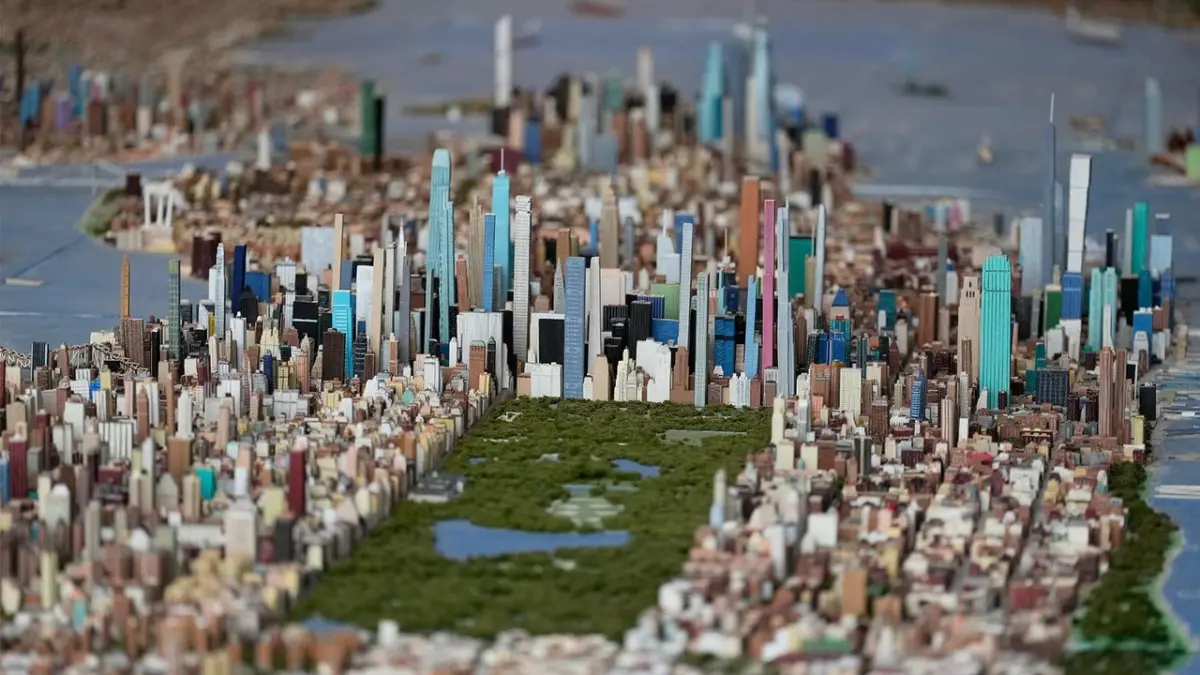
The scope of Macken’s creation is breathtaking. Spanning more than 300 large foam boards interconnected like giant puzzle pieces, the model covers all five boroughs alongside parts of New Jersey and suburban Long Island in street-level detail. The entire installation stretches 50 feet (15 meters) long and nearly 30 feet (9 meters) wide, maintaining a scale where every single inch represents roughly 160 feet (49 meters) of actual urban landscape.
Populating this vast geographic expanse are more than 800,000 individual structures constructed almost entirely out of light balsa wood. The miniature landscape features everything from Manhattan’s towering financial district skyscrapers to the humble, single-family residential homes characteristic of Queens. Iconic landmarks are rendered with meticulous care, including the Statue of Liberty, Yankee Stadium, and the Brooklyn Bridge.
The inspiration for the project stretches back decades to Macken’s childhood, specifically an elementary school field trip to the Queens Museum. During that visit, he laid eyes on the Panorama of the City of New York—the legendary scale model originally constructed for the 1964-1965 World’s Fair, which famously featured an overhead, helicopter-style gondola ride for visiting spectators. That childhood wonder planted a seed that would lie dormant for years.
It was not until Macken was in his 40s that the Queens native finally resolved to build his own version of the city. At the time, Macken and his young family had recently relocated northward, moving away from Long Island to settle in the Albany area of upstate New York. Looking back, Macken believes distance played a psychological role in triggering his creative endeavor. “I think, subconsciously, I might have missed New York,” he said.
Macken Took 10 Years Building Midtown, Then Kept Expanding
Lacking any formal background in professional model building, architecture, or design, Macken relied on basic materials sourced easily from local hobby shops. He humorously compares his early qualifications to playing with childhood toys like Lego blocks and Lincoln Logs.
He began his monumental undertaking with the heart of Manhattan, starting with Rockefeller Center and its iconic main tower, 30 Rock. From there, he methodically built outward to map the rest of Midtown Manhattan, a painstaking process that consumed roughly a decade of his life. Among all the structures he attempted, the Empire State Building and its intricate, ornate Art Deco spire proved to be the most formidable challenge.
“I wanted to make it perfect,” Macken explained, acknowledging the high standards he set for himself. “People are gonna be looking at it.”
As the years passed and the project expanded, Macken’s technical proficiency grew. The time required to construct individual buildings dropped dramatically as muscle memory and refined techniques took over. Reflecting on the learning curve, he expressed a touch of irony regarding his newfound efficiency. “I wish I would have done it 20 years earlier, knowing that I would have enjoyed it so much,” he said. “I can build one of the buildings in my sleep right now where it took me hours when I first started.”
The Model Consumed Much of Macken’s Free Time
For Macken, the model transcended the status of a casual hobby; it became a consuming daily ritual. He packed his modeling supplies for family summer vacations to the New Jersey shore and utilized lulls between shifts while working as a weekend bus driver to advance his construction work.
“It was just something that I couldn’t stop doing,” he said.
In the final stages, as the massive map neared its completion milestone, the work threatened to overwhelm his daily life. Macken admitted that the endeavor crossed the line from passion project into sheer compulsion. Describing his nightly routine near the end of construction, he noted how exhaustion would frequently catch up with him at the workbench. “Before bed, I’d be so tired sometimes, and I wind up being there for four hours, falling asleep at the table,” he said. “It got bad. It was an obsession. It still is.”
Notably, Macken’s miniature metropolis is not intended to serve as a strict, contemporary snapshot of the modern city. Instead, it functions partly as a repository of personal memory and local history. Out in miniature Queens, Macken consciously chose to recreate a beloved neighborhood diner from his childhood rather than the modern high-rise building that occupies the real estate today. Similarly, he preserved the historic Kosciuszko Bridge spanning the water between Brooklyn and Queens, despite the original structure being demolished in 2017 to make way for a modern replacement span.
In lower Manhattan, the twin towers of the original World Trade Center still stand guard within Macken’s miniature Gotham. They exist side by side with One World Trade Center and the other gleaming skyscrapers that rose in the financial district following the devastating terrorist attacks of September 11, 2001.
“I kept a lot of my own parts of the city,” Macken said of these deliberate historical preservation choices. “Just for me.”
Visitors Flock to Museum for Macken’s Model
On a recent weekday morning, the museum’s first-floor gallery welcomed a steady stream of curious visitors who walked up to the edge of the elevated platform to scan the vast miniature landscape for a familiar street corner, an old neighborhood, or a cherished landmark. While some patrons made use of the provided pairs of binoculars to inspect distant neighborhoods up close, the vast majority relied on squinting eyes and outstretched fingers, pointing eagerly into the distance.
Among the visitors was Jonathan Skolnik, who positioned himself near the corner of the exhibit representing lower Manhattan. Accompanied by his son, Tosha, Skolnik used the miniature streets to trace his family’s multi-generational history across the five boroughs, narrating the personal significance of various locations as his son listened intently.
Pointing across the wooden landscape, Skolnik identified his father’s first residential address in the United States, located on Manhattan’s Lower East Side near the foot of the Williamsburg Bridge. He pointed out the specific Queens neighborhood where he was born, as well as the cemetery where many of his relatives are laid to rest.
“I’m trying to do it all from memory,” said the Washington, D.C., area resident. “I don’t have it all exact.”
Having spent a lifetime toiling away in quiet anonymity on a private basement project, Macken now looks toward the future with broader horizons. When the current exhibition at the Museum of the City of New York concludes around Columbus Day, he hopes to find new venues willing to display the massive model.
In the meantime, the truck driver has no intention of putting down his balsa wood and foam board. He is already looking forward to expanding his physical archive of the metropolitan area, with plans to construct more than 50 new buildings and further extend the detailed terrain into the neighboring regions of New Jersey and Long Island.