Serbia’s Student List rode into political prominence as part of a vibrant wave of anti-corruption bicycle protests, but now that the movement is preparing to form the next government, translating that cycling spirit into urban reality for the capital remains an uphill battle.
For those who view the bicycle as one of humanity’s most efficient and sustainable forms of transport, navigating the streets of Belgrade remains a depressingly self-destructive experience. Far from being a pleasant daily commute, riding a bike through the Serbian capital feels more akin to urban combat. A plucky cyclist in Belgrade must constantly outmaneuver a fearsome combination of deep potholes, hazardous tramlines, and aggressively impatient motorists.
Despite the foundational role that cycling played in the rise of the political movement, there appears to be little hope that the incoming government has prioritized sweeping urban transport reforms to address these perilous conditions. This oversight seems particularly ironic given that epic bike journeys formed a central part of the youth-led, anti-corruption protests that ultimately birthed the Student List. During the height of the political mobilization, mass bicycle rides served as a powerful grassroots tool, spreading awareness of the movement to towns and villages across Serbia. One particularly ambitious journey even carried the protestors’ message all the way to the European Parliament in Strasbourg, showcasing endurance and a commitment to civic engagement on two wheels.
Yet a thorough review of the Student List’s official 11-point political programme reveals a striking omission: cycling is entirely absent from the agenda. Understandably, anti-corruption measures occupy the clear priority for the incoming administration, while pressing socio-economic concerns such as affordable housing and accessible healthcare also secure prominent mentions. Transport policy of any kind—let alone of the sustainable, non-motorized variety—is nowhere to be found in the foundational text.
This focus is entirely justifiable when viewed against the backdrop of recent national traumas. The tragic Novi Sad railway-station collapse in 2024, which claimed the lives of 16 people, brought the devastating human cost of Serbia’s endemic corruption to the absolute forefront of public consciousness. Against the gravity of such systemic failures, the desperate inadequacy of bike lanes in Belgrade might easily be viewed as a trivial concern. However, with the Student List now on the cusp of forming a government, there is a distinct opportunity to take inspiration from the very cyclists who pedaled alongside the movement on its path to power.
The capital’s infrastructure deficit is not a new revelation. It has been nearly a decade since Belgrade first launched an ambitious cycling strategy aimed at drastically increasing the share of urban journeys made by bike—targeting an ambitious leap from a fraction of a percent to nearly one in ten trips. Unfortunately, those grand plans, which included the rollout of 120 kilometers of new cycle lanes and a comprehensive municipal bike-sharing system, were never fully implemented. Even the modest fragments of infrastructure that successfully transitioned from strategic blueprints to actual city streets have largely vanished, swallowed up by chronic illegal parking and subsequent road reconstruction projects.
Consequently, taking to two wheels in Belgrade remains an activity reserved strictly for the brave or the reckless. The only notable exceptions are the dedicated leisure routes found along the Sava Promenade or looping around Belgrade’s premier river-island playground, Ada Ciganlija. For all of its historic charm and vibrant cultural life, the city’s Old Town desperately lacks a cohesive, safe, and integrated bike network. This absence represents a missed opportunity, especially given that increased cycling could play a vital role in alleviating two of the capital’s most persistent and severe modern problems: chronic traffic congestion and dangerous levels of air pollution.
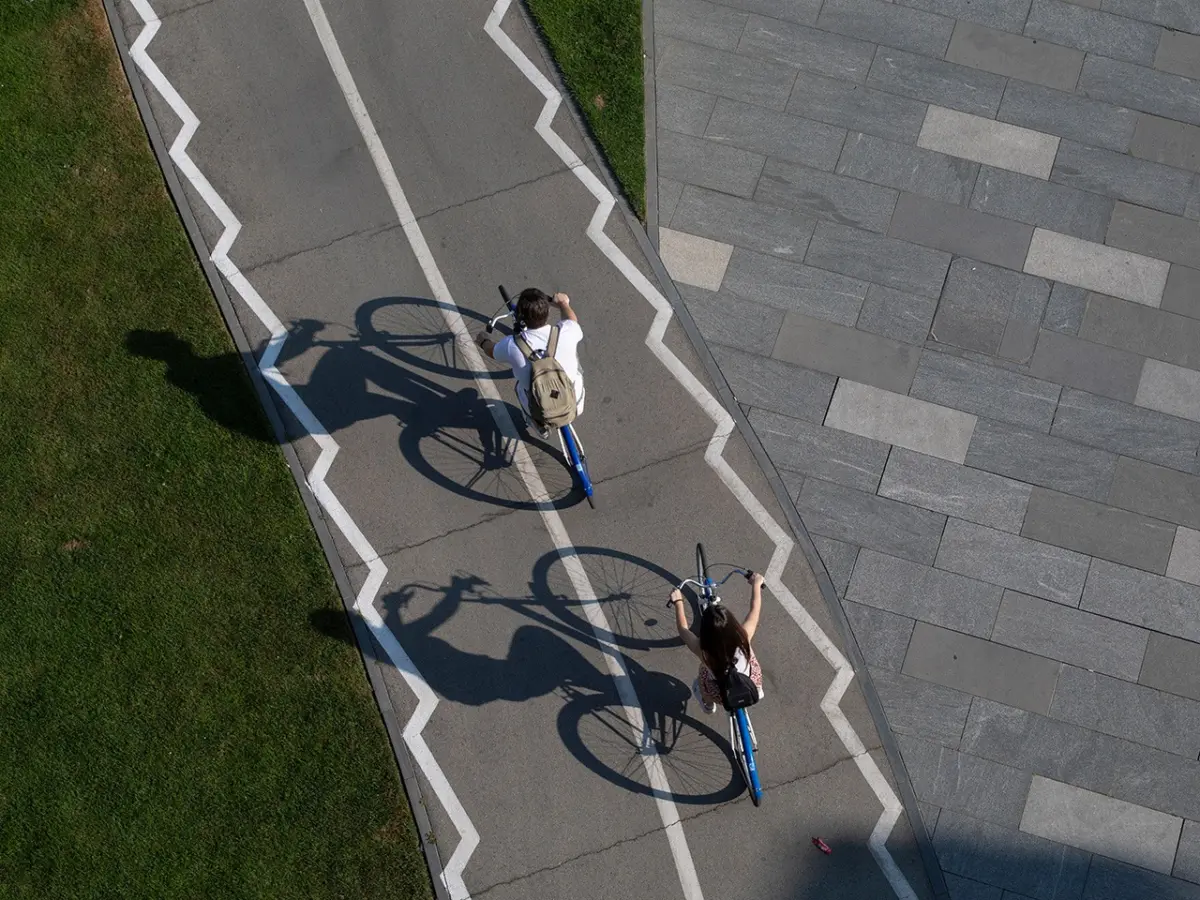
Interestingly, the urban landscape varies significantly across the river. In New Belgrade, located on the opposite bank from the historic city center, wide bike paths were integrated as a fundamental component of the area’s post-Second World War urban planning. Furthermore, Novi Sad, widely regarded as the spiritual home of the student movement, maintains a reputation for being relatively cycle-friendly, though that hospitality is perhaps only apparent when compared directly to the harsher environment of Belgrade.
For a new administration seeking practical inspiration on how to modernize urban mobility, compelling regional examples are readily available across Southeastern Europe. Ljubljana, the capital of neighboring Slovenia, stands out as a regional leader in sustainable transport, even if local cycling advocates frequently argue that roadways could be even better adapted for two-wheeled traffic. Through the implementation of a comprehensive network of interconnected bike lanes, Ljubljana has successfully raised the modal share of cycling to an impressive 13 percent—surpassing the local share of public transport. While this proportion remains lower than cycling capitals like Amsterdam or Copenhagen, bicycles have become a completely normal, integrated part of the city’s daily transport mix, providing the crucial safety that comes with high numbers of riders on the road.
A more direct and perhaps easily achievable model can be found in neighboring Croatia, where the capital city of Zagreb is governed by Možemo! (We Can!), a political party that similarly emerged directly from a grassroots civic protest movement. Since rising to power in 2021, Zagreb’s municipal administration has consistently prioritized pedestrians, cyclists, and public transit. The city’s Bajs bike-sharing scheme has proven to be a resounding success since its launch, with roughly a quarter of local residents now actively utilizing the system. To ensure that everyday riders feel secure in traffic, segregated cycle lanes have been made a compulsory requirement for all new road construction projects, while dedicated "bicycle highways" are currently under development.
Right now, beyond a hardcore peloton of dedicated urban believers, the vast majority of citizens will simply refuse to ride a bike unless they feel fundamentally safe from vehicular traffic. Swapping war stories about terrifying near misses and heated altercations with drivers has long been an accepted badge of honor and bravado among urban cyclists. Yet, if cities like Belgrade truly aspire to modernize and improve their urban environments, getting around on two wheels should not remain an extreme sport restricted to daredevils.
The Student List won its historic parliamentary mandate through a powerful, transformative response to a tragedy centered on a major transport infrastructure hub. It would be entirely fitting if its eventual legislative and municipal programme in government finally addressed the safety, dignity, and mobility of the very cyclists who helped propel the movement to power.