A decade after digital transformation reshaped corporate technology, history appears to be repeating itself across the enterprise landscape. Organizations around the world are pouring vast resources into generative artificial intelligence tools, anticipating dramatic gains in efficiency and operational performance. However, digital strategy expert Paul Boag warns that many of these initiatives are descending into corporate misdirection because executives are making the exact same mistakes that plagued digital transformation projects a decade ago: treating a profound cultural and human transition as a purely technical deployment.
Boag, author of the 2014 book Digital Adaptation published by Smashing Magazine, argues that the current corporate rush to adopt artificial intelligence exhibits striking similarities to the early days of corporate web and enterprise software rollouts. Back then, organizations routinely assumed that buying technology was synonymous with achieving organizational transformation. Today, management teams are falling into the same trap by acquiring company-wide artificial intelligence licenses while overlooking the human, psychological, and operational factors required to make those tools effective.
Revisiting the core lessons of digital transformation reveals why current corporate artificial intelligence strategies are stumbling and what leaders must do differently to navigate the complexities of AI integration.
It’s About People, Not Technology
Both digital transformation and artificial intelligence integration are undeniably driven by technological breakthroughs. Implementing software requires technical infrastructure, vendor management, and IT coordination. However, technical rollout represents only the visible tip of a much larger operational iceberg.
During the peak of the digital transformation era, enterprise IT departments routinely rolled out complex content management systems, customer relationship management platforms, and corporate intranets. Concurrently, customer-facing divisions launched new websites, mobile applications, and personalized digital experiences. Yet, despite these investments, organizations dedicated minimal effort to understanding how employees and customers would actually interact with these platforms. Internal software proved notoriously difficult to use, while end customers often ignored new features because the tools failed to solve their actual problems.
A virtually identical dynamic is unfolding in the rollouts of artificial intelligence. Executive leadership teams, captivated by industry hype, are approving enterprise software contracts and instructing IT departments to deploy tools like Microsoft Copilot Studio across their organizations. Once licenses are assigned and a brief, generic training webinar is delivered, leadership often considers the deployment complete.
As a result, employees are left with sophisticated tools but little clarity on how to apply them to their daily duties, all while facing intense pressure from management to demonstrate immediate returns on investment.
The situation today is further complicated by widespread workforce anxiety. Unlike earlier software rollouts, modern employees frequently view artificial intelligence as a direct threat to their employment security. Having read the same headlines about AI-driven automation and workforce reductions as their executives, staff members remain deeply skeptical of corporate reassurances regarding job security.
Why Would Staff Want to Adopt AI?
From the perspective of an individual employee, the value proposition of artificial intelligence is far from obvious. Setting aside concerns over job displacement, standard corporate implementations offer workers very few personal advantages.
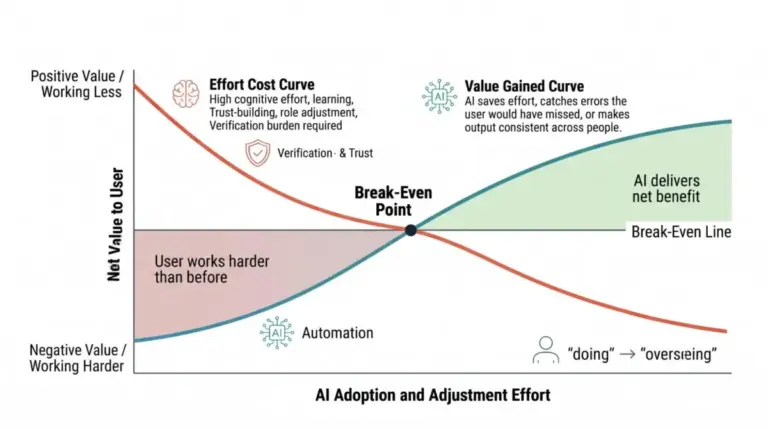
For senior management, the primary appeal of artificial intelligence lies in driving productivity—enabling staff to accomplish more work in less time. However, within a standard employment structure, increased productivity rarely translates into direct benefits for the frontline worker. Employees are still required to work their standard hours, but they are now expected to handle an increased volume of tasks within that same timeframe. Because their working hours remain unchanged and their compensation stays flat, staff have little intrinsic motivation to proactively embrace these technologies.
Before demanding widespread adoption, organizations must examine how they intend to motivate their workforce. Successful integration requires demonstrating how technology can serve as a genuine opportunity to improve an employee’s daily working life.
One effective starting point involves helping workers identify repetitive, burdensome, or frustrating tasks within their roles, and then showing them how artificial intelligence can streamline or eliminate those specific pain points. People naturally become far more receptive to operational changes when the transition tangibly lightens their administrative burdens.
Beyond task optimization, organizations need to consider structured incentives for technology adoption. Meaningful motivation can take the form of clear pathways for career progression, adjusted compensation models, or flexible scheduling that returns saved time directly to the workforce.
Staff Need Time and Support to Adopt AI
Integrating artificial intelligence into daily workflows is fundamentally different from updating standard software. It requires employees to re-evaluate and rebuild procedural knowledge—the ingrained habits, routines, and operational intuition built up over years or even decades of professional experience. Dismantling and reconstructing these established working patterns requires significant effort, even under ideal conditions.
Unfortunately, ideal conditions rarely exist in the modern workplace. Most employees operate under heavy workloads and struggle to keep pace with their existing daily commitments. They simply do not have spare capacity to pause, study complex software, and figure out how to integrate automated tools into their daily responsibilities.
Superficial instruction is insufficient to bridge this gap. Sending employees through generic, high-level training courses does not equip them to utilize artificial intelligence to its full potential.
Effective adoption demands role-specific instruction tailored to the distinct operational realities of different departments, similar to specialized artificial intelligence training designed specifically for user experience design teams. Organizations must invest in sophisticated, ongoing educational programs that help staff understand how to apply automated tools within the context of their specific duties.
Equally important is providing workers with dedicated time and operational space to experiment. Training programs only set the foundation; sustained adoption relies heavily on peer-to-peer support networks.
Experience from the digital transformation era demonstrates that bottom-up enthusiasm is vastly more effective than top-down executive mandates. Every organization possesses a subset of early adopters who naturally experiment with new technologies without being prompted. Bringing these enthusiasts together and giving them the dedicated time and platform to share successful techniques allows social proof to drive adoption across the broader organization.
During the digital transformation wave, internal showcase conferences—where employees demonstrated to their peers how they built solutions to solve real everyday problems—proved far more influential in driving operational change than any executive memo. When workers observe colleagues in similar roles using software successfully to ease their workloads, they are significantly more likely to adopt those practices themselves.
It Needs to Be Safe to Fail
Experimentation inherently involves trial and error, yet many corporate environments operate under a culture of fear where mistakes are interpreted as evidence of professional incompetence. This fear of making errors presents a major obstacle to technological adoption.
This dynamic was a recurring failure point during the digital transformation era. Executive leadership regularly demanded rapid digital transformation but expressed confusion when organizational progress stalled. In reality, management was issuing contradictory mandates: demanding innovation while simultaneously enforcing rigid Key Performance Indicators (KPIs) and penalizing operational mistakes during annual performance reviews. Under relentless pressure to deliver short-term targets, staff recognized that experimenting with unfamiliar digital tools carried unacceptable professional risk.
Today, this pattern is repeating in even more restrictive ways. Reports are emerging of employees being formally reprimanded for exceeding allocation limits on artificial intelligence tokens just weeks after being ordered by management to integrate the tools into their work. In other cases, workers are inundated with detailed lists of restrictions regarding what they cannot do with artificial intelligence, creating a climate of caution where staff decide it is far safer to stick to traditional methods.
If management expects employees to adopt new operational tools, leadership must establish psychological safety. Organizations must actively adjust performance metrics, modify review processes, and selectively relax rigid administrative oversight while staff are actively learning how to navigate new tools.
Handle Governance With Care
While formal governance is essential when introducing powerful technology into an enterprise, organizations consistently struggle to strike the right balance, often leaning toward paralysis or complete negligence.
During the digital transformation era, governance frameworks frequently swung between two unhelpful extremes: either completely non-existent, leading to operational chaos, or so restrictive that innovation was choked off entirely. A similar pattern is taking shape around artificial intelligence.
Employees need clear parameters to understand what is expected of them, what boundaries exist, and how sensitive data should be handled. However, when governance takes the form of dense, highly restrictive instruction manuals outlining endless prohibitions, it fosters confusion and anxiety, convincing workers that non-adoption is the safest career choice.
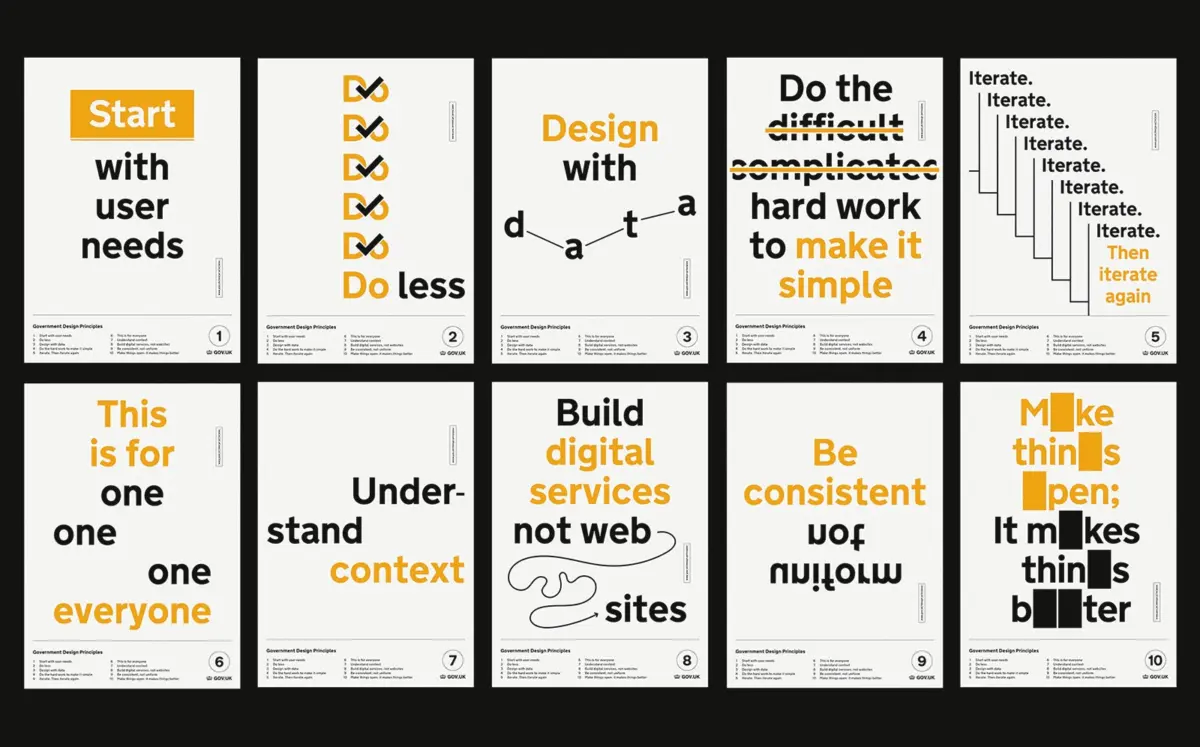
Instead of heavy administrative documentation, organizations benefit from establishing a concise, clear set of core principles that can easily be posted and remembered, drawing inspiration from high-level frameworks like the UK government’s design principles (gov.uk). Simple, high-trust guidelines provide essential boundary lines while relying on employees to apply sound professional judgment in their day-to-day work.

Management must accept that early mistakes are an inevitable cost of operational evolution, framing governance around risk mitigation and support rather than pre-emptive restriction.
Adaptive Technological Rollout and the Rise of Shadow AI
From an IT perspective, centralizing control over technical infrastructure often creates severe bottlenecks that stifle innovation. Overstretched IT departments during the digital transformation era routinely mandated standardized, organization-wide software suites with minimal input from frontline end-users. Any team needing specialized software outside the pre-approved stack had to navigate cumbersome approval processes involving executive steering committees. This institutional friction slowed progress to a crawl and contributed heavily to the high failure rate of digital transformation initiatives.
Today, enterprise IT teams are repeating this approach by designating a single broad enterprise tool—such as Copilot—as the universal AI solution for the entire workforce. While standardizing on a single vendor simplifies corporate procurement, it often fails to meet the specialized needs of distinct teams.
For example, a user experience design team attempting to build an AI-powered research repository and synthetic user personas may find that standard enterprise tools lack the necessary technical capabilities to execute the project. If every request to utilize specialized software requires navigating an artificial intelligence steering group, the review process quickly becomes bogged down in bureaucracy. As approval stalls and enthusiasm wanes, teams abandon their initiatives.
When corporate infrastructure prevents employees from fulfilling their professional duties, staff inevitably find workarounds. Just as "shadow IT" emerged during the digital transformation era—with workers secretly turning to unauthorized consumer applications like Dropbox or Google Docs to bypass restricted internal systems—organizations today are confronting the rapid rise of "shadow AI."
When official corporate tools prove incapable of performing necessary tasks, workers routinely open personal accounts on public artificial intelligence platforms like ChatGPT or Claude using personal smartphones or home laptops.
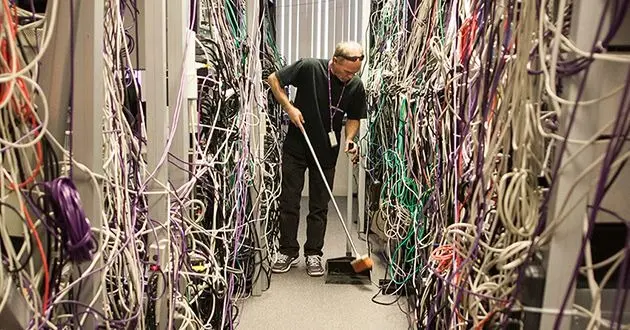
Shadow AI introduces substantial security and compliance risks. Corporate data is uploaded into external environments outside the organization’s monitoring, governance, and security perimeters, creating exposure to data leaks. By attempting to lock down technical environments too rigidly, organizations inadvertently drive operational risk into invisible, unmonitored channels.
Punitive measures—such as blocking external domains, monitoring network traffic, or threatening disciplinary action—rarely solve the underlying problem and typically push shadow behavior further underground. Shadow AI should be viewed as a valuable diagnostic indicator: it reveals precisely where officially provided enterprise tools are failing to support workers.
Instead of attempting to suppress unauthorized tool usage through strict enforcement, leadership should investigate why employees are turning to personal accounts. By understanding what workers are trying to accomplish and where current corporate software falls short, organizations can make informed decisions about updating their official technology stacks.
While managing a diverse software environment carries operational overhead, organizations must tolerate a degree of initial variability while teams explore the practical applications of artificial intelligence. Enterprise standards can be gradually established as genuine organizational needs become clear over time.
A Dangerous Time for Corporate Strategy
For many executives, relinquishing central control and allowing flexible experimentation feels inherently risky. Corporate leadership naturally seeks to manage technological transitions through strict oversight to prevent operational errors. However, fundamental organizational change always carries risk, and in a rapidly evolving technological landscape, the risk of moving too slowly far outweighs the friction of early, iterative experimentation.
The greatest threat facing enterprise strategy today is treating artificial intelligence as merely a technical upgrade while overlooking the human architecture of the workplace. Successful adoption is fundamentally an exercise in change management, organizational culture, and human psychology. Organizations that adjust their strategies to support, empower, and incentivize their people will successfully navigate this transition, while those relying on top-down mandates risk repeating the costly failures of the past.