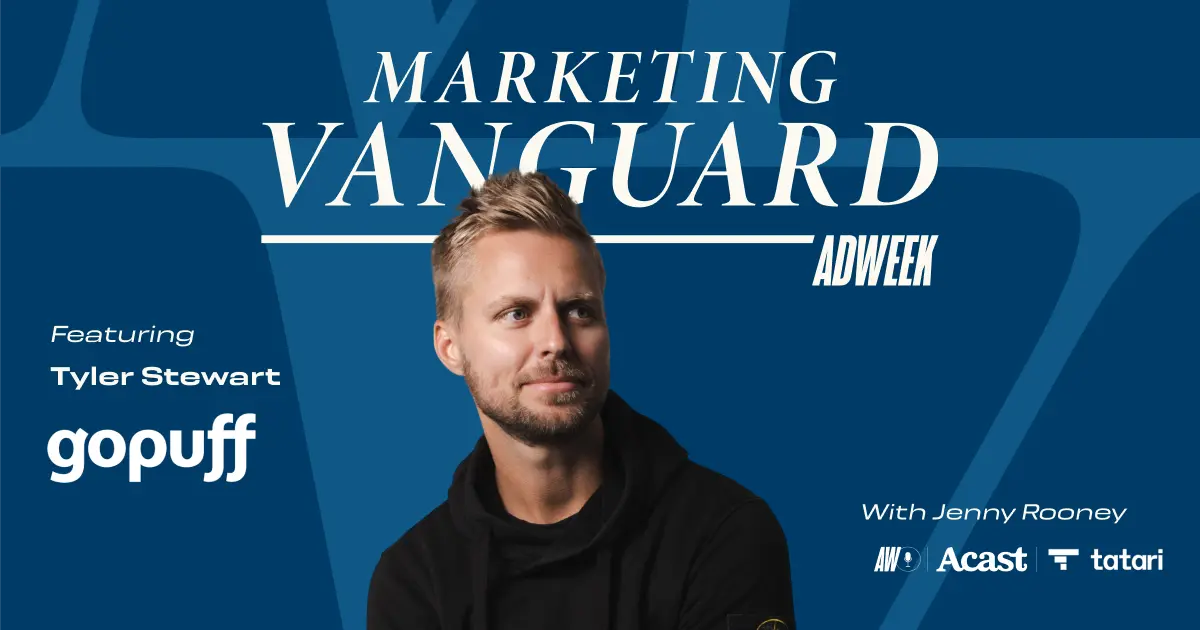
Playing it safe in modern commerce is an expensive strategy when nobody notices you. That was the central thesis delivered from the Marketing Vanguard stage at Brandweek 2026, where Adweek’s Jenny Rooney sat down with Tyler Stewart, head of marketing at Gopuff. In a wide-ranging, live discussion presented
in partnership with Tatari, the two dissected how a prominent challenger brand can successfully carve out market share in one of the most crowded, fiercely contested corners of commerce without attempting to outspend deep-pocketed legacy giants.
The conversation offered a rare, behind-the-scenes look at Gopuff’s evolving marketing philosophy. Stewart addressed everything from why the company’s real competitive edge is anchored in first-party logistics to how former competitors can seamlessly transform into valuable distribution partners. He also unpacked why the modern corporate promise of "instant" commerce means far more than simply shaving a few minutes off a delivery window, diving deep into the realities of modern brand building, resourcefulness, and cultural relevance.
This special live session was captured as part of a dedicated vidcast series recorded on location at Brandweek 2026, showcasing how modern marketing leaders are navigating an increasingly complex attention economy. For Stewart, whose professional background spans a diverse mix of sports entertainment, talent representation, media, and integrated marketing roles—including stints at GQ, The Players’ Tribune, and Bleacher Report—the mandate is clear. That eclectic career path, blending sports, media, startup culture, and entertainment, now deeply shapes how he approaches marketing at Gopuff. It is all about finding precise moments where the brand can command genuine attention, forging partnerships that consumers actually care about, and translating internal operational strengths into culturally resonant narratives.
Could Your Competitors Be Your Best Distribution Partners?
In the fast-paced world of instant commerce, companies often view one another through a strictly adversarial lens. However, during the Brandweek session, Stewart challenged that conventional wisdom, arguing that the category does not have to be a zero-sum game. While Gopuff routinely goes toe-to-toe with major delivery platforms for consumer attention and market share, Stewart does not view the competitive landscape through a hostile filter.
Instead, Gopuff leverages its robust first-party logistics infrastructure to create alternative avenues for growth. The company successfully sells products through major competing platforms like DoorDash and Uber Eats, while simultaneously functioning as a last-mile partner in other capacities. For broader marketing and business strategists, this dynamic offers a profound lesson: a true competitive advantage does not just mean beating everyone else at their own game; it can create entirely new operational options, strategic flexibility, and revenue streams that traditional rivals might miss entirely. By recognizing where operational strengths can serve others, a challenger brand can redefine its position within the broader ecosystem.
How Gopuff Competes Against the Giants
When operating in a category dominated by behemoths with seemingly limitless financial resources, smaller brands face an existential choice on how to allocate their capital. Stewart was refreshingly blunt during the Brandweek stage conversation, acknowledging outright that Gopuff simply does not possess the massive marketing budgets required to match every larger competitor dollar for dollar in a traditional media-spending war.
Faced with this financial asymmetry, Gopuff’s answer is resourcefulness over raw spending power. Rather than throwing money at endless ad impressions, the brand focuses on strategic high-impact initiatives. Collaborations with elite talent, such as sports icon Tom Brady, are deliberately engineered to create innovative products, secure unique consumer access, and spark genuinely interesting cultural moments. The goal is never to merely rent celebrity reach or slap a famous face on a standard banner ad; it is to integrate talent into the fabric of the brand experience in a way that feels authentic and compelling to the audience.
“We’d Rather Be Debated Than Ignored”
Perhaps the most defining moment of the Brandweek 2026 session came when Stewart articulated Gopuff’s core brand philosophy with striking clarity. In today’s hyper-fragmented attention economy—where capturing consumer focus is increasingly difficult and fleeting—playing it safe is no longer a neutral choice. Stewart stated plainly that he would rather push the creative envelope far enough to spark active debate than execute a safe, muted campaign that leaves people indifferent.
For a challenger brand operating in a crowded marketplace, invisibility is a far greater risk than drawing criticism or sparking conversation. When nobody notices your marketing, the money spent on safety is entirely wasted. By embracing campaigns that provoke thought, discussion, and even polarized reactions, Gopuff ensures it remains culturally relevant and top-of-mind for consumers who are constantly bombarded with corporate messaging.
One Deep Creator Partnership Beats Ten Logo Slaps
This philosophy of prioritizing impact over ubiquity heavily influences Gopuff’s approach to influencer and creator partnerships. Stewart outlined a strategy built on a simple premise: do less, but do it much better. In an era where consumers have developed a blind spot for routine sponsored social media posts and superficial brand alignments, Gopuff moves away from simply paying creators for a logo slap or a transactional product shoutout.
Instead, the company attempts to build substantive projects alongside creators, collaborating on actual products, exclusive content formats, or unique consumer access points. The ultimate objective is to make every creator relationship feel entirely organic and mutually beneficial to both the talent and their respective audiences. By investing in fewer, deeper partnerships rather than scattering thin sponsorships across dozens of channels, Gopuff manages to cut through the noise, validate its challenger mindset, and turn operational strengths into lasting cultural capital.