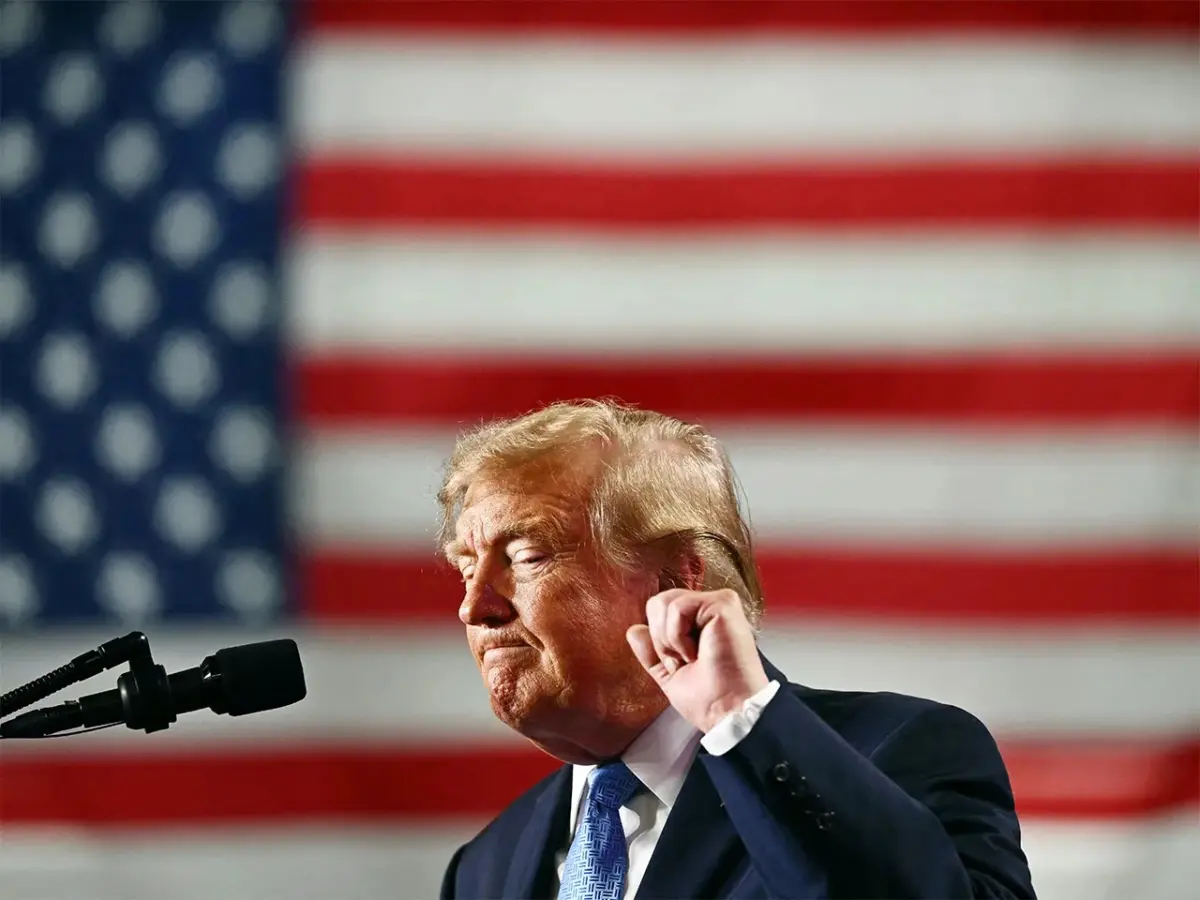
President Donald Trump has cut an unusually solemn and introspective figure following a bruising set of midterm elections that handed the US Democrats control of both chambers of Congress. Yet, even behind closed doors in the executive mansion, the fundamental political reality of the White House remains unchanged: Donald Trump famously hates losing and never admits to being wrong.
It came as little surprise on election night when the president immediately began casting about for scapegoats to blame for his party’s crushing defeat at the polls. Pointing fingers in every direction, he laid responsibility for the losses on everything from lacklustre Republican candidates on the ground to critical coverage from media outlets such as Fox News.
No one was seriously expecting deep introspection or public contrition from a leader who once famously declared that he did not apologize because he never made mistakes. However, a palpable sense of concern is rapidly growing within his own inner circle—and across Washington more broadly—that the administration’s response will soon move far beyond name-calling on Truth Social into a much more concerted campaign of political vengeance.
Since the earliest days of his career as a New York real estate mogul and throughout his subsequent political ascent, Trump has operated under a singular tactical assumption: that the absolute best line of defense is a relentless, unyielding offense. Now, facing an emboldened Democratic Party majority in both the House of Representatives and the Senate, he can realistically expect two years of aggressive investigations, legislative roadblocks, and unremitting attempts to curtail his executive power and hold his administration to account. The pressing question echoing through the corridors of Washington is simple yet volatile: who will Trump lunge at first?
The Scale of the Defeat Limits Challenges to the Results
Fears that Trump might immediately challenge the validity of the election results or cast doubt on the integrity of the vote proved to be unfounded. The sheer, undeniable scale of the Democratic victory—with the party flipping seven Senate seats and capturing at least 25 seats in the House of Representatives—made it exceptionally difficult for him to cry foul. Instead, recognizing the definitive nature of the tallies, he was quick to state publicly that he would accept the outcome.
Much of the political quaking and nervous anticipation, therefore, is taking place entirely within the confines of the White House. Historically, disastrous midterm elections invariably prompt sweeping cabinet reshuffles, and American media outlets have already begun reporting an atmosphere of acute foreboding and internal infighting as senior officials scramble to save their political skins.
Given that the escalating conflict with Iran and the resulting sharp spike in global fuel prices have been widely cited by analysts as major factors driving the severity of the electoral losses, one glaring potential target for a shake-up is Secretary of War Pete Hegseth. Attention has also naturally shifted toward Trump’s chief of staff, Susie Wiles, though the White House has strongly pushed back against reports that she could be on the chopping block.
A Delicate Balance for Congressional Democrats
How the next two years unfold will also depend heavily on the Democrats’ own appetite for political retribution. During Trump’s first term in office, after the Democrats successfully won back control of the House of Representatives in the 2018 midterms, party leaders moved swiftly to launch impeachment proceedings against the president the following year.
Those legislative attempts ultimately proved unsuccessful, and political strategists now widely understand that the move may have inadvertently bolstered Trump’s long-term support by allowing him to lean heavily into a compelling narrative of political persecution. Mindful of those lessons, Democratic leaders have been notably cooler and more deliberate on the idea of rushing into impeachment proceedings against Trump this time around.
Instead, the party’s leadership is weighing alternative avenues of oversight. They could choose to train their investigative crosshairs on other prominent figures close to the president, including Secretary of War Pete Hegseth. The strategy gains even more traction given that allegations of personal enrichment among Trump’s inner circle and political allies formed a central, winning theme in many Democratic candidates’ successful campaigns across the country. Future congressional investigations could easily target broader networks of the president’s friends, associates, and family members.
The Prospect of Retaliation and Institutional Warfare
President Trump appears acutely aware that his inner circle will inevitably find itself in the firing line of the new congressional majorities. Reflecting on the political landscape ahead in an interview with Time magazine last month, Trump remarked, “They’ll probably go after me and I’ll go after them.”
During that same interview, the president notably declined to rule out deploying the military domestically or invoking the Insurrection Act in the wake of the midterms. While those extreme options are viewed by legal scholars as unlikely to materialize, Trump has repeatedly demonstrated a distinct willingness to utilize the Department of Justice to pursue personal political vendettas. He could ultimately instruct department lawyers to investigate individual Democrats who launch aggressive congressional probes into his official actions as commander in chief.
Bipartisan cooperation is expected to be virtually nonexistent. Trump has already signaled his willingness to draw a hard line against the legislative branch, promising to veto any Democratic legislation that manages to land on his desk over the next two years.
Navigating Domestic Stymieing and Foreign Policy
While all-out political warfare on the home front remains a distinct possibility, attention is also turning to the international arena. With his domestic policy initiatives effectively stymied by a hostile Congress, the president could potentially pivot to place a heavier emphasis on foreign interventions and international diplomacy. Securing a lasting historical legacy remains one of his chief personal concerns, and he certainly would not want his ultimate presidential bequest to be leaving the United States mired in an intractable, open-ended conflict in the Middle East.
Another plausible scenario is that a frustrated Trump administration will turn increasingly insular, focusing its remaining political capital on domestic politics while becoming deeply consumed by vanity construction projects, such as his beloved executive ballroom.
However, even those pet projects will not escape the political crossfire. The proposed ballroom will not be completed before the end of Trump’s current term, and the newly empowered Democrats could utilize their fresh majority in Congress to investigate, delay, or even outright halt the roughly $600 million project. It promises to become yet another high-stakes flashpoint in what is shaping up to be a tumultuous and bitterly contested two years ahead in Washington.