The digital landscape is undergoing its most profound transformation in decades. For nearly half a century, navigating the internet has meant manipulating visible interfaces—clicking drop-down menus, filling out multi-stage forms, adjusting range sliders, and managing dozens of open browser tabs. Today, that foundational contract between human and computer is fundamentally changing. Driven by rapid advancements in artificial intelligence and large language models, a new design philosophy known as Intent-Driven Design is taking hold across the web, shifting the user experience away from visible, mechanical controls and toward transparent, goal-oriented AI interactions.
Since the commercial debut of the Graphical User Interface (GUI) pioneered by systems like the Xerox Star and later popularized by Apple’s original Macintosh, software interaction has depended heavily on direct, manual manipulation. Under this traditional point-and-click paradigm, users wishing to book travel, purchase footwear, or research a medical symptom must navigate complex digital labyrinths. They spend a significant portion of their digital lives managing software interfaces—dismissing cookie banners, cross-referencing information across multiple browser windows, and manually orchestrating step-by-step inputs—rather than directly accomplishing their end goals.
Intent-driven web tools flip this long-standing dynamic. Rather than requiring users to learn intricate menus or navigate multi-step conversion funnels, these modern platforms capture high-level human objectives expressed in natural language or derived from context, executing the underlying labor silently in the background. This evolution draws directly on established human-computer interaction concepts, including Golden Krishna’s foundational ethos that "the best interface is no interface," alongside Don Norman’s principles of human-centered design. As modern web development re-evaluates its priorities, the primary objective is moving away from building visually flashy buttons and complex animations, aiming instead toward reducing or eliminating interface friction altogether.

The Death of the "10-Click" Process
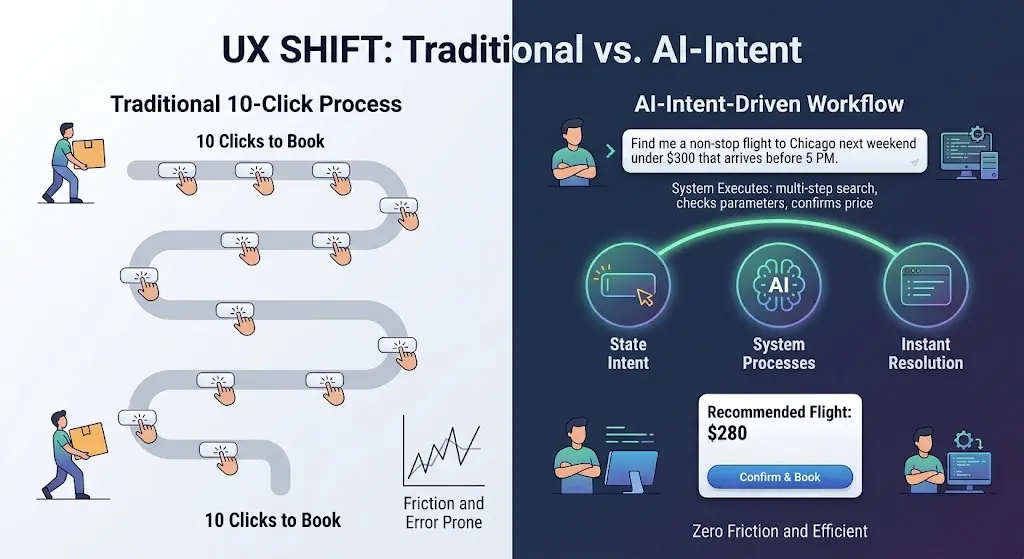
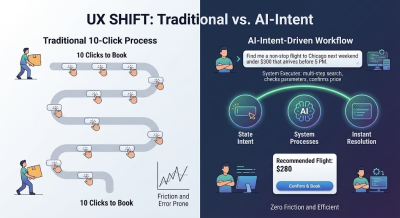
To fully grasp this design evolution, it is necessary to examine the friction historically accepted as standard behavior in web software. The traditional workflow for booking an airline ticket offers a prime example of hyper-interactive friction. In a classic point-and-click environment, the computer serves primarily as a passive storage vessel for data, forcing the human user to act as an operational manager. The user must manually input departure and arrival locations, adjust date calendars, select flight times, filter by price range, choose seat preferences, and review terms before completing a purchase.
Intent-driven design replaces this mechanical sequence by asking a direct question: what is the user actually attempting to achieve? When a user expresses a specific goal—such as requesting a non-stop flight to Chicago for the upcoming weekend under $300 that arrives prior to 5 PM—the underlying AI system interprets the broader intent. The software autonomously queries databases behind the scenes, compares flight schedules, applies constraint filters, and presents a single, actionable resolution ready for approval. In this model, what previously required a ten-click manual routine dissolves into a single intent-focused interaction.
Three Web Platforms Replacing Buttons with Intent
This movement away from rigid UI components is no longer merely theoretical. Several widely accessible web platforms are actively demonstrating how intent-capturing mechanisms can replace traditional navigation structures.
Perplexity AI: Search Without Open Tabs
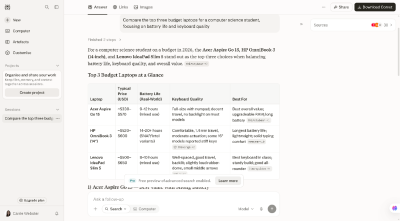
Traditional search tools like Google were originally constructed as directories. When presented with a search query, traditional engines return a list of links, shifting the burden of research onto the user. The individual must open several separate browser tabs, skim long articles, filter out promotional content, and manually synthesize a coherent answer. While traditional search engines are beginning to incorporate summarized AI overviews, platforms like Perplexity AI demonstrate a fully intent-driven approach. Perplexity captures the user’s core inquiry and synthesizes a direct, comprehensive response pulled from multiple web sources in real time, eliminating the need to manually navigate through numerous external sites and open browser tabs.
Vercel v0: Web Design Without Dragging and Dropping
Digital design and software development have traditionally required laborious manual layout assembly. Designers and developers spend hours placing rectangular containers, fine-tuning padding, selecting precise hexadecimal color codes, and building visual elements within layout tools like Figma or drag-and-drop web page builders. Vercel v0 offers a direct alternative through generative interface construction. Accessible directly from its homepage without mandatory sign-in barriers, the platform allows users to describe a functional design objective in natural language. Vercel v0 then dynamically generates production-ready code and tailored UI components on demand, bypassing the manual process of drawing and arranging visual elements.
Goblin.tools: Breaking Down Overwhelming Tasks
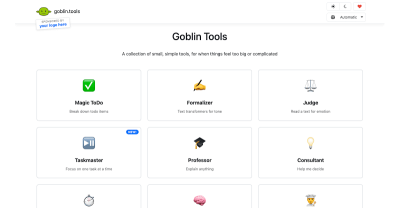
In productivity software, conventional applications typically demand that users manually create task structures, construct Kanban boards, set micro-deadlines, and organize sub-tasks item by item. Goblin.tools offers a sharp contrast by providing a suite of single-task AI tools designed specifically to assist neurodivergent individuals or anyone experiencing task paralysis. Requiring no account registration or complex setup, the tool takes a singular, high-level intent—such as preparing for a job interview or organizing a project—and automatically deconstructs it into manageable, actionable micro-steps, removing the cognitive overhead associated with manual planning.
The Core Pillars of Intent-Driven Web Design
As conventional navigation structures, sidebars, and static input forms recede, web designers are relying on three key foundational pillars to maintain software usability and clarity.
High-Level Goals and Contextual Awareness
The first pillar shifts input mechanics away from micro-actions—such as clicking dropdowns, toggling switches, or selecting radio buttons—and toward capturing broad human intent. Rather than waiting passively for explicit user commands, intent-driven systems leverage contextual data to anticipate immediate needs. Guided by standards such as Apple’s Human Interface Guidelines on Contextual and Ambient Design, modern applications evaluate environmental metadata, including current device state, location details, time parameters, and past usage patterns, to initiate proactive, highly relevant assistance.
Generative UI and Dynamic Adapting Layouts
The second pillar reimagines interface state. In traditional web development, web pages present static, uniform layouts where every visitor sees identical navigation structures, regardless of their immediate goal or past history. Grounded in research from the Nielsen Norman Group analyzing AI as an emerging UX paradigm, computing is transitioning from command-based instructions toward outcome specification. This enables Generative UI, where user interfaces are constructed dynamically on the fly based on specific, real-time user needs. For instance, if a user expresses an intent to analyze complex financial figures, the interface instantly generates a custom calculation widget tailored to that context, which recedes once the objective is fulfilled.
Autonomous Execution by AI Agents
The third pillar fundamentally alters task execution by delegating repetitive procedural steps to background AI agents. Traditional applications heavily emphasize error prevention through intrusive confirmation dialogs and warning overlays. Intent-driven architecture adapts classic usability principles—such as Jakob Nielsen’s 10 Usability Heuristics regarding user control and error recovery—by shifting the main safety mechanism from pre-action prevention to effortless post-action reversibility. Because AI agents execute complex sequences autonomously, products prioritize visible rollback features, such as clear undo controls, conversational revision prompts, and transparent audit trails, replacing interruptive warning dialogs with actionable transparency.
Navigating Ethical Pitfalls and Design Risks
While eliminating interface friction significantly enhances convenience, stripping away explicit visual controls introduces serious design, ethical, and practical challenges. When software acts on inferred intentions rather than direct physical clicks, designers must carefully navigate systemic risks.
The Illusion of Control
When digital tools take decisive actions autonomously, users can quickly experience a loss of agency or feel that the system is behaving invasively. Research conducted by the Stanford Human-Computer Interaction (HCI) Group stresses that automated systems must establish explicit operational boundaries to prevent user frustration. Furthermore, ethical frameworks established by the Center for Humane Technology warn that product creators must actively avoid embedding manipulative default settings within automated flows. UX designers must establish a precise balance: routine, low-risk execution should be automated seamlessly, while high-stakes decisions—such as issuing financial payments, publishing public statements, or modifying security settings—must explicitly prompt the user for confirmation.
The Black Box Problem
In a conventional point-and-click interface, when an unexpected outcome occurs, users can usually identify the root cause, such as an incorrectly selected filter or a mistyped input box. In intent-driven systems, diagnosing errors becomes far more challenging because the underlying reasoning is obscured. To address this "black box" challenge, the Google PAIR (People + AI Research) Guidebook recommends implementing continuous, transparent feedback loops. An AI system must explicitly state how it interpreted the user’s intent—such as explicitly showing that it is filtering for non-stop flights under a specified price threshold—enabling users to calibrate trust and instantly correct any misunderstandings.
The Evolving Role of UX Designers
As intent-driven paradigms continue to mature, the responsibilities of UX professionals are undergoing a fundamental transformation. Rather than devoting resources to designing static button states, complex drop-down menus, and rigid input forms, designers must learn to orchestrate dynamic, generative interface components that adapt organically to user context.
Mastering this emerging landscape requires developing expertise in ambient feedback mechanisms, contextual inline prompts, and transparent AI status indicators. By focusing on how systems infer and execute human objectives, designers can ensure that screenless, agent-driven applications remain accessible, ethical, and strictly aligned with human needs.
Redefining Success: From Engagement to Invisible Completion
For decades, the digital industry has evaluated software quality through user engagement metrics, measuring app retention, session length, click-through rates, and pageviews per visit. Digital platforms were structured specifically to maximize visual interaction and retain user attention for as long as possible.
The philosophical shift behind Golden Krishna’s core thesis—that the best interface is no interface—aligns closely with the Center for Humane Technology’s "Time Well Spent" movement, challenging these conventional success metrics. The benchmark for effective digital software is no longer how visually striking its interface controls are, but how efficiently it can resolve a user’s problem and recede into the background.
As the web continues to evolve, software applications will increasingly be judged not by the density of their visual features, but by their capacity to make complex interfaces unnecessary. The future of digital interaction lies not in adding more buttons, menus, and controls, but in achieving seamless, invisible completion.