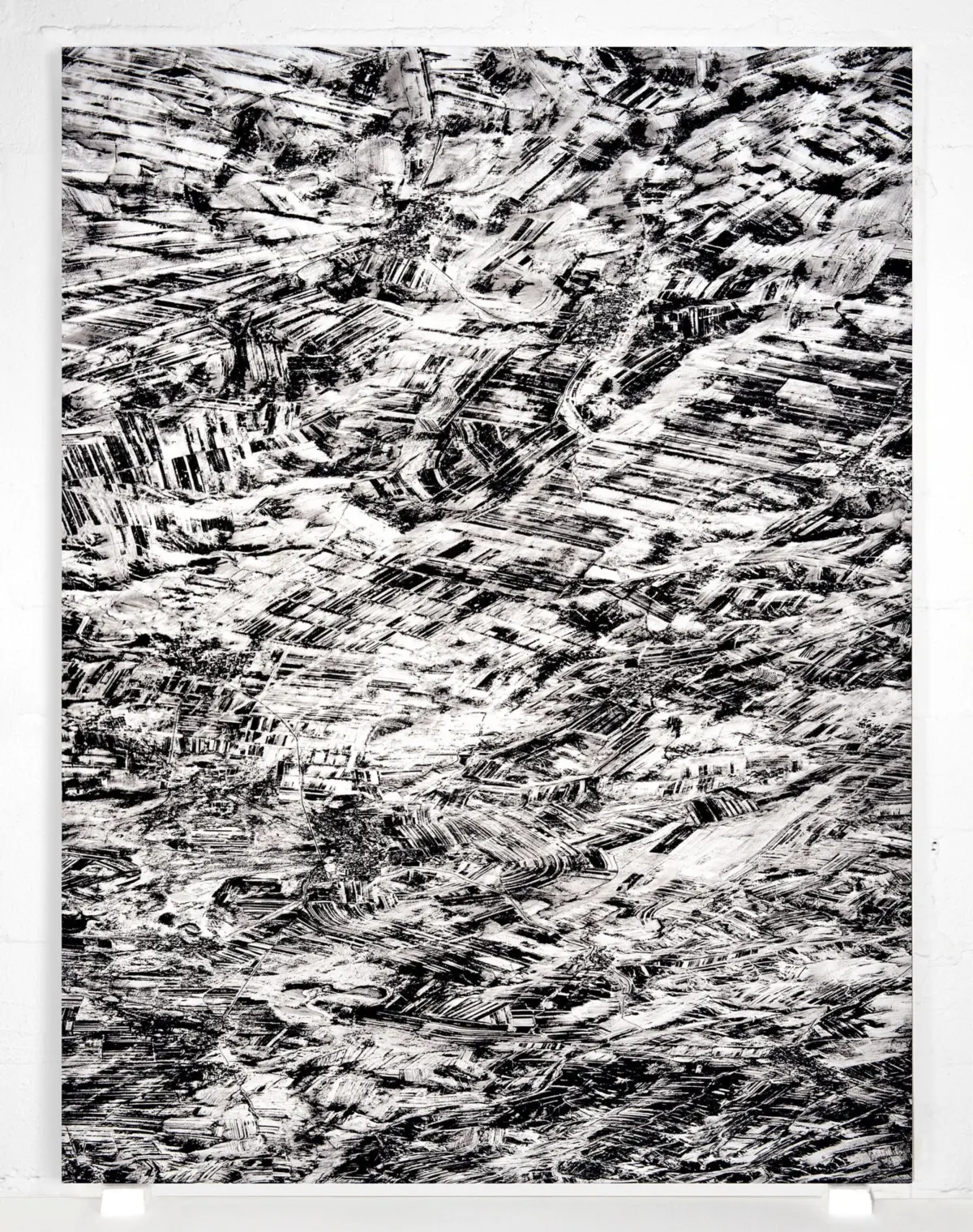
From a certain vantage point inside Justin Brice Guariglia’s expansive Brooklyn studio, visitors might find themselves momentarily disoriented, unsure of exactly what hangs on the back wall. At a distance, a towering 16-foot print immediately resembles a heavily textured painting, complete with jagged, physical edges that seem almost tangible, inviting the hand to reach out and touch them. Yet, upon closer visual inspection, the illusion shifts; the eye realizes the surface is entirely flat, behaving more like a conventional photograph than a traditional canvas. In reality, this masterful trompe l’oeil exists somewhere fascinatingly between the two mediums.
"They’re paintings derived from photographs," Guariglia explains, describing the intricate physical hybridity that defines his latest body of work.
This particular monumental piece traces its origins directly to Guariglia’s recent, high-altitude flight alongside NASA’s Operation IceBridge mission. It features a striking aerial shot of the Jakobshavn Glacier, widely recognized as Greenland’s largest and most rapidly melting hunk of ice. The image forms a central part of a broader, haunting series of landscape prints that the artist assembled for his upcoming exhibition, Earth Works: Mapping The Anthropocene, scheduled to open at the prestigious Norton Museum of Art in Palm Beach, Florida.
The journey that brought Guariglia to this intersection of fine art, environmental science, and aerospace exploration has been defined by a deliberate evolution in his creative philosophy. He originally established himself in the creative sphere as a freelance magazine photographer working across Asia, documenting cultures, landscapes, and human stories for various publications. However, roughly a decade ago, he made a conscious and decisive switch to fine art, driven by a growing existential frustration with the disposable nature of print journalism. Photographs printed in glossy magazines are inevitably discarded, recycled, or forgotten within days of publication; Guariglia wanted to create physical objects that could endure indefinitely, carrying their messages far into the future.
To achieve this lasting quality for his current show, Guariglia spent years figuring out how to print his sweeping aerial photographs directly onto remarkably durable industrial substrates, specifically aluminum and polystyrene canvases.
"The physical object in the photo is already gone," he reflects, noting the rapid disappearance of the very landscapes he captures due to accelerating climate change. "But the actual image will last forever—as long as we don’t recycle it."
These arresting images, captured from dizzying operational altitudes ranging anywhere from 1,500 feet to a soaring 40,000 feet, systematically transform rural Asian countrysides and remote Arctic landmasses into mesmerizing abstract forms. Through Guariglia’s acute compositional lens, ordinary farmland is rendered into shimmering, gilded geometries, while massive, ancient glaciers are stripped of their familiar spatial markers to become ambiguous, minimalist vistas of stark white.
Many of the most striking photographs featured in the exhibition were secured directly from his time embedded with the IceBridge mission. NASA’s Operation IceBridge is renowned for flying low-elevation research aircraft over Greenland and Antarctica to gather critical, continuous data on the world’s rapidly deteriorating ice sheets and glaciers. During these intense scientific flights, Guariglia would often lay prone on the floor at the feet of the working pilots, snapping rapid-fire photographs of the constantly shifting, melting landscape below through the plane’s specialized drop windows.

Back in his Brooklyn workshop, Guariglia deliberately exercises a high degree of restraint, eschewing heavy digital manipulation or excessive tinkering.
"I’m mostly just trying to reduce the image to its most basic essential form," he says, prioritizing raw emotional and visual impact over synthetic enhancement.
To bring these visions to life, he employs a massive, industrial-grade printer that serves effectively as his primary paintbrush. This extraordinary piece of machinery, custom-built and handmade in Switzerland, carries a price tag roughly equivalent to the cost of a very nice apartment in Brooklyn. The printer operates by dispensing an extraordinarily fine, microscopic layer of acrylic ink onto the chosen surface before powerful ultraviolet lights instantly cure and bind the pigment directly to the material.
While the printer is commercially utilized primarily for producing high-end architectural and commercial signage, Guariglia routinely subverts its intended engineering.
"I make it do things it’s not supposed to do," he says, pushing the limits of the technology by printing directly onto rigid polystyrene or laying down an astonishing 150 dense layers of ink at a staggering 900 percent saturation. "I’ve logged about 1,500 hours testing material and printing processes."
The end result of this relentless experimentation is a photographic print that effectively defies decay, lasting practically forever despite capturing subject matter that is rapidly disappearing from the face of the Earth.
Every facet of Guariglia’s meticulous process, from his choice of fleeting subject matter to his selection of permanent, industrial materials, is intentionally designed to represent the Anthropocene—the unofficial current geological age defined largely by humanity’s profound, irreversible impact on the global environment. The ultimate goal, as the artist explains it, is to implicate not just himself as an artist consuming raw industrial materials to create commodities that will inevitably become part of the future fossil record, but also every single spectator who stands before the work.
The monumental prints serve as a stark, unavoidable reminder that the colossal environmental crises modern humans face are driven predominantly by our own collective actions. Yet, when captured, carefully cropped, and forcefully printed onto rigid rectangular panels, these overwhelming global realities are brought into sharp focus, making them at least a little easier for humanity to see, confront, and contemplate.