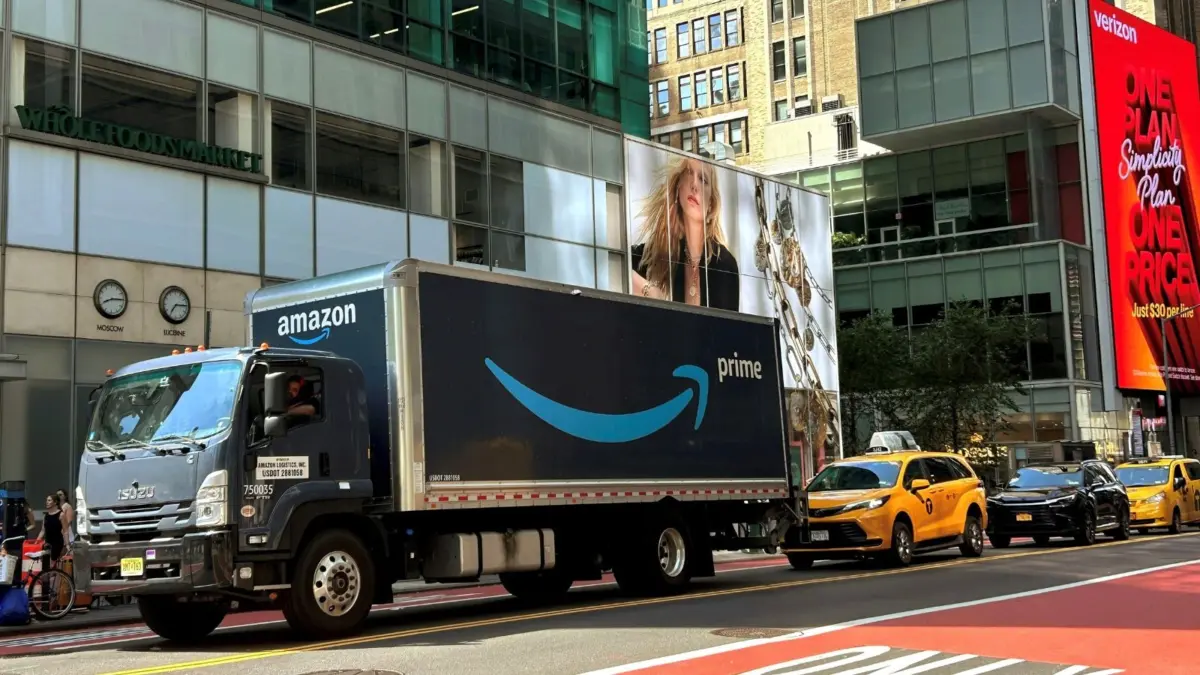
Amazon has delivered a powerful financial performance for its latest quarter, propelled by robust growth across its cloud computing division, expanding advertising revenues, and a record-breaking operating margin. The e-commerce and technology giant posted massive overall sales figures alongside accelerating momentum in artificial intelligence infrastructure, even as industry analysts begin to eye looming competitive challenges on the horizon from emerging consumer AI shopping tools.
The company’s recent financial disclosures paint a picture of an enterprise firing on all cylinders, balancing traditional retail dominance with high-margin digital services and cloud infrastructure. Yet, beneath the glow of record profitability and surging engagement on streaming platforms, leadership is navigating a shifting technological landscape where generative artificial intelligence assistants threaten to upend traditional digital advertising paradigms.
The Numbers
To understand the sheer scale of Amazon’s current operations, one must look closely at the financial metrics driving the enterprise forward. For the third quarter, Amazon reported net sales of $201.9 billion, representing a strong 12% increase compared to the same period a year prior. This sustained top-line expansion demonstrates that despite macroeconomic headwinds and cautious consumer spending environments in various global markets, Amazon’s core retail and marketplace ecosystem continues to capture massive consumer wallet share.
Perhaps most notably for Wall Street investors, Amazon achieved an operating margin of 13.9% for the quarter. This marks the highest operating margin the company has ever recorded in its history, reflecting rigorous cost discipline, increased efficiency within its fulfillment and logistics network, and a favorable revenue mix leaning more heavily toward high-margin segments like cloud computing and digital advertising.
Advertising remains one of Amazon’s most formidable growth engines. Over the trailing 12-month period, the company’s advertising revenue has climbed to an astonishing $78 billion. This trajectory was reinforced during the third quarter alone, where ad revenue reached $19.6 billion, marking an 11% year-over-year increase. Brands continue to pour marketing dollars into Amazon’s ecosystem to capture high-intent shoppers directly at the point of purchase, cementing the platform as a dominant third pillar in the digital advertising duopoly alongside Google and Meta.
Meanwhile, Amazon Web Services (AWS), the company’s cloud computing and enterprise technology arm, staged a remarkable re-acceleration. AWS generated $46 billion in revenue, marking a staggering 39% year-over-year increase. This represents the division’s fastest growth rate in almost five years, driven heavily by enterprise demand for artificial intelligence capabilities. During the quarter, the division rapidly expanded its Bedrock AI platform—a managed service that gives developers access to high-performing foundation models—and successfully signed major new agreements with prominent technology and artificial intelligence leaders, including Meta, NVIDIA, and OpenAI.
Beyond retail, cloud, and advertising, Amazon’s media and entertainment investments are also yielding measurable dividends. According to Nielsen data provided by Amazon, the first six games of "Thursday Night Football" broadcast on Prime Video attracted an average of 17.7 million viewers. This audience figure represents a 17% increase compared to last year’s viewership, validating the company’s multi-billion-dollar bet on live sports streaming as a mechanism to drive Prime memberships, consumer engagement, and connected-television advertising inventory.
The Watercooler Talk
Even as Amazon celebrates these record-breaking financial figures and operational milestones, industry insiders and market observers are engaged in intense discussions regarding the long-term structural threats facing the company’s lucrative advertising model. The conversation centers around the rapid rise of conversational artificial intelligence agents—such as OpenAI’s ChatGPT, Google’s Gemini, and Meta’s Muse—which are fundamentally changing how consumers discover products, compare features, and make purchasing decisions.
For years, Amazon has reaped enormous financial rewards by selling sponsored product listings, banner displays, and search placement ads to brands eager to stand out to consumers browsing its digital storefront. When shoppers visit Amazon.com to search for an item, sponsored placements heavily influence their buying journey. However, the emergence of advanced AI shopping agents threatens to disintermediate this process entirely.
As more consumers turn to standalone AI assistants to research products, curate recommendations, and manage shopping tasks outside of traditional e-commerce platforms, the initial product discovery phase is increasingly happening away from Amazon’s website or app. If shoppers rely on conversational agents to evaluate options and make direct purchases, Amazon’s ability to deliver sponsored listings, targeted display ads, and high-margin promotional impressions to active shoppers could face significant pressure.
These generative AI tools synthesize reviews, compare specifications, and surface purchasing options without exposing users to the traditional grid of sponsored search results that forms the bedrock of Amazon’s retail media network. While Amazon is aggressively investing in its own artificial intelligence infrastructure and enterprise tools through AWS and Bedrock, the shifting habits of everyday consumers present a nuanced strategic challenge. The company must continuously adapt its consumer-facing discovery mechanisms to ensure that its dominant retail marketplace and advertising machine remain relevant in a future where AI assistants increasingly stand between the buyer and the digital shelf.