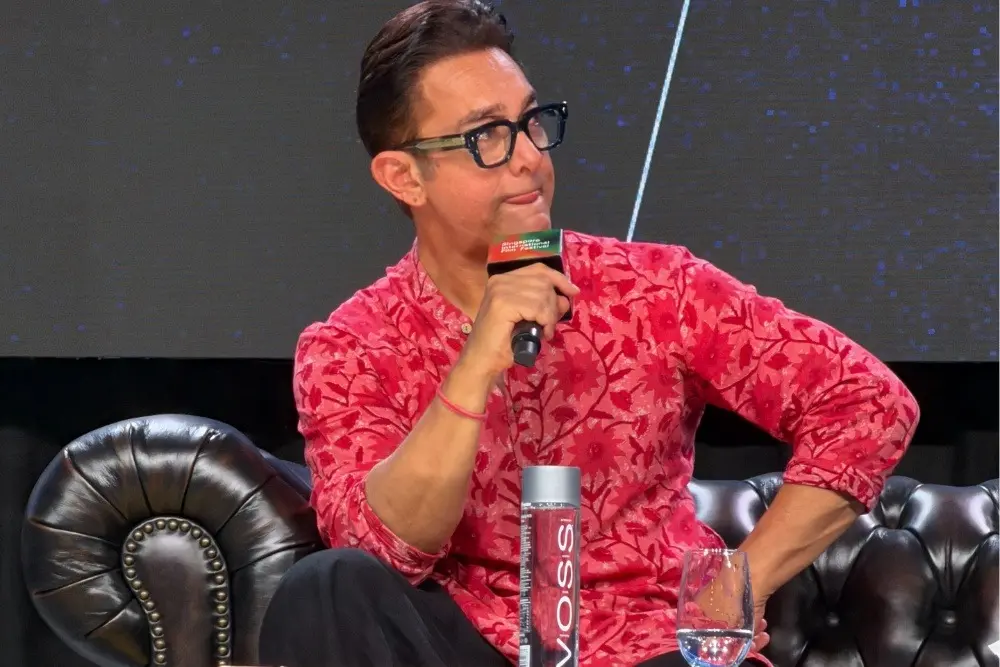
Bollywood icon Aamir Khan delivered a deeply personal and emotionally charged appearance at the Singapore International Film Festival on Thursday, breaking down onstage as he reflected on the personal toll of his decades-long career. Accepting the festival’s prestigious Screen Icon Award from renowned Hong Kong director Peter Chan Ho-sun, the actor engaged in a wide-ranging, candid conversation moderated by Singaporean comedian Rishi Budhrani, touching upon career-defining low points, the landscape of artificial intelligence, piracy in international markets, and highly anticipated updates regarding potential sequels to some of Indian cinema’s most beloved comedy classics.
The emotional peak of the evening arrived late in the program when Khan was asked to share the most challenging and vulnerable periods of his storied journey. Known globally for his meticulous dedication to his craft, Khan described himself as a lifelong workaholic who had spent decades eating, sleeping, and breathing cinema. He acknowledged that his family had historically shown immense patience and understanding, giving him the space necessary to pursue his artistic vision with obsessive intensity.
However, the enforced stillness of the COVID-19 pandemic forced a profound introspection that altered his perspective on life and work. Khan recounted sitting quietly during the lockdown and realizing that approximately thirty years of his life had vanished in a relentless blur of production. While he noted that it is entirely acceptable to operate with complete, singular obsession for a year, two years, or even five, maintaining that level of relentless drive over three decades carried a devastating personal cost. He realized that in his pursuit of cinematic excellence, he had missed vital years with his family, noting with sorrow that his children had grown into adults while he was perpetually consumed by his next project, evoking a profound, overwhelming sense of loss.
As the memory and the weight of those realizations caught up with him, Khan paused mid-sentence and broke down in tears onstage. The audience immediately responded with supportive applause, and an empathetic attendee quickly handed him a box of tissues. After gathering himself and wiping away his tears, Khan expressed gratitude that this sobering realization struck him when he was 56 years old rather than at 86, when it would have been far too late to make amends. He shared that for the past four years, he has actively and deliberately restructured his life to carve out meaningful, uninterrupted time for his family and close friends, transforming the painful pandemic reflection into a lasting personal realignment.
Shifting the tone of the conversation toward lighter subjects, moderator Rishi Budhrani steered the discussion into the realm of potential cinematic sequels, specifically asking about the status of "3 Idiots," the landmark 2009 campus comedy directed by Rajkumar Hirani that remains a touchstone of modern Indian cinema.
Responding to enthusiastic cheers from the crowd, Khan admitted that while his lips are largely sealed, he could share a promising development. He revealed that Rajkumar Hirani is actively developing a script for a follow-up. According to Khan, once he returns home in the coming weeks, the filmmaker is scheduled to narrate the final version of the script to him, leaving the actor and fans alike with hopeful anticipation.
Budhrani added context to the revelation, sharing that Khan had actually telephoned Hirani live in front of him the previous day to seek permission to share the news with the festival audience. Although Hirani initially missed the call because Khan had recently changed his phone number, the filmmaker ultimately gave his blessing. Khan elaborated on his current relationship with technology, mentioning that he had completely shut down his phone a few weeks prior and disconnected from all social and digital applications after discovering that mindless scrolling could easily consume three uninterrupted hours of his day.
The conversation naturally drifted toward another monumental milestone in Indian comedy, Rajkumar Santoshi’s 1994 cult classic "Andaz Apna Apna," which starred Khan alongside Salman Khan. When pressed by the audience and the moderator about whether a sequel to that beloved film is officially on the cards, Khan confirmed that Rajkumar Santoshi is currently working on a concept. While keeping further details strictly under wraps with a characteristic chuckle, Khan confirmed that the filmmaker is exploring possibilities, leaving the door open for what might come next.
Khan’s reflections on vulnerability were not limited to his pandemic-era realizations; he also opened up about a harrowing professional crisis at the very beginning of his career. Following the massive success of his 1988 debut feature "Qayamat Se Qayamat Tak," a youthful and eager Khan made the mistake of signing nine additional films within the span of just six months. Believing that established movie stars could comfortably juggle dozens of concurrent projects, he assumed he could handle ten. Once principal photography commenced on multiple fronts, however, the logistical and emotional reality set in. He recalled returning home night after night to weep in front of his then-wife, Reena, as the films subsequently collapsed at the box office one after another, leading cynical industry observers to brand him a "one-film wonder."
Describing that dark chapter, Khan used the vivid metaphor of sinking into quicksand, explaining that mentally and emotionally, every frantic struggle to regain his footing only pulled him deeper into despair.
Salvation came in the form of an offer from filmmaker Mahesh Bhatt, who was riding high on critical and commercial successes like "Saaransh," "Arth," and "Naam." At that juncture, Khan had made a strict personal vow to himself: he would only commit to a project if he genuinely loved the script, the director, and the producer. Upon reading Bhatt’s offered script, he realized it did not meet his personal standard. After enduring a sleepless, agonizing night, he made the difficult decision to turn Bhatt down. Reflecting on that pivotal moment, Khan noted that had he chosen the path of practical compromise and simply said yes to keep his career moving, his entire professional trajectory would likely have been defined by a continuous series of compromises. Fortunately, the professional rejection did not permanently sever their relationship, as the two later collaborated successfully on "Dil Hai Ke Manta Nahin" and "Hum Hain Rahi Pyar Ke."
Accepting the Screen Icon Award later in the evening, Khan expressed deep appreciation for the Singapore International Film Festival and noted that having Peter Chan Ho-sun present the honor added a layer of profound personal significance. Emphasizing the collaborative nature of his craft, Khan reminded the audience that filmmaking is fundamentally a collective art form where countless individuals contribute significantly to one another’s success.
The conversation also explored Khan’s massive popularity in international markets, particularly China. When asked to explain why his films have struck such a powerful chord with Chinese audiences, Khan offered a remarkably candid assessment. He noted that the phenomenon began when young viewers across China and the broader East Asian region started sharing digital copies of "3 Idiots," paving the way for audiences to actively seek out his broader filmography. With characteristic honesty, Khan declared that his widespread popularity in China is largely attributable to piracy, though he was quick to clarify that he does not endorse or advocate for illegal distribution. Instead, he attributed the deep cultural resonance to a shared emotional key between Indian and Chinese societies, recalling that when he watched "Dangal" inside a crowded Chinese theater, the collective emotional reactions felt identical to those experienced by audiences back home.
Delving deeper into his rigorous creative process, Khan shared insights into his approach to testing and producing films. He revealed that he routinely conducts between 50 and 60 test screenings for his projects, gathering audiences of roughly 25 people at a time to gauge reactions, noting candidly that the very first test screening for his acclaimed directorial venture "Taare Zameen Par" was an absolute disaster. Furthermore, when working on smaller, independent-spirited films whose modest budgets cannot accommodate his customary upfront acting fee, Khan routinely foregoes his salary in exchange for a backend profit-sharing arrangement, ensuring that the financial burden on the producer is minimized if the film underperforms.
Addressing the rapidly evolving technological landscape, Khan shared his perspective on the rise of artificial intelligence in the entertainment industry. Viewing AI as simply another tool in the filmmaker’s arsenal much like visual effects, he drew a practical comparison to historical production methods, noting that building a massive castle set once required an army of 200 carpenters. However, he offered a sober caveat regarding its immediate socioeconomic impact, stating that his common sense dictates that in the short term, people within the industry are undoubtedly going to lose jobs.
Khan, who last visited the Singapore International Film Festival nine years ago to present "Secret Superstar," concluded his festival appearance with another celebratory milestone. The actor is scheduled to attend a special 25th-anniversary screening of "Lagaan," the epic historical sports drama that marked his debut as a film producer, closing out a reflective and eventful weekend celebrating a career that has spanned generations and left an indelible mark on global cinema.