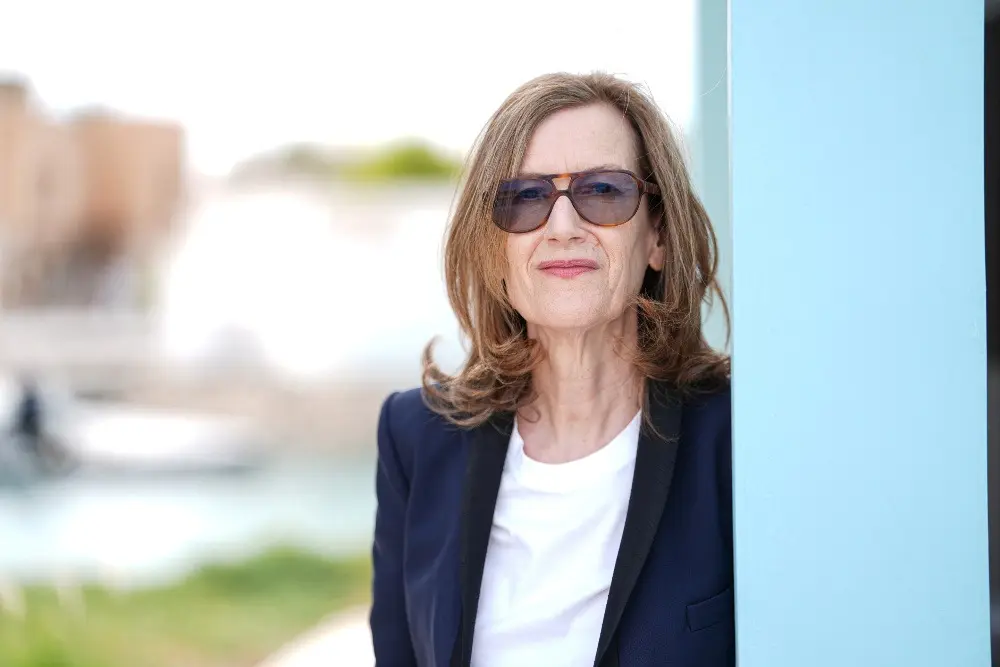
British filmmaker Joanna Hogg, currently presiding over the Feature Narrative Competition jury at the ninth edition of Egypt’s El Gouna Film Festival, approaches the cinematic art form with a deliberate and unburdened mindset. Speaking with Variety this week during the festival, the acclaimed director revealed that she prefers to know as little as possible about a film before the projection begins, choosing to step into the theater without even a rudimentary synopsis of the story.
This conscious blank slate allows her to evaluate works without preconceived notions. Hogg explains that she prefers to go into every screening with absolute zero criteria and a very open mind. Rather than checking off boxes or measuring films against a rigid rubric, she is searching for something that moves her or strikes her in a particular way. She clarifies that a film does not necessarily need to reduce her to tears, but rather needs to possess a certain clarity, signaling that the filmmaker behind the lens holds genuine ideas and a distinct artistic vision.
This open-minded philosophy is especially vital given the eclectic mix of entries at El Gouna, which features films from first-time directors alongside established masters, spanning a vast range of genres and diverse storytelling traditions from across the globe. Hogg notes that applying a uniform set of criteria to such varied works would be counterproductive. Instead, she has embraced the global scope of the festival selection, remarking that she truly feels as though she has traveled all over the place, despite remaining stationed in the Egyptian resort town of El Gouna.
For Hogg, this festival appearance represents her first-ever visit to Egypt. She describes herself as an outsider within a diverse jury composed of filmmakers from Egypt, Iraq, and Turkey. Listening closely to the unique perspectives and cultural insights of her fellow jurors has, in her words, whetted her appetite to discover more films, not just from Egypt, but from the Middle East in general.
The experience also serves as a welcome reentry into the world of active viewing after months spent largely isolated at her desk, entirely immersed in the solitary writing process. Hogg admits that she had been stuck at home for quite a few months working on her next script and practically not watching any films at all. She notes that while she was reading a great deal during that period, she completely abstained from cinema. Coming to El Gouna with a clear, uncrowded mind, entirely detached from her usual viewing habits, has ultimately made her far more receptive to the cinematic works presented in competition.
From Script to Screen: Navigating the Tension of Personal Experience
The ongoing writing project that kept Hogg sequestered at home once again finds her grappling with the delicate, complex line that separates lived experience from pure fiction. The director’s celebrated body of work—which includes critically acclaimed features such as The Souvenir, The Souvenir Part II, and The Eternal Daughter—is renowned for its deeply personal, autobiographical texture.
Hogg explains that she remains profoundly interested in exploring the tension between personal, real-life experiences she has personally undergone and the cinematic process of turning those memories into fiction. Yet, despite drawing directly from her own life across multiple films, she insists that the creative process has not grown any easier with time. Because she is tackling a completely different story with this new film, she feels she is learning everything from scratch once again—a challenge she finds genuinely appealing rather than daunting.
Looking back on her career, Hogg’s path to feature filmmaking was neither immediate nor straightforward. Although she graduated from film school, she initially found herself working in television production rather than directing feature films, a transitional phase she remembers with a distinct lack of fondness. She acknowledges that going into television felt like a disappointment in many ways. She pursued that path simply because she needed to earn a living, and breaking into feature filmmaking proved far more difficult than she had anticipated at the outset of her career.
The pivotal turning point for Hogg occurred while she was directing an episodic television shoot to which she felt entirely disconnected. Vividly recalling the moment, she remembers almost exactly where she was standing on the set while rehearsing a scene with the actors. The environment was emblematic of standard television production, and the story was one with which she had zero personal relationship, having played no part in writing the script. In that exact instant, the realization struck her with simple clarity: she knew she had to tell a personal story.
The final push toward feature filmmaking came from the late American producer Barbara Stone, a close friend of Hogg’s who would eventually produce her 2007 feature debut, Unrelated. When Hogg shared her intention to make a short film, Stone challenged her ambitions outright, asking her why she would waste time on a short when she could simply make a feature film instead.
Decades of Collaboration and Creative Evolution
That early leap into feature filmmaking set the stage for a career defined by distinct artistic integrity. Alongside her journey as a director, Hogg shares a longstanding professional relationship and deep friendship with actress Tilda Swinton. Their creative partnership dates back to Hogg’s 1986 graduation film, Caprice. Following that early student collaboration, their respective career paths diverged creatively for decades as each developed their own distinct artistic identities.
Many years later, they finally reunited on the two The Souvenir films and subsequently on The Eternal Daughter. Reflecting on the long gap between their early student work and their later collaborations, Hogg notes that they have discussed the timeline and concluded that the separation was ultimately beneficial. They realized that it was probably not a bad thing at all that they both developed their own ways of working first. When they finally came together years later for The Souvenir, the reunion was such a profound pleasure that they asked themselves why it had taken them so long to collaborate again, resolving to work together more frequently in the future.
For the moment, however, Hogg’s immediate focus remains firmly anchored in her duties at the El Gouna Film Festival and the jury deliberations for the Feature Narrative Competition. Once the festival concludes, she will face the transition back to the quiet world of her own unannounced script waiting for her back home in the United Kingdom.
Having spent intense days immersed in the creative visions and cinematic storytelling of other directors from around the world, Hogg anticipates that returning to her own writing desk will require a deliberate adjustment period. She explains that she will need time to decompress, allowing the impressions of the films she has watched during the festival to fully settle in her mind before she can quietly return to her own story.