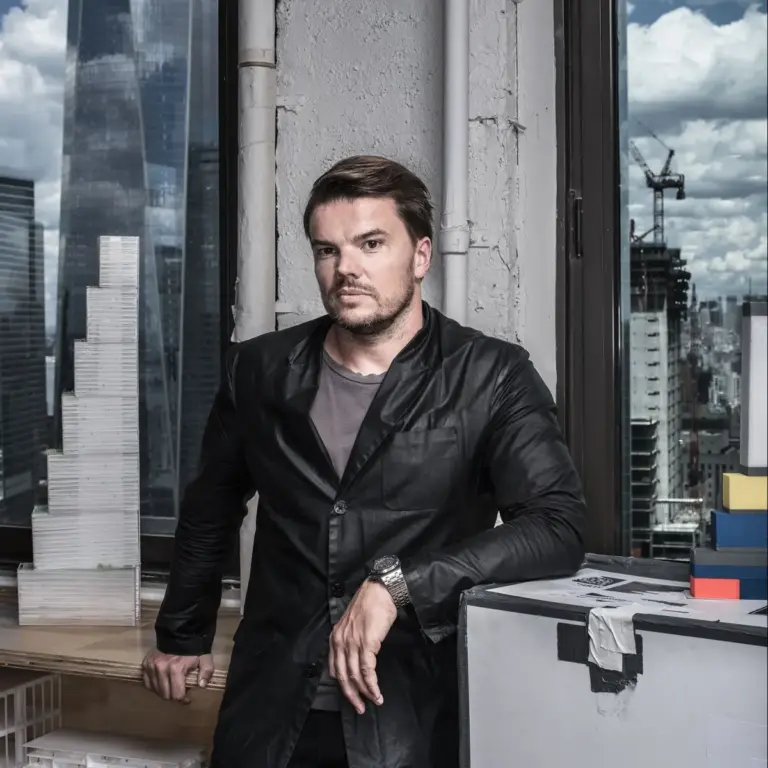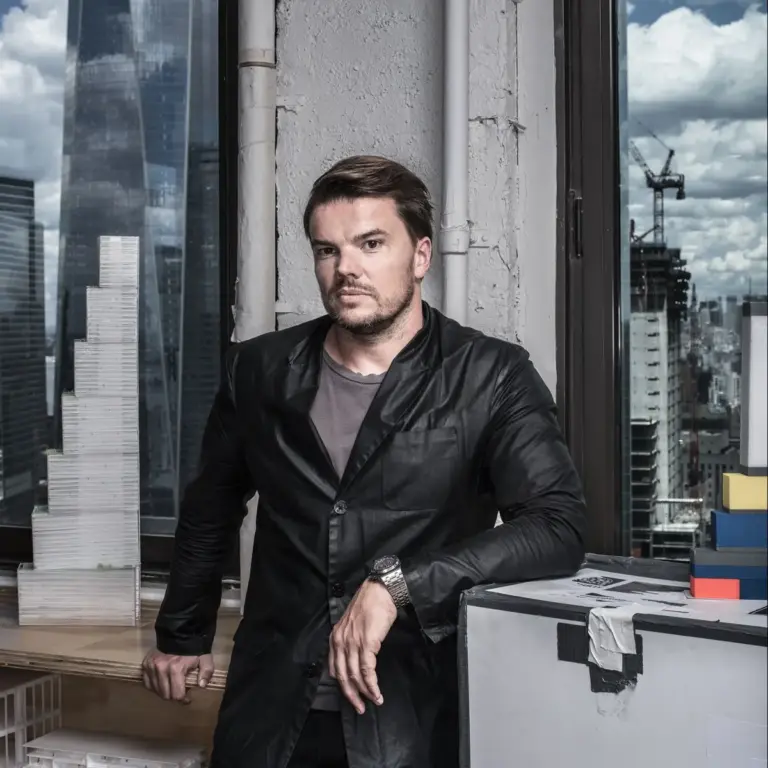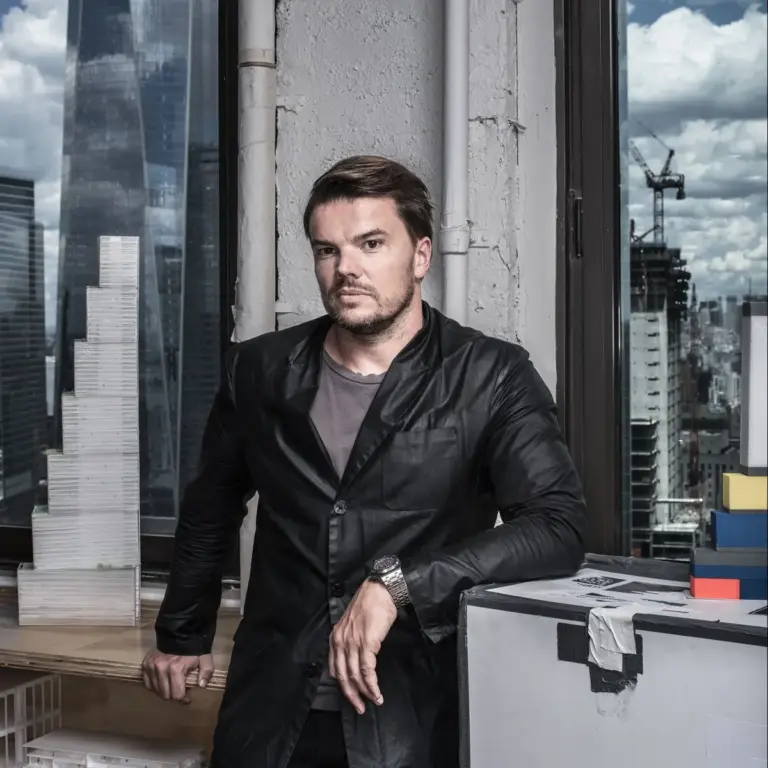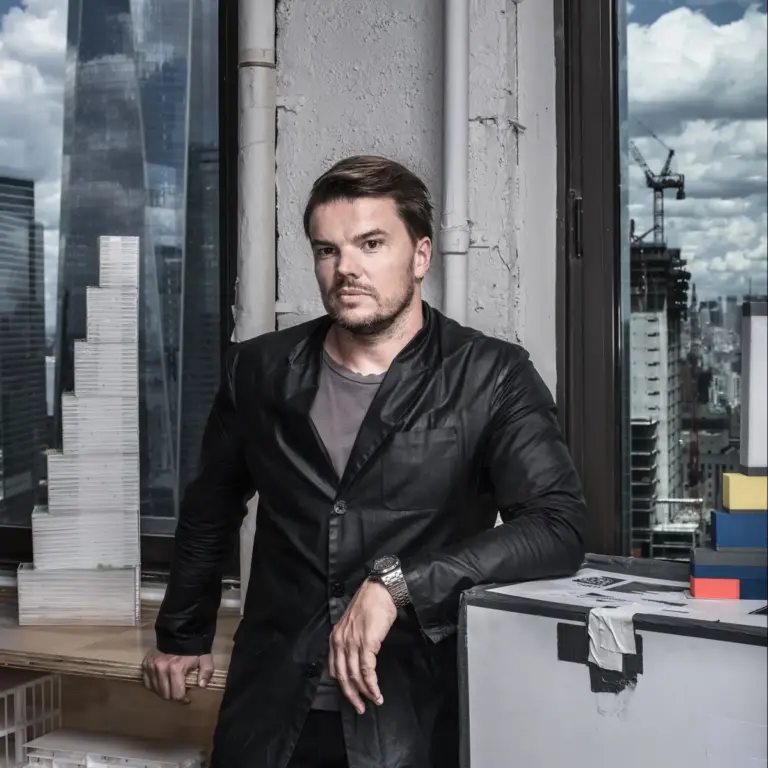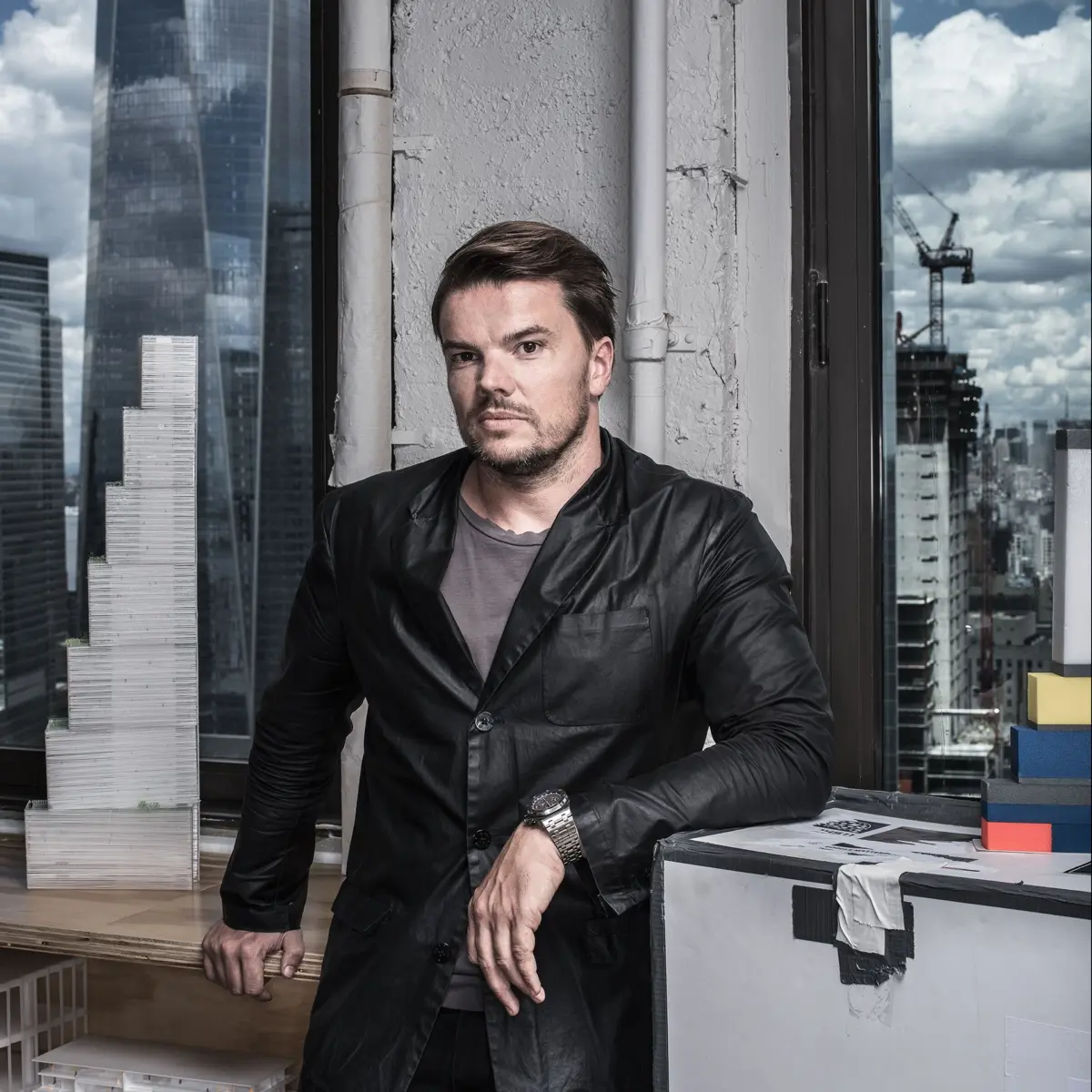
On a misty April morning, Danish architect Bjarke Ingels stands on the roof of an old brick building high above a cobblestoned street in Lower Manhattan, the collar of his black coat rakishly popped. The 40-year-old architect is filming a promotional video for the most significant commission of his career thus far: his design for the skyscraper known as Two World Trade Center.
At this stage, the project remains a work in progress. His primary client, media magnate Rupert Murdoch, has yet to officially sign off on the design. Yet, Ingels does not let doubt interfere with his ambitious introduction. He has obsessed over every line and image, instructing his director to capture visuals that will make viewers swoon. At the time of the shoot, Murdoch’s plan to relocate his corporate empire is one of the worst-kept secrets in New York real estate, but Ingels can barely contain his excitement, eager to signal a monumental shift in the city’s architectural identity.
Between takes, Ingels gestures toward an open void in the densely packed Manhattan skyline, tracing the profile of a skyscraper that, for the moment, exists only in his imagination. From this vantage point, his design resembles a stack of seven distinct blocks, ascending like a staircase toward One World Trade Center, its monolithic neighbor.

"In a way, it is almost like a physical manifestation of the spirit of America," Ingels says. "Out of many, one."
If completed, the tower will stand among the tallest buildings in New York City and serve as the final addition to the master plan for the redeveloped World Trade Center site. The completed ensemble will ring two cascading pools that honor the roughly 3,000 people who died in the terrorist attacks of September 11, 2001. Ingels, however, remains focused on the future rather than the past. "The memorial is about the memorial," he explains. "The tower should be about the living city."
Eclecticism on Demand
Ingels often describes architecture as "the art of turning fiction into fact." He possesses a rare combination of talents—draftsman, salesman, and a charismatic cultivator of his own professional brand—but his greatest asset is a remarkable gift for storytelling. He excels at constructing compelling narratives around hard practical necessities, even when his designs lean toward the fantastical.

Among his global portfolio is a waste-to-energy plant in Copenhagen featuring a slanted roof that doubles as a recreational ski slope, complete with a smokestack designed to puff a symbolic ring of carbon dioxide each time the plant emits a ton of greenhouse gases. For a proposed expansion of Google’s campus in Mountain View, California, Ingels collaborated with designer Thomas Heatherwick to envision an elaborate complex of geodesic domes, proposing a lifestyle of biking, hiking, and coding beneath a sunlit glass terrarium.
Such imaginative flights have made Ingels internationally famous and highly sought-after at an age considered remarkably young by the rigorous standards of the architecture profession. Yet fame can be deceptive in his line of work. As Ingels notes, an architect’s completed structures—much like the light of a distant star—only reach the public eye after a lengthy, years-long journey.
His largest completed project in New York at the time, a striking pyramidal apartment building along Manhattan’s West Side Highway at 57th Street, is roughly one-third the scale of Two World Trade Center. "At the moment we are working seriously on one of the most daunting buildings in downtown New York," Ingels acknowledges, "we still haven’t completed a skyscraper."

With Two World Trade Center, Ingels believes he has devised a way to reinvent the high-rise work environment, turning a building type that is fundamentally vertical and hierarchical into a structure that promotes horizontal interaction. Now comes the laborious task of proving he can transform that captivating narrative into reality.
To realize the design, Ingels must continually validate its value to a pair of demanding octogenarians: Murdoch and Larry Silverstein, the veteran developer who controls much of the World Trade Center rebuilding effort. Before the $4 billion skyscraper can be financed, Murdoch and Silverstein must finalize a long-term lease.
"There’s a lot of drama with the deal right now," Ingels admits on the day of the shoot. "I don’t know how worried I should be."

Even if the parties reach an agreement, numerous other hurdles remain: a volatile commercial real estate market, the political sensitivities inherent in building on a site of national tragedy, and a lumbering government bureaucracy embodied by the Port Authority of New York and New Jersey, which owns the underlying land.
For 14 years, these complicating factors have kept the redevelopment process lurching forward unpredictably, derailing many architectural ambitions. In fact, Ingels’ design displaced an earlier concept by renowned architect Lord Norman Foster. To avoid a similar fate, Ingels must balance the conflicting demands of Murdoch and Silverstein while managing a growing roster of high-profile international clients.
Overcoming Inertia and Structural Realities
The first major hurdle Ingels had to clear at the World Trade Center was institutional inertia. Silverstein initially favored Foster’s existing design and expressed deep skepticism regarding Ingels’ early drawings, worrying that the stacked structure would appear asymmetrical or precarious from certain angles.

The developer nearly walked away from the proposal altogether until key endorsements from the architects of other World Trade Center buildings shifted his perspective. Shortly after, Ingels learned that Rupert Murdoch himself wanted to review the latest iterations of the design.
During a high-stakes meeting in a conference room overlooking the site, Ingels faced rapid-fire questioning from Murdoch. "It’s almost sort of like kangaroo boxing," Ingels recalls. Murdoch’s chief concern centered on basic structural safety: why didn’t the building look like it would fall over?
With assistance from David Childs, the architect of One World Trade Center, Ingels explained that the leaning effect was an optical illusion. The unorthodox stepped form resulted from placing the structural core off-center, creating expansive interior spaces for newsrooms, outdoor terraces, and sweeping views of the plaza for Fox News studios. The explanation won Murdoch over.

"Before you get that story, most people suspect that it’s all just follies," Ingels says. "The more blatantly the architect can explain why things are the way they are, the better."
Ingels also found a vital ally in James Murdoch, Rupert’s son and corporate heir apparent. As the driving force behind the relocation of 21st Century Fox and News Corp. from an aging facility near Rockefeller Center, James sought an open, loft-like creative workplace rather than a traditional corporate tower. Ultimately, the search led them to the World Trade Center and to Ingels. "We were struck by what a great problem solver he was," James notes. "This is someone who can take a set of constraints and create something surprising and effective out of them."
However, working within the remnants of Foster’s previously laid foundation—constructed to accommodate an underground transportation hub—presented severe engineering complications. Furthermore, New York Police Department security standards mandated that all facades at the World Trade Center utilize heavy laminated safety glass to protect against potential explosions, erasing initial cost-saving measures and driving up the estimated budget.

As Silverstein and Murdoch navigated tense lease negotiations, any departure from standard architectural formulas threatened to derail the project entirely. "Right now," Ingels remarks during the peak of negotiations, "the architecture is essentially held hostage."
Navigating the Realities of Urban Development
Despite ongoing structural adjustments and budgetary pressures, Ingels managed to steer the design through its most precarious phases, retaining the core identity of his stepped concept. While the journey involved compromises, including modifications to the building’s height and structural supports, the project steadily gained momentum.
The challenges underscore a broader truth of the profession: architects must learn to navigate the complex interplay of economics, public policy, and corporate interests. Reflecting on his rapid ascent, Ingels maintains his philosophical outlook on setbacks. Referencing an evolutionary metaphor, he compares design obstacles to moments when an animal is forced to find a new route or explore uncharted territory.

"In architecture, sometimes the eureka moment is actually when you give up a stance and say, OK, we have to try something else," Ingels says.
With several major urban initiatives underway—including the Dryline flood defense system in Manhattan and master planning for the Smithsonian in Washington, D.C.—Ingels and his firm, BIG, continue to expand their global footprint. Yet, as the firm scales its operations and takes on increasingly massive commissions, the core challenge remains balancing boundless architectural imagination with the unyielding realities of the built environment.
Standing in his firm’s new offices overlooking the Manhattan skyline and the World Trade Center site, Ingels reflects on the journey ahead. With a tentative agreement in place and the project moving steadily toward reality, he remains characteristically optimistic about the impact of his work on the city he has chosen to reshape.