The world of architecture was once brimming with radical ideas, daring experimentation, and cutting-edge design meant to reshape human society for the better. Today, however, the industry appears to be caught in a loop of safe, homogeneous projects that capture top accolades not for their daring vision, but for checking the right boxes. As architectural awards increasingly honor routine developments, observers are left asking a pressing question: are these conventional projects that now sweep award ceremonies a sign of the times, or a symptom of an industry that has completely lost its imagination?
The Royal Institute of British Architects (RIBA) Stirling Prize, widely regarded as the United Kingdom’s highest honor for building of the year, has long faced scrutiny. While critics once dismissed the gala as a mere moment for auto-erotic self-congratulation among industry elites, recent winners suggest a reality far worse—an unmistakable sign that the architectural profession has exhausted its last shred of true creativity.
Excitement in modern architecture has largely become tangential. Instead of celebrating groundbreaking structural feats or visionary urban concepts, prizes like the Stirling Prize have devolved into virtue-signalling exercises. They are awarded not for peerless design, but for creations that judges want to signal to the wider world as "Good Things."
Last year, the prize went to housing designed specifically for the elderly, namely the Appleby Blue Almshouse. The year before that, the spotlight fell on public infrastructure with London’s Elizabeth Line. Yet, even when judged on these well-meaning social terms, there is a distinct lack of lasting substance.
The Elizabeth Line, which stands as the most expensive completed public-infrastructure project in British history, already shows signs of heavy wear and tear. Because the architects opted for a porous cladding material that proved fundamentally impossible to repair properly, Transport for London has been left to patch up the deteriorating surfaces with faux-concrete-effect stickers. Yet, architectural judges have been more than happy to overlook this glaring dereliction of duty toward the public purse, seemingly willing to sacrifice practical longevity to cleanse their collective professional conscience.
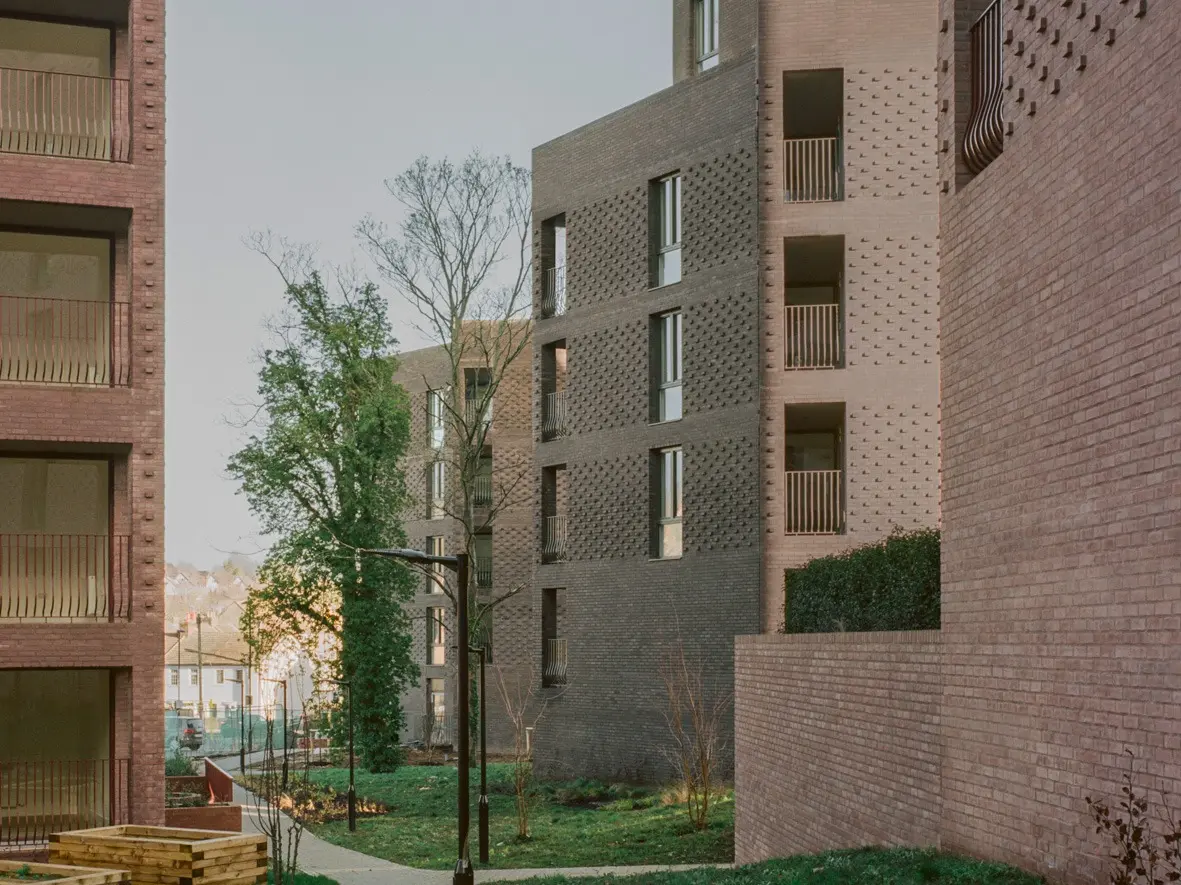
This year, the trend continued as the prestigious award was handed to Lion Green Road, a residential development designed by Mary Duggan Architects in collaboration with Ruff Architects. In bestowing the honor, the judges lauded the project for addressing the pressing need for national housing. In doing so, they conveniently ignored a fundamental reality: virtually any new social housing project, entirely regardless of its actual architectural merit, addresses the housing shortage simply by definition.
Architects have long flattered themselves with the idea that they might single-handedly solve complex societal crises like housing shortages through design. Throughout modern history, the architectural discipline has accumulated a centuries-spanning pile of theoretical ideas aimed at socially re-engineering the nuclear family, ranging from modular construction systems to ambitious self-built housing communities.
Yet, the grand contribution of this year’s Stirling Prize winner to this vast intellectual lineage boils down to a "considered arrangement" of blocks. The project was officially cited by the judges for its "generous daylight," "open views," and direct "connection to nature."
Anyone familiar with the history of the built environment might notice that this description sounds an awful lot like Le Corbusier’s "essential joys" of modernist urbanism: sun, space, and greenery. The last time these concepts represented truly radical propositions was when they were first formulated approximately 90 years ago. Even the supposedly "sculpted," angled facade of Lion Green Road feels like a less-than-coincidental echo of Frederick Gibberd’s The Lawn, recognized as the United Kingdom’s very first residential tower, which was completed back in 1951. If this is genuinely held up as the absolute best of the best that contemporary designers can offer, it stands as an implicit admission that 21st-century architecture is permanently stuck on rinse and repeat.
Fortunately, the general public can still rely on common sense to pop the self-satisfied bubble of the architectural elite. Reacting to this year’s award announcement, one member of the public bluntly asked a question that resonated widely: "Am I missing the point? How is this any different from any new beige housing in London?"
The disconnect between elite juries and the public has tangible consequences. The fact that the BBC has long since given up on televising the Stirling Prize ceremony due to consistently poor television ratings means that another vital opportunity for architecture to sit at the forefront of broader public conversation has gone down the drain. Handing the top prize to Lion Green Road represents yet another missed opportunity to engage ordinary citizens in a meaningful dialogue about the spaces where they live. But surely, RIBA will continue to explain why everyone should feel genuinely thrilled about brickwork executed in three subtle shades of brown.