If you spend time around children under the age of 12, you may have recently heard them repeatedly chanting the phrase "Tung tung tung sahur" around the home or on school playgrounds. For many parents and guardians, asking what the phrase means leads down an unexpected and deeply bizarre internet rabbit hole. Yet, behind this viral playground obsession lies a landmark legal dispute currently unfolding in a California federal court—one that could fundamentally redefine intellectual property law and the legal protections afforded to artificial intelligence creations.
The viral phenomenon responsible for this cultural wave is known across digital spaces as "Italian brain rot." Having emerged in early 2025, the surreal trend quickly took over social media platforms, online gaming communities, and physical spaces worldwide. The subculture centers on absurd, AI-generated characters that pair bizarre, mismatched visual concepts with distinct, Italian-sounding names.
Despite their nonsensical origins, these characters have rapidly evolved from ephemeral internet jokes into a multi-million-dollar global business encompassing merchandise, trading cards, physical toys, video game integrations, and high-stakes courtroom litigation.
The Nonsensical Universe of ‘Italian Brain Rot’
To understand the legal controversy, one must first grasp the visual and thematic world of the Italian brain rot subculture. The characters defined by this trend are surreal, hyper-specific mashups of entirely unrelated objects, animals, and pop-culture elements, almost exclusively produced using text-to-image generative AI tools.
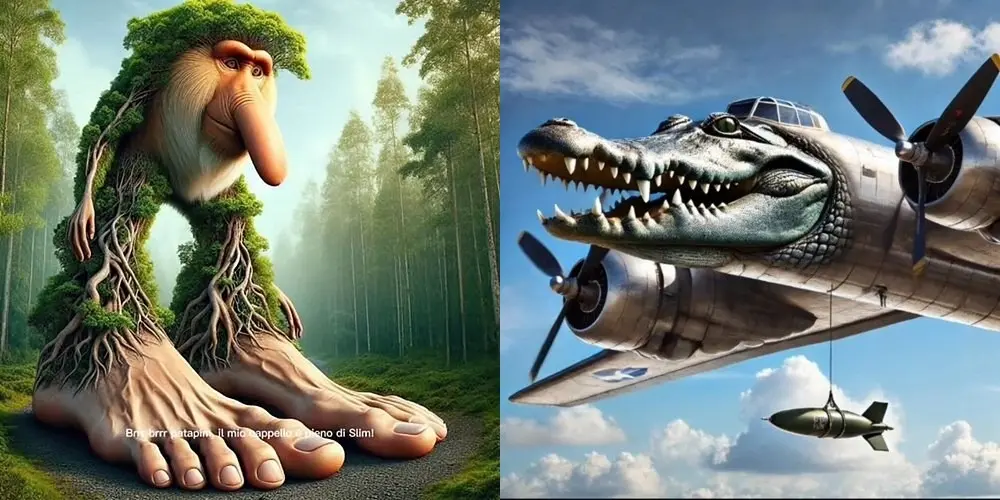
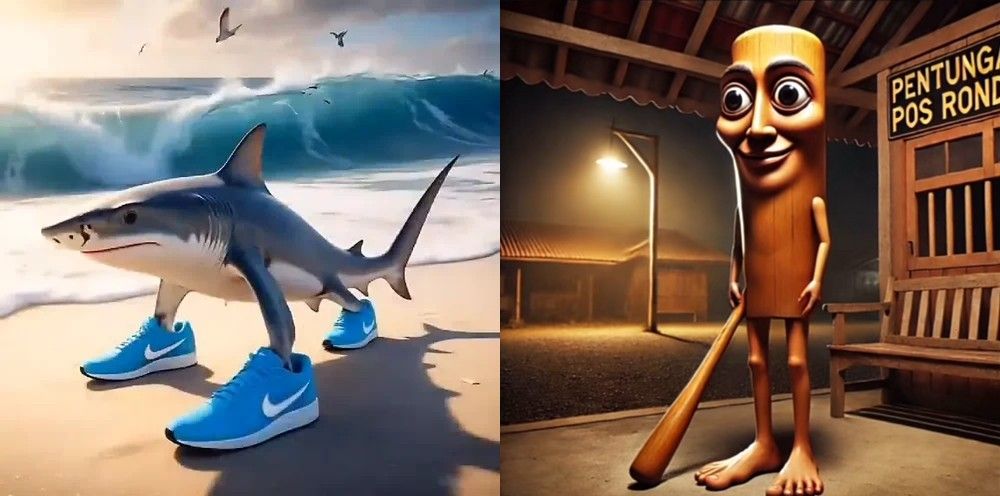
Among the most recognizable figures in this viral pantheon is Ballerina Cappuccina, an elegant dancer who features a steaming coffee cup in place of a human head. Another staple is Tralalero Tralala, a surreal three-legged shark sporting blue Nike trainers on its feet as it stands upon a sandy beach. The trend also features military-themed hybrids like Bombardiro Crocodilo, a creature combining the head and upper body of a crocodile with the fuselage of a wartime bomber aircraft, and Brr Brr Patapim, a moss-covered tree trunk endowed with giant human feet and the distinctive face of a long-nosed monkey set deep within a forest.
While the imagery is unapologetically absurd, the commercial footprint of Italian brain rot is anything but trivial. What began as low-fidelity AI images shared on social feeds quickly transformed into physical trading card sets, an official Panini sticker album, line extensions of physical toys, and digital avatar integrations in mainstream gaming platforms like Fortnite.
However, nowhere has the trend
found a more lucrative home than on the user-generated gaming platform Roblox, where a game titled Steal a Brainrot became an instant multiplayer hit, allowing players to collect and trade virtual versions of these absurd digital entities.
The Story Behind Tung Tung Tung Sahur
At the absolute center of the legal conflict is one of the movement’s flagship characters: Tung Tung Tung Sahur.
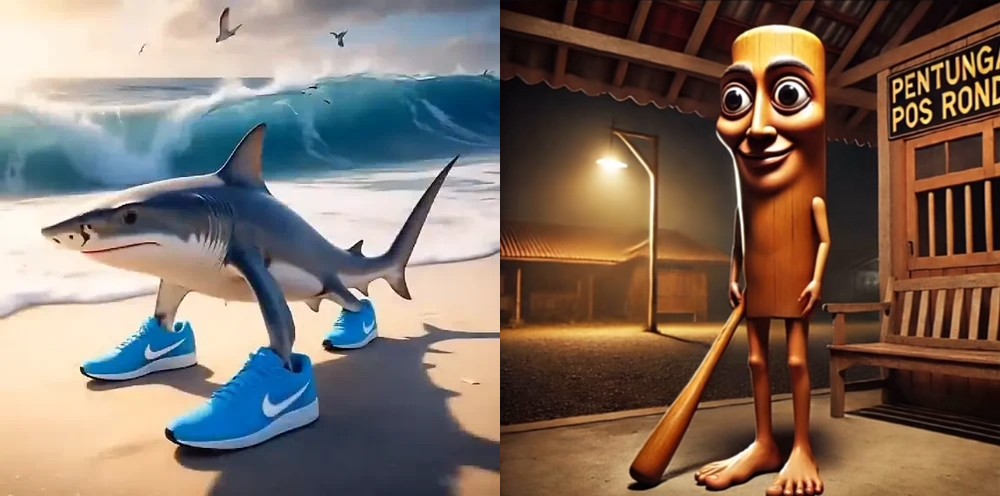
Visually, Tung Tung Tung Sahur appears as a grinning wooden figure set upon human legs, holding a baseball-style bat. Despite its surreal presentation and whimsical Italian-style naming convention, the visual concept draws directly from established cultural traditions in Southeast Asia. The character is an anthropomorphic rendering of the kentongan—a traditional slotted wooden drum beaten across villages in Indonesia and neighboring regions to wake Muslim residents for sahur, the pre-dawn meal consumed before fasting during the holy month of Ramadan.
The character was brought into existence by an Indonesian teenager who goes by the online moniker Noxa. Using OpenAI’s generative image tools, Noxa crafted the digital figure in roughly 15 minutes through a series of seven text prompts, starting with the simple direction to "draw a pentungan sahur with a face and legs."
After Noxa’s visual creation spread virally across global online channels, the young creator was signed by Mementum, a French talent and brand management agency specializing in internet trends and digital intellectual property. Mementum quickly set out to commercialize and aggressively protect the image rights associated with Noxa’s viral hit.
The Legal Clash: Do Big Studios v. Mementum
The commercial battle over Tung Tung Tung Sahur escalated into formal legal warfare in September 2025. Mementum issued a formal cease-and-desist demand to Do Big Studios, the development firm behind the popular Roblox title Steal a Brainrot, alleging that the game was improperly monetizing and exploiting Noxa’s copyrighted character design.
In response to the threat of litigation, Do Big Studios initially complied by removing Tung Tung Tung Sahur from the game. The studio subsequently entered into licensing negotiations with Mementum in an effort to reach an out-of-court financial settlement. However, when those business discussions broke down without an agreement, Do Big Studios took proactive legal action.
Rather than waiting to be sued for copyright infringement, Do Big Studios filed a lawsuit against Mementum in a California federal court, seeking a declaratory judgment that Mementum holds no enforceable copyright over Tung Tung Tung Sahur.
The core argument advanced by Do Big Studios rests on established principles of United States copyright law. Under current statutes and legal precedent in the U.S., copyright protection is explicitly restricted to original works created by human authors. Non-human entities, algorithms, and automated processes cannot hold copyright ownership.
This principle was reinforced in a comprehensive 2025 report published by the U.S. Copyright Office, which affirmed that purely AI-generated materials are ineligible for copyright registration. However, the U.S. Copyright Office noted an important caveat: works containing a combination of AI outputs and human guidance could potentially qualify for legal protection, provided there is "sufficient human creative input." Because the law does not set a firm numerical threshold for what constitutes sufficient input, the Copyright Office emphasized that such determinations must be evaluated on a case-by-case basis.
This grey area lies at the heart of the litigation between Do Big Studios and Mementum. Do Big Studios contends that a 15-minute process involving just seven text prompts—starting with a basic instruction like "draw a pentungan sahur with a face and legs"—fails to meet the legal standard for meaningful human authorship. Mementum, conversely, argues that the conceptual framing, iterative prompting, and creative direction supplied by Noxa represent genuine creative input worthy of legal protection.
Why it matters
The legal determination made by the California federal court in the case of Tung Tung Tung Sahur carries profound implications that extend far beyond teenage internet subcultures and Roblox games. The ruling stands to set a major legal precedent for creative agencies, digital designers, commercial brands, and freelancers who increasingly incorporate generative AI tools into their professional workflows.
If the court rules in favor of Do Big Studios—concluding that a short series of text prompts does not provide enough human creative input to secure copyright protection—the decision could expose commercial work reliant on generative AI to widespread copying.
For instance, if a design firm or freelance creator uses generative AI tools to rapidly produce logos, brand mascots, or marketing illustrations for a corporate client, those assets might be deemed legally unprotectable under U.S. law. In such a scenario, competing companies could freely duplicate, distribute, or modify the brand’s assets without facing legal consequences, severely undermining the commercial value of AI-assisted creative services.
Conversely, if the court rules in favor of Mementum—establishing that a handful of text prompts and minor iterative adjustments are sufficient to claim original copyright—it could dramatically reshape the economics of the creative industries. Clients and businesses might question the necessity of hiring human designers, illustrators, and agency teams for labor-intensive, hand-crafted visual assets if an individual can secure full, legally enforceable copyright protection in a matter of minutes simply by entering prompts into an AI generator.
Regardless of which party ultimately prevails in court, the suit over a viral wooden drum figure holding a bat ensures that an entire industry of creative professionals, corporate attorneys, and technology developers will be closely monitoring the outcome in California.