A remarkably rare, UFO-shaped Futuro house nestled among the pine trees and granite outcrops of Idyllwild, California, has officially been listed for sale with an asking price of $1.495 million. Designed by the visionary Finnish architect Matti Suuronen during the height of the Space Age, the striking, elliptical dwelling stands as a physical manifestation of a late-1960s utopian dream. It represents an era when rapid advancements in synthetic materials, prefabrication techniques, and the global fascination with space exploration promised entirely new, highly mobile ways of inhabiting remote and challenging landscapes.
Today, with fewer than 100 original Futuro units ever manufactured worldwide, this surviving example—known locally as the Donaldson Futuro—offers architecture enthusiasts and historic preservation collectors a rare opportunity to acquire a certified piece of radical design history. Listed through Desert Sotheby’s International Realty, the property is currently owned by historic preservationist Milford Wayne Donaldson, a former Obama administration appointee, alongside his wife, Laurie Donaldson. Their meticulous stewardship has ensured that the flying saucer-shaped residence retains its authentic 1969 character, earning it a prestigious spot on the National Register of Historic Places.
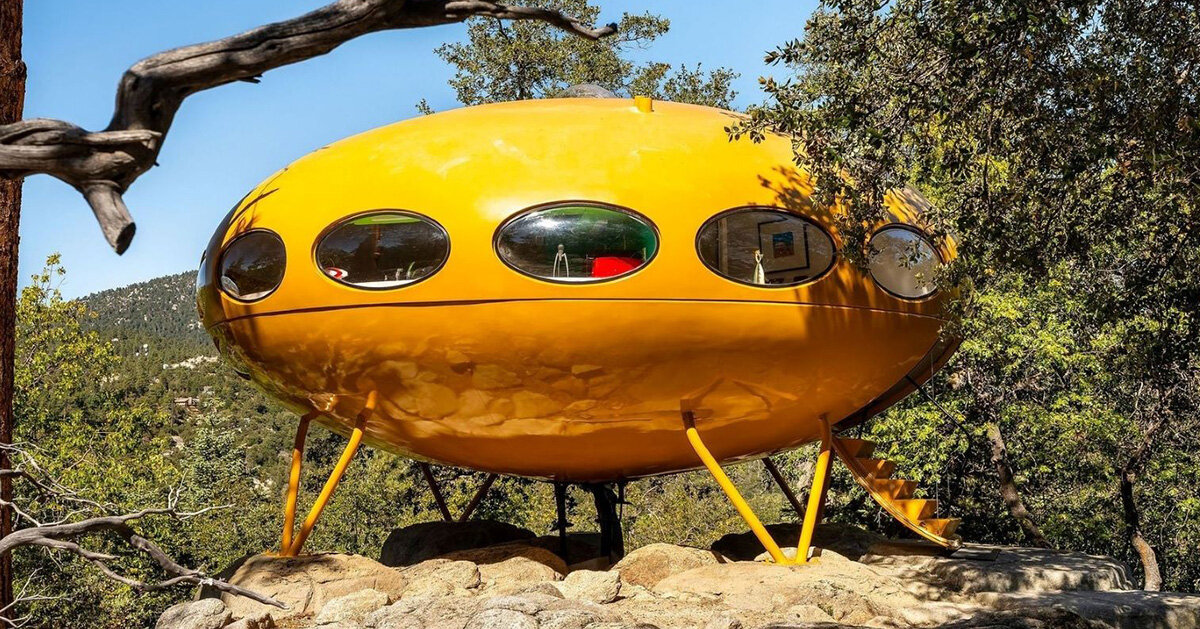
The Matti Suuronen-Designed House Is Designed to Go Anywhere
The conceptual roots of the Futuro trace back to a commission Suuronen received from a friend who wanted a modern, easily heated ski cabin that could be erected quickly on a steep, snowy slope without requiring traditional, heavy foundations. In response, the Finnish architect envisioned a structure that completely broke away from conventional construction paradigms. Rather than building a house piece by piece on-site from the ground up, Suuronen engineered a modular, lightweight dwelling that could be entirely manufactured in a factory, transported in sections, and rapidly bolted together in virtually any remote or rugged environment.
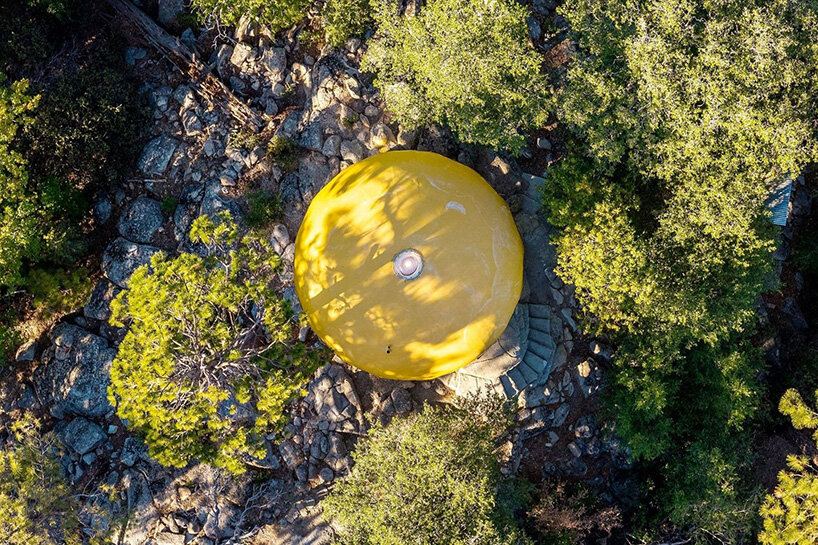
The resulting architectural marvel is constructed primarily from fiberglass-reinforced polyester plastic, a cutting-edge synthetic material of its time, paired with internal polyurethane insulation to provide thermal efficiency in cold climates. Measuring approximately 8 meters in diameter and 4 meters in height, the enclosed structure provides roughly 73.7 square meters of interior living space. Despite its generous proportions for a portable pod, the entire dwelling weighs an astonishingly light 5,398 kilograms.
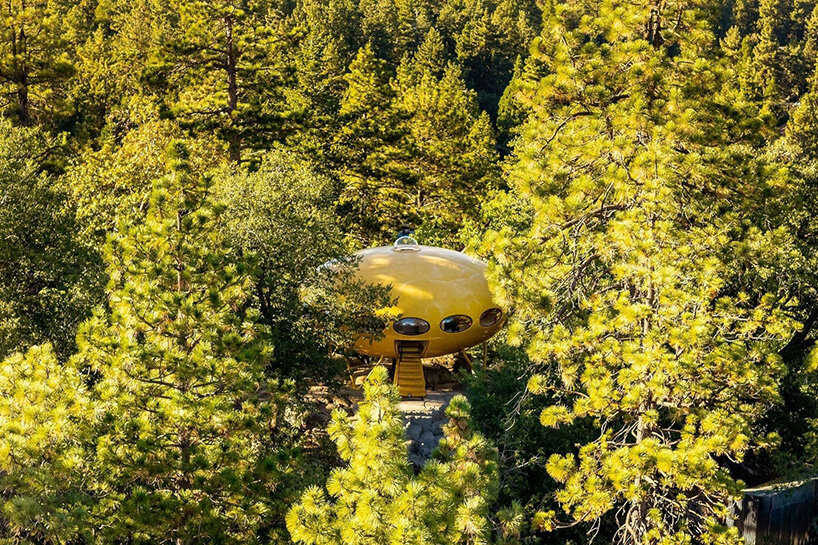
One of the most revolutionary aspects of Suuronen’s original engineering was its foundation requirements. The elliptical shell was designed to rest upon a simple metal ring supported by just four concrete piers. This minimal footprint drastically reduced the environmental disturbance on the landscape, eliminating the need for extensive grading or permanent foundations. Furthermore, the lightweight construction and aerodynamic profile meant the cabin could theoretically be airlifted by a helicopter into virtually inaccessible wilderness areas, embodying a true nomadic philosophy for modern habitation.
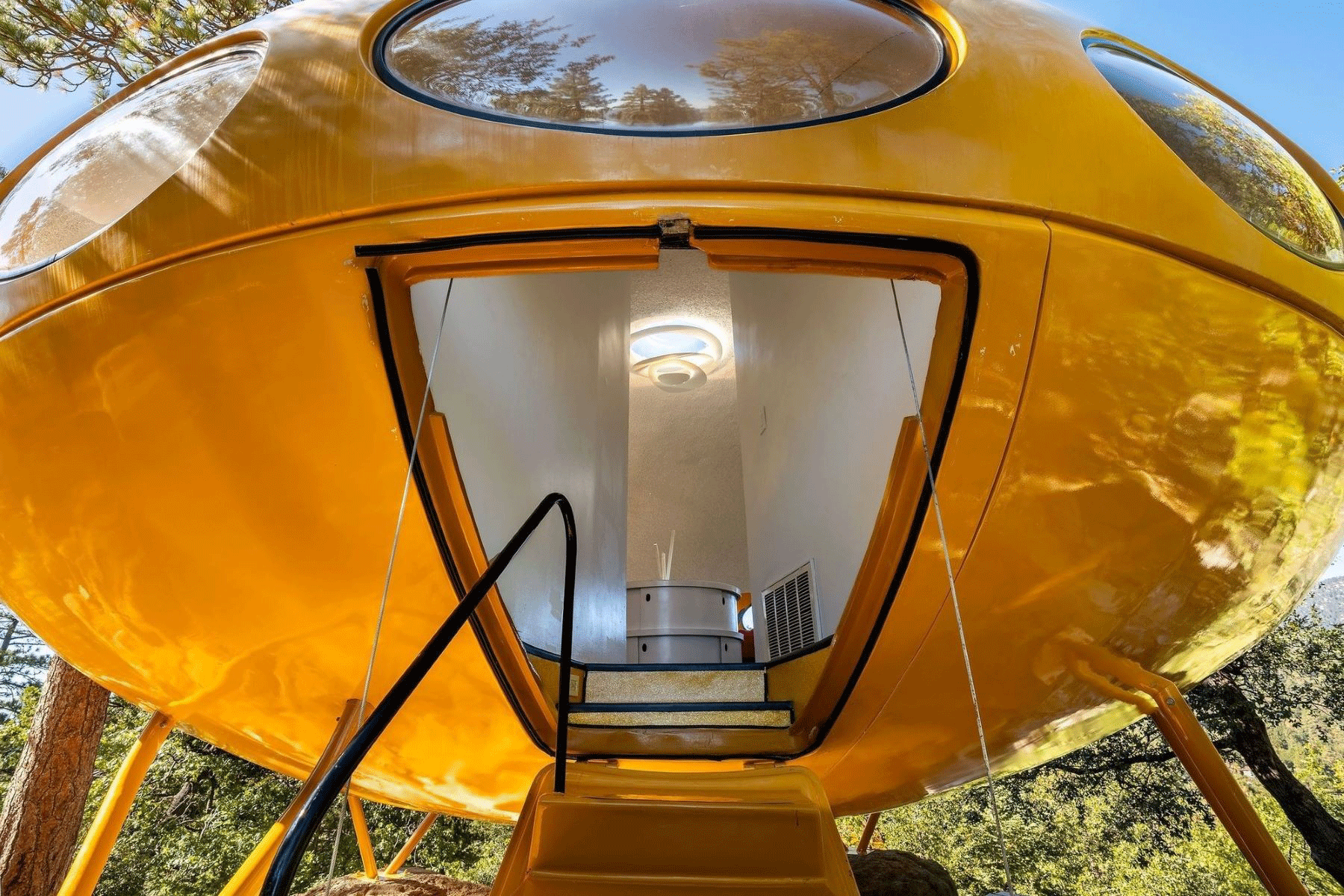
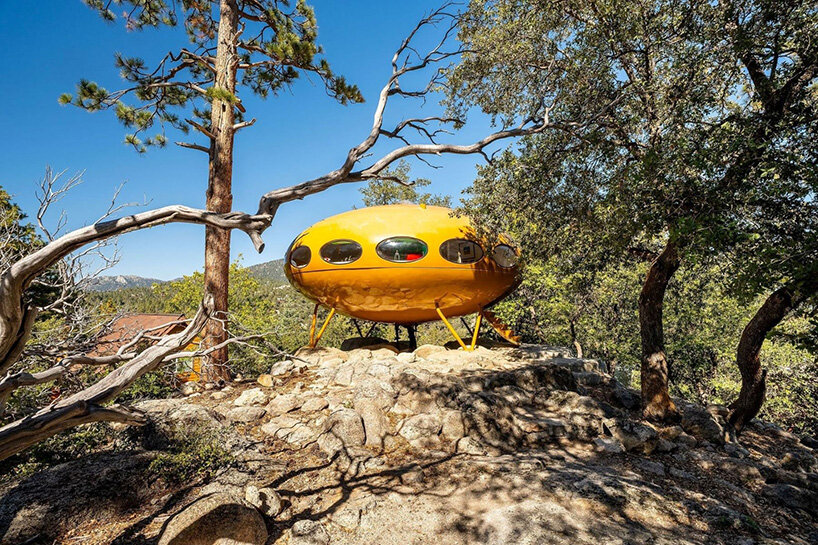
Nestled on a serene 0.23-hectare parcel within the San Jacinto Mountains, the Donaldson Futuro looks as though it has landed gently among the natural granite boulders and towering conifers of Southern California. Its vibrant yellow exterior shell is punctuated by rows of circular, oval windows that harken back to classic science fiction depictions of extraterrestrial spacecraft. An aircraft-style fold-down staircase serves as the primary entrance, reinforcing the whimsical, transportive experience of stepping inside a piece of mid-century futurism.
Why the Futuro Never Became the House of the Future
When the Futuro was first introduced to the public in the late 1960s, it generated an immense amount of media attention and widespread curiosity. It arrived during a period of profound technological optimism, when mass industrial production was widely viewed as the ultimate solution to housing shortages, modern mobility, and changing lifestyles. The promise of the Futuro was intoxicating: a home that could be ordered, delivered, and installed with unprecedented speed, allowing humans to live flexibly across mountains, coastlines, and forests without leaving a permanent scar on the earth.
Despite the initial enthusiasm and visionary momentum, the Futuro ultimately failed to capture a mainstream commercial market. Several significant hurdles conspired against Suuronen’s utopian vision. First and foremost, the radical aesthetics and unconventional plastic construction shocked many traditional neighborhoods. Prospective buyers frequently encountered fierce resistance from local zoning boards and municipal planning departments, which were often governed by strict building codes that had no legal framework for fiberglass UFO houses.
Securing traditional mortgages for an experimental plastic dwelling proved equally difficult for buyers during the era. Compounding these regulatory and financial roadblocks was a major global macroeconomic shock: the 1973 oil crisis. Because the Futuro relied heavily on petroleum-derived synthetic materials, the sudden, sharp spike in oil prices caused production costs to skyrocket overnight. This dealt a fatal blow to the economic viability of mass-producing plastic architecture, cutting the commercial enterprise short after fewer than 100 units had been fabricated across the globe.
What was originally intended to be an accessible, mass-produced housing solution for the masses was abruptly relegated to the status of a rare architectural experiment. Over the decades, many of the original Futuros built worldwide succumbed to neglect, vandalism, or demolition, heightening the cultural and historical value of the few remaining examples that managed to survive.
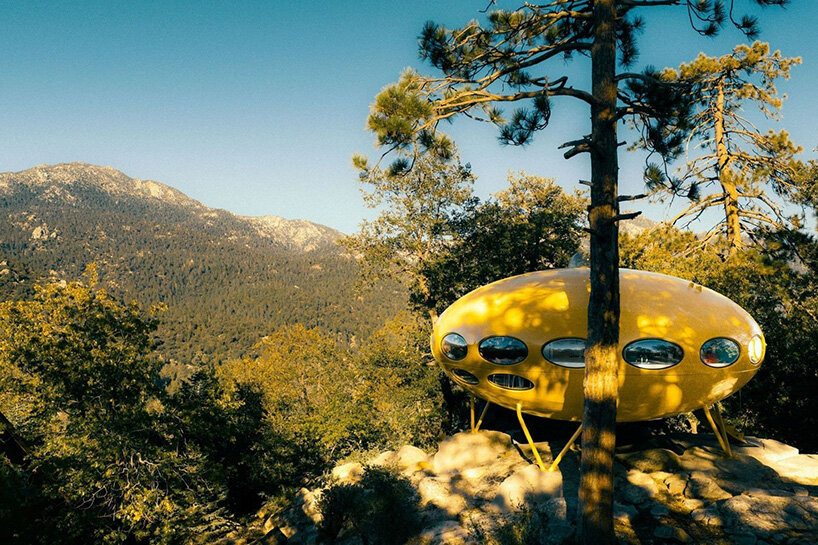
The Donaldson Futuro in Idyllwild stands as a brilliant testament to dedicated historic preservation. Through careful restoration work, the current owners have ensured that the interior and exterior retain the absolute integrity of Suuronen’s original 1969 design, right down to the fidelity of the materials and period-appropriate workmanship. Its official recognition and listing on the National Register of Historic Places cement its importance within the broader narrative of experimental 20th-century residential architecture.
The property’s current listing for $1.5 million highlights a fascinating paradox at the core of the Futuro’s legacy. Conceived more than half a century ago as a mass-produced, highly mobile dwelling meant to democratize access to remote landscapes, it now exists as a heavily guarded, highly sought-after collector’s item. By failing to achieve its original commercial ambitions, the Futuro has paradoxically transcended its initial purpose. Through extreme scarcity, meticulous preservation, and widespread cultural reappraisal, Matti Suuronen’s space-age vision has secured a permanent, revered place in architectural history, offering a rare window into a time when designers boldly imagined that the future of living was just a helicopter ride away.