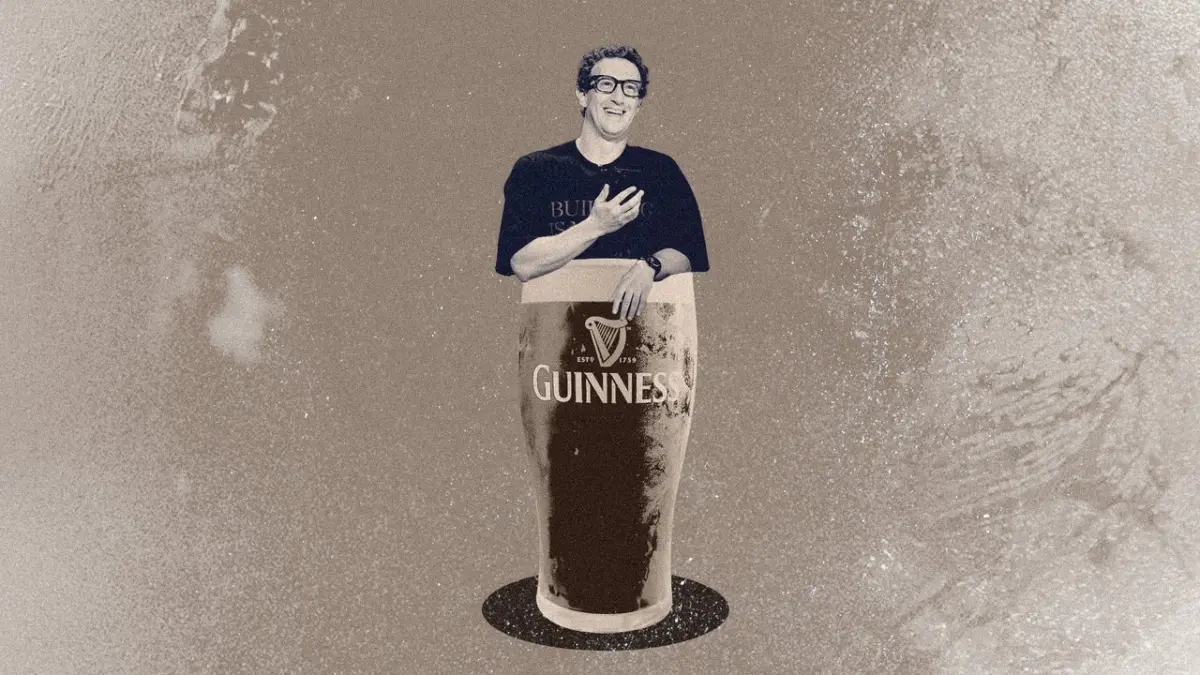
Specifically, a widely shared clip from the Meta founder’s appearance on The Cheeky Pint—a podcast hosted by Stripe cofounder John Collison where guests discuss tech over a beer—captured Zuckerberg’s notably unenthusiastic reaction to the legendary Irish stout. Upon tasting the brew, his facial muscles tightened into an unmistakable wince. As one observer aptly put it, the tech executive looked as though he had just accidentally swallowed the little paper cup of fluoride at the dentist’s office.
The moment was undeniably funny, prompting widespread amusement across social media platforms. But it quickly raised a larger question: Why did the "Guinness Wince" morph into such a massive viral roasting? After all, Zuckerberg is certainly not the first person to discover that the distinct, heavy taste of an authentic dry Irish stout simply is not for everybody.
The answer likely lies in who is holding the glass. As one of the most surreally rich and powerful figures on the planet, Mark Zuckerberg remains effectively cloistered and largely out of reach from the routine frictions, mundane inconveniences, and shared experiences of everyday life. Like his billionaire peers, he largely inhabits spaces that he controls—vast mansions, sprawling estates, private yachts, and private jets. When he does enter the public eye, his appearances are typically carefully choreographed, whether he is testifying during intense congressional hearings, unveiling futuristic product lines at developer conferences, or engaging in highly curated personal hobbies. Meanwhile, Hollywood filmmakers and authors routinely produce movies and books speculating about various phases of his corporate and personal career.
Seeing a master of the corporate universe do something as fundamentally human, unscripted, and vulnerable as wince at an unfamiliar or acquired taste is simply jarring. It breaks the illusion of calculated perfection, reminding the public that even the architects of the modern digital world have ordinary sensory limits and personal preferences.
In a modern media landscape, these rare, unscripted incidents function as a high-stakes litmus test for authenticity and, arguably, even normality. The public is constantly searching for cracks in the carefully managed facades of the global elite, using everyday actions to gauge whether these powerful leaders possess any genuine connection to standard human experiences.
The last similarly high-profile example of this phenomenon occurred when a promotional video surfaced showing McDonald’s CEO Chris Kempczinski gingerly biting into the fast-food chain’s then-new Big Arch burger. Once again, the internet noticed instantly, scrutinizing the bite and widely judging Kempczinski to be a man who clearly did not regularly eat fast food. The corporate world’s competitive nature quickly capitalized on the misstep; rival fast-food giants Burger King and Wendy’s took immediate notice, subsequently releasing videos of their own top executives taking large, ravenous, and enthusiastic burger bites. In doing so, these companies converted the simple physical act of food consumption into a high-profile brand-reputation performance.
Yet, these awkward public food moments do not always read like the actions of confused outsiders or out-of-touch figures. Other tech billionaires have navigated the intersection of corporate image and public consumption in entirely different ways. Elon Musk, true to form, has made his own distinct mark in this genre with displays of excess. During his own appearance on The Cheeky Pint, Musk knocked back three beers with ease, and he previously made history by infamously puffing a blunt during a widely watched interview on Joe Rogan’s podcast.
Similarly, NVIDIA chief Jensen Huang has successfully turned his public food moments into powerful signals of accessibility, down-to-earth charm, and cultural curiosity. Huang has been frequently recorded enjoying Beijing street noodles and Korean fried chicken, and he has even been filmed handing out red bean buns to people on the streets of Tokyo. His culinary forays have become so widely followed by the public and admirers that a dedicated website has even been created solely to track Jensen’s food adventures around the world.
For most corporate tech executives, however, such intense public scrutiny of everyday habits is much more difficult to navigate and requires a constant adjustment. Politicians, for whom performing relatability and apparent normality is a foundational part of the electoral process, learn the tricky mechanics of public consumption early in their careers. They master the art of hoisting a beer with salt-of-the-earth gusto for the cameras, while carefully avoiding infamous campaign gaffes—such as attempting to eat pizza with a fork or being photographed mishandling a county fair corn dog.
Chief executive officers and technology founders, in stark contrast, are traditionally held to an entirely different standard. They are not required to campaign for votes, kiss babies, or routinely rub elbows with the hoi polloi. Consequently, when they are suddenly placed in casual, unscripted scenarios that require them to partake in common cultural rituals, the results can occasionally reveal just how isolated their everyday lives truly are.