A little over a year ago, the design and maker brand HOZO effectively wrote a eulogy for the traditional hobby knife. When the company launched its NeoBlade—a tool relying on ultrasonic vibrations to slice through materials—it came swinging with a bold promise to put an end to blades that snag, skip, or crack delicate 3D-printed models. At the time, coverage of the release even kicked off with headlines declaring the death of the classic craft knife. However, a fascinating plot twist has now emerged from the Hong Kong-based studio. HOZO has just engineered and introduced a brand-new hobby knife of its own, proving that their previous eulogy was less about permanent rest and much more about demonstrating what modern design could achieve when applied to a neglected tool category.
Interestingly, this product was never originally supposed to be part of the company’s roadmap. The team had initially set out simply to expand the blade lineup for the NeoBlade. During that process, designers came across a standard hobby knife available online that appeared exceptionally well-crafted in marketing imagery, prompting them to purchase one to examine up close. Upon arrival, however, the real-world product proved to be a severe letdown, lacking the precision and reliability expected by serious creators. This disappointment served as the unlikely catalyst for an entirely new hardware development cycle, driven by the straightforward internal logic that if a superior tool does not exist on the market, a maker has to build it.
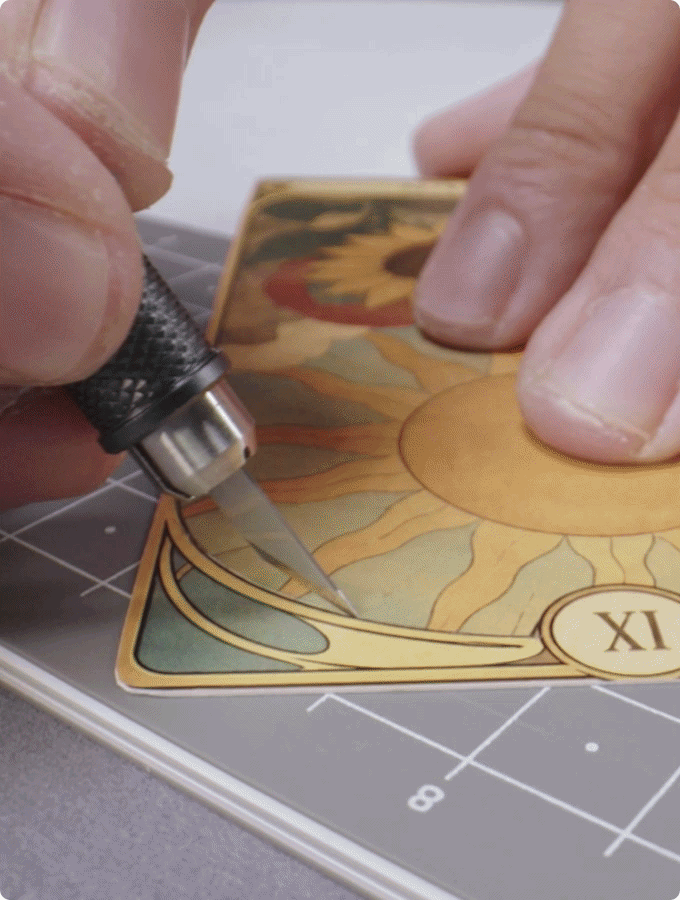
This latest release marks the tenth product from HOZO following a nine-year tenure of designing and manufacturing precision measuring devices, ultrasonic cutters, and detail sanders tailored specifically for the global maker community. Billed as a compact precision craft knife, the new HOZO Hobby Knife introduces a spring-loaded, one-press blade changing mechanism. This innovative system is neatly paired with an innovative carrying case that seamlessly unfolds into a portable cutting mat. The tool inherits six flat blade profiles from the NeoBlade ecosystem while introducing four brand-new specialized attachments. Among these additions, the newly engineered U-Gouge and V-Gouge profiles are fully compatible with both the new hobby knife handle and the original NeoBlade, resulting in a versatile collection of eight interchangeable blades that can be shared across both handles.
HOZO has targeted the tool directly toward a wide demographic of creators, including leatherworkers, cosplayers, paper crafters, Gunpla model builders, and fine jewelers. The genesis of the project—born from purchasing a subpar competitor and deciding to out-engineer it—underscores a pragmatic approach to product development that prioritizes practical utility over novelty.
Examining the physical build of the tool reveals a deliberate focus on ergonomic refinement and functional physics. A traditional round hobby knife handle notoriously rolls off any slanted surface, an everyday annoyance that the maker community has quietly dealt with for generations without seeing a meaningful fix. HOZO addressed this issue by designing the Hobby Knife body from full aluminum with a distinct hexagonal cross-section. By relying purely on geometry rather than a cumbersome pocket clip or an external desk stand, the knife naturally rests flat on any workbench.
The handle features a thoughtfully textured grip zone alongside raised rings positioned directly at the balance point. These tactile elements provide secure registration during long, intricate crafting sessions without making the instrument feel overly engineered or bulky. Measuring 6.3 inches or 160 millimeters in length with the protective blade cap attached, and weighing a mere 26 grams in total, the tool rests comfortably in the hand, feeling much more like a precision technical pen than a conventional utility knife. The material breakdown demonstrates careful selection, incorporating stainless steel at the collet, a durable aluminum alloy throughout the primary body, and a specialized blend of nylon and glass fiber for the activation button. This construction ensures the knife remains remarkably lightweight while retaining structural integrity.
One of the most compelling engineering achievements of the design is its quick-change mechanism. Pressing the spring-loaded button integrated into the body releases the blade in one fluid motion. This eliminates the traditional two-handed process required by standard craft knives, which typically involves a frustrating twisting routine and a high risk of losing grip or cutting oneself. The stainless steel collet features an integrated magnet that securely holds the blade in place. Consequently, pressing the button simply loosens the internal grip rather than forcefully firing the blade out or allowing it to drop free unexpectedly.
HOZO drew inspiration from the familiar, effortless mechanics of a click-action ballpoint pen, a comparison that translates accurately into practical use. The magnetic hold ensures that fine cuts remain entirely free of mechanical play, while the internal spring locks everything firmly into position the moment a new blade seats itself. The entire blade swap process takes under a second, offering a tactile and deliberate user experience far superior to the twist collet systems found on comparable tools in the category.
Versatility is further expanded through the inclusion of ten distinct interchangeable blade types, offering a breadth of utility that the standard No. 11 scalpel system has never truly provided. The six flat blade profiles inherited from the NeoBlade lineup cover standard, long, chisel, mini chisel, curved, and double-edge configurations suitable for paper, leather, film, and soft woods. To these, HOZO has added specialized U-Gouge and V-Gouge attachments, with the former designed for carving smooth, rounded grooves and the latter engineered for creating sharp, defined lines. Furthermore, a fine saw attachment handles tougher materials, while a dedicated metal file refines edges once cutting operations are complete, successfully pushing the instrument beyond simple slicing into genuine finishing work. Because eight of these ten blade options are cross-compatible with the NeoBlade ultrasonic cutter, users can maintain a unified blade drawer that serves both handles instead of managing two separate, incompatible supply piles.
Safety and storage have also been reimagined, addressing areas where hobby knife systems have remained largely stagnant for decades. All blades are forged from quenched 420 stainless steel, making them naturally rust-resistant without requiring protective oil coatings. They are manufactured with rounded, non-cutting ends, which significantly reduces the risk of accidental injury when retrieving them from the auto-feeding dispenser. This dispenser is housed within a translucent casing, allowing creators to check the remaining blade count at a glance rather than resorting to an uncertain shake test.
Additionally, the case incorporates a dedicated disposal slot designed to keep spent blades securely contained rather than rattling loosely at the bottom of a tool bag—a common hazard for anyone who has ever reached into a utility roll and encountered a used point head-on. By treating storage, feeding, and disposal as essential design challenges rather than packaging afterthoughts, HOZO has delivered a uniquely cohesive ecosystem.
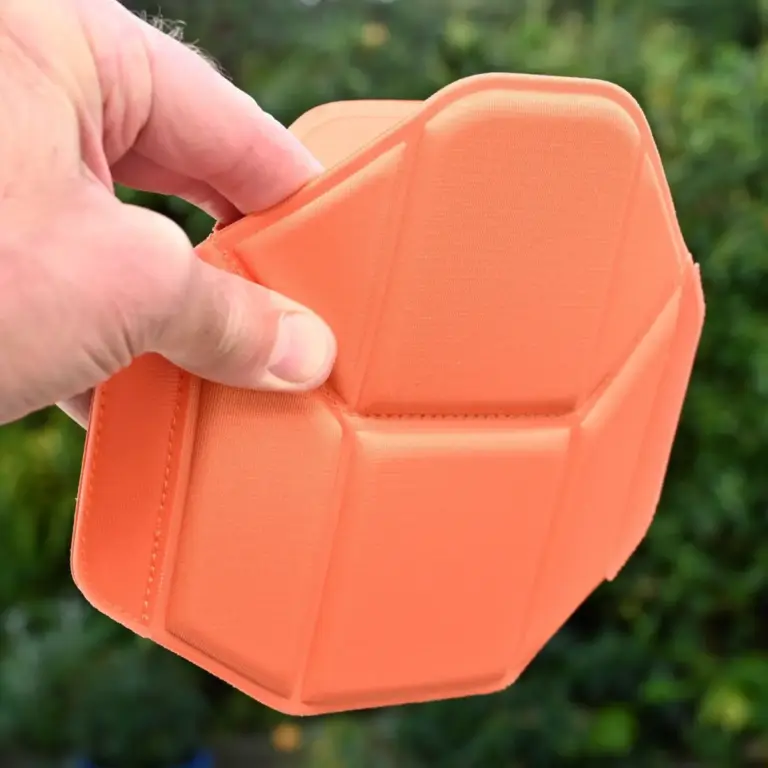
Another standout innovation is the integration of a PVC cutting mat directly into the knife case. This clever feature solves a frequent frustration of portable craft work: arriving at a workspace or a workshop only to realize the cutting mat was left behind. The case folds smoothly through four distinct modes, transitioning from a slim closed carry configuration to a flat open mat, a propped desktop viewing angle, and a fully extended layout that nearly doubles the available working area to 5.2 by 7.6 inches, or 133 by 192 millimeters.
The mat and leather protective case form a single integrated piece, while the aluminum tool body housing the knife and blades attaches magnetically to the assembly. If the cutting surface eventually wears out from heavy use, the pouch and mat can be replaced as a unified unit, with various color options available. For makers engaged in multi-stage workflows, the setup integrates naturally with other tools in HOZO’s ecosystem, such as the NeoSander, which provides 13,000 strokes per minute for post-cutting finishing tasks.
The base HOZO Hobby Knife Set is available via crowdfunding for $59, compared to its standard MSRP of $79, and includes the knife handle, the convertible knife case with an integrated pouch and cutting mat, a starter set of knife blades, and a 10-in-1 blade refill set. For users seeking a more comprehensive kit, the Premium Set is priced at $129 against a $219 MSRP, featuring the complete regular blade set covering blade types one through eight. Individual replacement knife pouches and cutting mats are offered at $15.90 each, while additional blade refill sets run $9.90. For comprehensive tool upgrades, an All-In-Combo bundling the Hobby Knife alongside the NeoSander and NeoBlade is priced at $489, compared to an MSRP of $739. Because the blade system is proprietary to HOZO rather than universally compatible with standard No. 11 blades, ongoing resupply is handled directly through the company’s retail channels, and the compact design of the folding mat is tailored specifically for portability.