Carles Puigdemont will have to reconnect with a Barcelona that looks vastly more fragmented than the one that he left behind when he returns to put the pieces of Catalan independence back together.
After spending almost nine years away from Spain, the president of the Together for Catalonia (Junts) party is eyeing a path back home. Puigdemont had lived under the shadow of an active arrest warrant, risking immediate imprisonment if he ever set foot inside the country. Holed up in Brussels following the dramatic and ultimately failed Catalan independence bid in 2017, he was forced to watch major milestones of his personal life unfold from afar. He could not return when his parents passed away, missing both of their funerals entirely. Last week, however, the Spanish Supreme Court provided a significant turning point when it decided to provisionally lift the warrant against him. Yet, the Catalonia that he left behind in the tumultuous autumn of 2017 is a far cry from the one to which he might soon return.
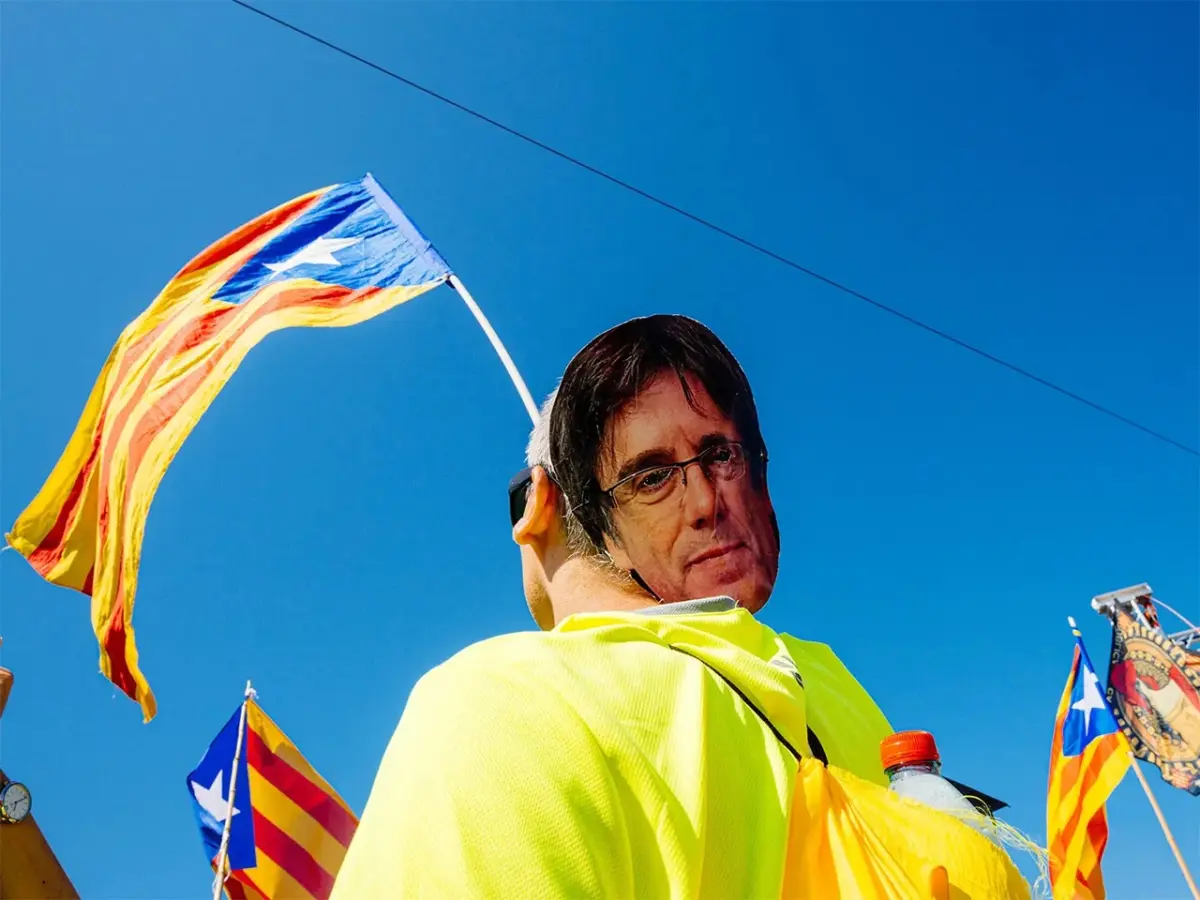
A stroll through downtown Barcelona today offers a stark and immediate glimpse of the region’s profound transformation over the past decade. The Estelada—Catalonia’s iconic starred independence flag, which famously became an ubiquitous fixture on balconies, windows, and public squares in the charged run-up to the 2017 referendum—is simply not as prominent as it once was. Instead of a unified sea of separatist banners, the urban visual landscape has diversified. The rich mix of languages heard on the streets of the Catalan capital reflects a population with increasingly diverse global backgrounds. Today, more than a third of the city’s residents were born abroad, marking a sharp and notable increase from about a fifth in 2016.
These rapid demographic shifts have inevitably put pressure on the Catalan language, which has historically served as a vital cornerstone of the region’s distinct national identity. While children in the region are still compelled to learn and be instructed in Catalan at school, the language can increasingly feel disconnected from the realities of everyday urban life, commerce, and interpersonal communication in an increasingly cosmopolitan metropolis. Of course, Catalonia extends far beyond the borders of its bustling capital. In many of the region’s smaller, more traditional towns and rural communities, symbols of national identity remain prominently displayed and fiercely protected. But even in these traditional heartlands, the feverish fervour for immediate independence appears to have noticeably cooled. Furthermore, Madrid is no longer routinely cast as the existential demon that it once was during the peak years of the constitutional crisis.
The very focus of everyday conversations among ordinary citizens has fundamentally changed as well. Only a few years ago, a casual night out in Barcelona or Girona often led organically to an impassioned discussion with a stranger about the merits, mechanics, and moral imperatives of Catalan independence. As the geopolitical landscape shifted, those conversations later pivoted toward Brexit and the complex parallels—as well as the striking differences—between the Catalan secession movement and the United Kingdom’s departure from the European Union. These days, however, such comparisons and debates rarely arise in casual settings. While the issue of independence has by no means disappeared completely from the political landscape, it seems to have largely lost its dominant place as a staple subject of everyday conversation.
This shift does not mean that local grievances have vanished entirely or that citizens have suddenly grown content with institutional shortcomings. Infrastructure frustrations persist; the notorious Rodalies de Catalunya commuter rail network still suffers from chronic delays, cancellations, and operational failures, and long-standing arguments concerning the exact level of financial investment and resource allocation from Madrid into Catalonia remain entirely unresolved. What has fundamentally changed, however, is the nature of the political and societal response to these frustrations. While these very same institutional failures once helped to draw hundreds of thousands of angry citizens out onto the streets under the unified banner of Catalan self-determination and anti-Madrid sentiment, public discontent today is channeled elsewhere.
A key driver of this shift is the dominance of pressing socio-economic concerns that stretch far beyond abstract questions of political identity or constitutional status. Chief among these are the rising cost of living and soaring rent prices that are pricing locals out of their own neighborhoods. Interestingly, Puigdemont’s party, Junts, recently chose not to back the housing bill put forward by the embattled socialist prime minister, Pedro Sánchez. Such a legislative move hardly suggests a close attunement with the immediate, bread-and-butter concerns of ordinary Catalans who are struggling to pay their monthly rent. Meanwhile, the broader cause for independence itself has become increasingly fractured and internally divided. While Puigdemont might still command the unwavering personal loyalty of committed core supporters, he can no longer rely on the broader independence movement to unite seamlessly behind a single, shared strategic vision.
The former Catalan government leader has yet to officially announce a precise date for his return to Spain. Whenever it happens, his homecoming will likely be less dramatic than his sneaky 2024 appearance in Barcelona, which was characterized by a brief, theatrical public speech followed by a swift and quiet departure before regional and national police forces could catch up with him and execute the arrest warrant. Coming back ahead of the upcoming snap election scheduled for 29 November would undoubtedly provide Junts supporters with a powerful emotional rallying point and energize the party’s base. On the other hand, waiting until after the election might help him to avoid immediate polarization and allow him to reach beyond the party’s traditional confines, helping him reconnect more thoughtfully with a broader Catalan society whose priorities and worldview have fundamentally shifted.
There is little tangible evidence to suggest that Puigdemont’s core political views or his overarching separatist convictions have softened during his nearly nine years in European exile. Consequently, he faces the immense and complex challenge of not only attempting to revive a dormant or fragmented independence movement, but also finding a viable, persuasive place for it within a Catalonia that has fundamentally transformed since 2017. If he is to successfully lead a new chapter for the political cause that defined his career, he will have to demonstrate convincingly how it speaks directly to the lived realities of Catalans today—rather than merely appealing to the abstract ambitions that defined their identity almost a decade ago.