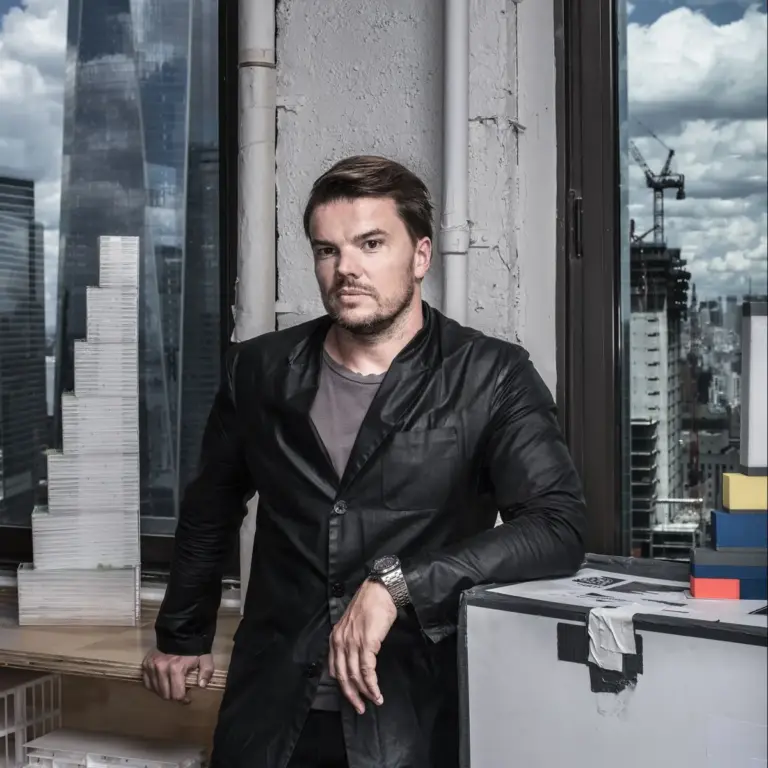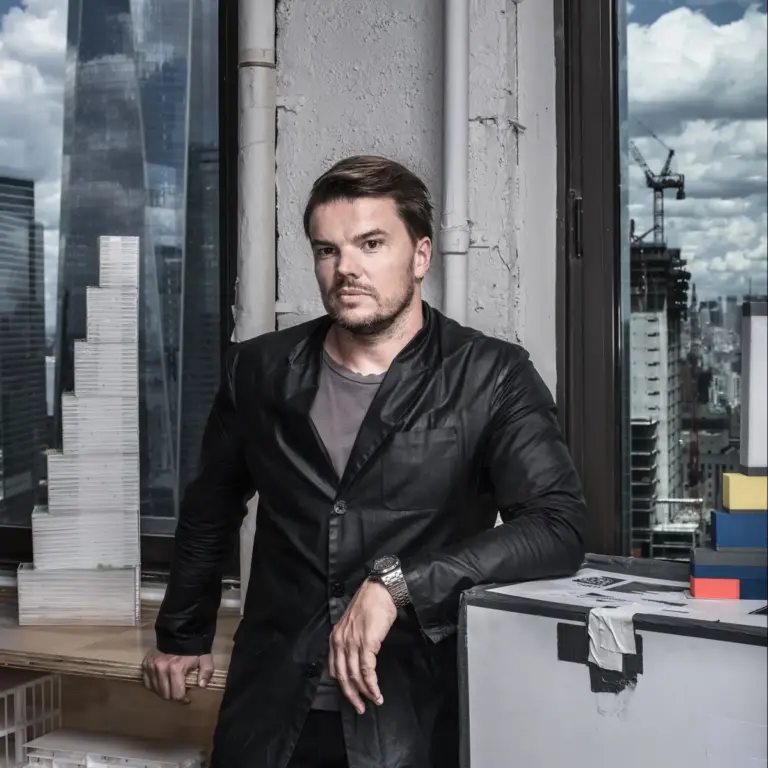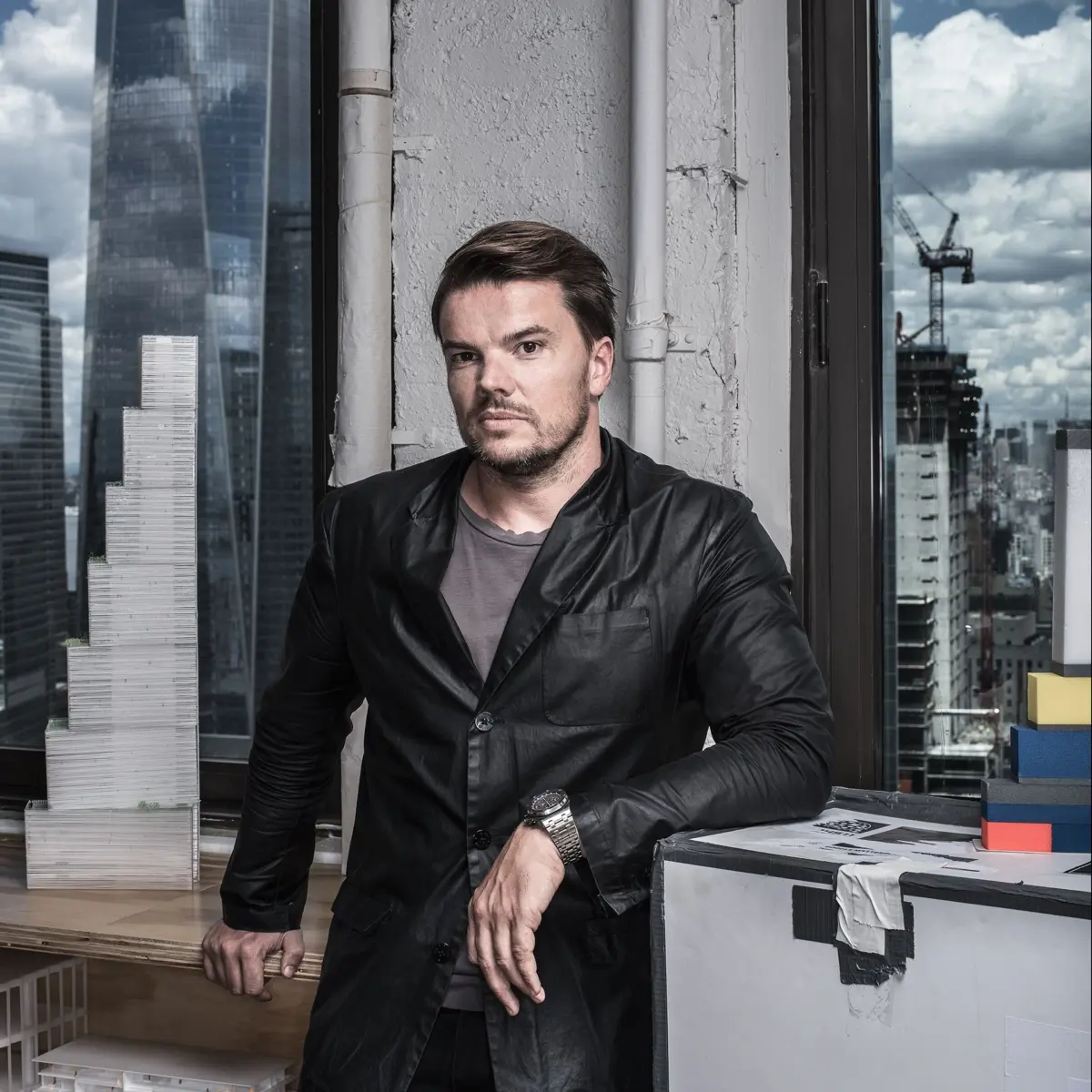
On a misty April day in Lower Manhattan, Danish architect Bjarke Ingels stood on the roof of an old brick building, the collar of his black coat popped against the crisp air. Below him lay cobblestoned streets and, just a short distance away, the sacred and heavily scrutinized grounds of the World Trade Center. Ingels was shooting a promotional film for the most important commission of his young career: his revolutionary design for the skyscraper known as Two World Trade Center.
At the time, the project was still a work in progress. His primary client—the imperious media magnate Rupert Murdoch—had yet to formally sign off on the plans, and Murdoch’s ultimate strategy to relocate his media empire remained one of New York real estate’s tightly guarded secrets. Yet, the hyper-eloquent 40-year-old architect refused to let doubt stand in his way. Having obsessed over every line and image, he told his director that he wanted viewers to swoon. He was ready to shout the news, quite literally, from the rooftops.
Between takes, Ingels pointed toward a void in the densely packed Manhattan skyline, tracing the profile of a skyscraper that, for the moment, existed only in his mind and in his digital renderings. From this perspective, his design resembled a stack of seven offset blocks, ascending like a grand staircase toward One World Trade Center, its monolithic neighbor.
"In a way, it is almost like a physical manifestation of the spirit of America," Ingels reflected. "Out of many, one."
If completed, the tower would stand among the tallest buildings in New York City and serve as the final piece in the master plan for the redeveloped World Trade Center site. The ensemble of structures rings two cascading pools that pay tribute to the roughly 3,000 people who lost their lives in the terrorist attacks of September 11, 2001. But Ingels was not overly preoccupied with the solemn history of the ground below; he wanted to make his own mark on the future. "The memorial is about the memorial," he noted. "The tower should be about the living city."
Ingels is fond of saying that architecture is "the art of turning fiction into fact." He boasts many talents—as a draftsman, a charismatic salesman, and a master cultivator of his own winning public image—but his greatest asset is an undeniable gift for storytelling. He possesses a rare ability to construct a compelling narrative around practical, hard-nosed engineering necessities.

Often, his designs careen in fantastical directions. In Copenhagen, he designed a waste-to-energy plant featuring a slanted roof that doubles as a recreational ski slope, complete with a smokestack engineered to puff a symbolic ring of steam every time it emits a ton of carbon dioxide. For a proposed expansion of Google’s campus in Mountain View, California, Ingels—collaborating with designer Thomas Heatherwick—conceived an elaborate complex of geodesic domes, envisioning a lifestyle of biking, hiking, and coding inside a sunlit glass terrarium.
Such imaginative flights have made Ingels famous, and highly sought-after, at an age considered remarkably precocious by traditional architecture standards. Yet, fame can be a deceptive indicator in his profession, where an architect’s built work, much like the light of a distant star, often reaches the public eye only after a grueling, years-long journey.
Ingels’ largest completed project in New York at the time, a striking pyramidal apartment building along the West Side Highway known as Via 57 West, was roughly one-third the size of Two World Trade Center. "At the moment we are working seriously on one of the most daunting buildings in downtown New York," Ingels acknowledged, noting the sobering reality of his portfolio: "We still haven’t completed a skyscraper."
With Two World Trade Center, Ingels believed he had found a way to reinvent the high-rise work environment, transforming a form that is traditionally vertical and rigidly hierarchical into a place that encourages horizontal interaction. But first came the laborious, grinding part of the job: proving he was capable of translating that captivating story into hard facts on the ground.
Eclecticism on Demand
Ingels playfully refers to his firm as BIG, and his approach to architecture as "BIGamy." Rather than adhering to a rigid, singular aesthetic, he tailors his ideas to meet the distinct demands of his clients—all in service of creating designs unlike anything seen before.
To realize his vision for the Trade Center, however, Ingels had to continually prove its value to a pair of hard-nosed octogenarians: Rupert Murdoch and Larry Silverstein, the veteran developer who has controlled much of the World Trade Center rebuilding process. Before the $4 billion skyscraper could secure financing, Murdoch and Silverstein had to agree on a long-term lease.

"There’s a lot of drama with the deal right now," Ingels admitted the day of the film shoot. "I don’t know how worried I should be."
Even if the real estate moguls reached an accord, there were numerous other hazards to navigate: a volatile market, the intense political melodrama inherent in building on a site of mass murder, and an often inflexible government bureaucracy embodied by the Port Authority of New York and New Jersey, the agency that owns the underlying land.
For 14 years, these complicating factors had conspired to keep the redevelopment lurching along unpredictably, dashing the ambitions of many prominent architects. Ingels’ design had actually displaced an earlier proposal by renowned architect Lord Norman Foster. (Turnabout was fair play, as Foster had previously pushed aside Ingels on a national library project in Kazakhstan.)
To avoid his predecessor’s fate, Ingels had to balance the sometimes conflicting demands of Murdoch and Silverstein, who planned to market the top half of the building as premium office space. At the same time, he had to juggle a swelling roster of international clients who had rushed to hire his firm. While a single triumphant building can make an architect’s reputation, it takes only one major disaster to ruin it. Yet Ingels, never short on bravado, insisted he relished the pressure, comparing the ordeal to a Zen exercise: "Turning the force of your enemy into your own strength."
The first force Ingels had to overcome at the World Trade Center was institutional inertia. Silverstein initially believed he had a perfectly good design from Foster and harbored serious concerns about Ingels’ early drawings, worrying that the stacked structure would look asymmetrical and teetering from certain angles. He questioned whether it truly fit the context of the site.
The resistance was so strong that Silverstein nearly walked away from the deal entirely, until endorsements from the architects of other World Trade Center buildings eventually changed his mind. Even so, hurdles remained. Days after his roof shoot, Ingels learned that Murdoch wanted to personally review the latest iterations of the design.

The following Monday, the principals gathered in a conference room overlooking the site. Known for his unflappable demeanor, Ingels found himself momentarily thrown off balance by the media mogul’s rapid-fire questioning.
"It’s almost sort of like kangaroo boxing," Ingels remarked later back at his office.
Murdoch’s primary concern boiled down to a fundamental question: Why doesn’t it fall over? With assistance from David Childs, the architect behind One World Trade Center, Ingels explained that the leaning effect was an optical illusion. The unorthodox stepped form of the building resulted from shifting the inner core—which houses the elevators—off-center, a layout that yielded expansive interior spaces for newsrooms, outdoor terraces, and prime views of the plaza for Fox News studios. Murdoch was ultimately convinced.
"Before you get that story, most people suspect that it’s all just follies," Ingels noted. "The more blatantly the architect can explain why things are the way they are, the better."
In his efforts, Ingels counted on a powerful ally: James Murdoch, Rupert’s son and corporate heir apparent. As the driving force behind the decision to relocate 21st Century Fox and News Corp. from an aging building near Rockefeller Center, the younger Murdoch was initially skeptical of traditional architectural posturing.
"We sort of thought, ‘Let’s not hire a starchitect, let’s not build a big tower,’" James recalled, expressing a preference for an open, loft-like creative workplace. But after a protracted search, they landed at the World Trade Center with Ingels—a star who nevertheless understood their practical desires. "We were struck by what a great problem solver he was," James said. "This is someone who can take a set of constraints and create something surprising and effective out of them."

The foremost structural constraint involved Foster’s previously laid foundations. Due to a political compromise between Silverstein and the Port Authority, Foster’s subterranean foundation had already been constructed to support a $4 billion underground transportation hub. Piggybacking a radically new skyscraper onto an existing foundation created complex engineering headaches, particularly in the lobby and lower floors, which had to be engineered to transfer the tower’s immense weight onto preexisting supports.
Whatever Ingels wanted to create high in the air had to connect seamlessly to what was already set deep in the ground. Ten days after meeting with Murdoch, Ingels was back at his office sketching on a whiteboard.
"A lot of towers, as they get over a certain height, tend toward a square footprint," he explained, noting that uniform floor plates are cheaper and easier to lease. But Ingels believed he could shape his skyscraper differently. "We just redistributed the calories," he said.
Shortly after, his project manager, Ute Rinnebach, returned from a meeting with the engineering team bearing bad news: Ingels’ idea to retrofit the foundation by shoring up underground walls within the Port Authority’s domain was prohibited. Like a Jenga block, removing that crucial reinforcement threatened the entire structural scheme.
Worse still, a facade consultant informed him that New York Police Department security standards required all exterior glass at the World Trade Center to be heavy laminated safety glass, driving up the projected facade costs by $60 million.
"I was like, fuck!" Ingels recalled. "Because that’s a piece of information that hadn’t reached me. I just thought I had an ace up my sleeve, which I didn’t, because the building has to be safe from explosions."

As negotiations between Silverstein and Murdoch reached a tense juncture, any departure from standard construction formulas triggered severe cost penalties. "Right now," Ingels observed at the time, "the architecture is essentially held hostage."
For weeks, the project’s fate hung in the balance. But after agreeing to a series of painful structural compromises, Ingels managed to salvage the core concept. Walking across the World Trade Center plaza one afternoon, he ran into Janno Lieber, Silverstein’s second-in-command, who offered unexpected praise.
"I gotta tell you, I gotta give you a hug," Lieber said. "That was a helluva turnaround that you guys did in the last week."
"Suddenly, the sum of a lot of nudges adds up," Ingels replied.
Reflecting on the ordeal, Ingels leaned into his favorite metaphor for architectural problem-solving. "In Darwinian evolution, the animal has two primary instincts, right? Fight or flight," he said. "And normally you would associate innovation with plowing through and fighting for your standpoint. But often in evolution it is the moment of flight where you are forced to go another route… In architecture, sometimes the eureka moment is actually when you give up a stance and say, OK, we have to try something else."
That evolutionary philosophy neatly rationalizes an unfortunate truth of the profession: architects must learn to live with continuous defeats. In his 2009 manifesto, Yes Is More, Ingels wrote that "most architectural projects either miscarry or die in early infancy," estimating that of 200 designs produced in his first eight years, only 11 were built.

Fame has since improved those odds, drawing deep-pocketed clients to BIG’s door. Yet even tech giants face roadblocks; after Google’s ambitious Mountain View campus plans met resistance from local officials who denied necessary development rights, the tech company had to scale back its initial vision.
Still, work continues to pour in. In Manhattan, Ingels is simultaneously designing four major additions to the Hudson River skyline alongside the Dryline, a $335 million hybrid park and flood defense system along the East River. In Washington, D.C., he is leading the master plan for the Smithsonian Institution’s South Mall campus. Each project expands BIG’s reach, burnishing a reputation that has left academic peers awestruck.
"He has just bypassed all the rest of the avant-garde," said Preston Scott Cohen, an acclaimed architect and professor at the Harvard Graduate School of Design. "No one has done it that fast, with that degree of success. You name them, he has just flown right over their heads."
Traditionally, museum-grade architecture has been limited to elite civic projects, while profit-driven office buildings remained utilitarian boxes crafted by uninventive corporate firms. Ingels insists that BIG is "both pragmatic and utopian," seeing no reason why artistry cannot be applied to office complexes, housing, and stadiums.
"It’s a genre shift, because he’s almost a corporate architect at this point," Cohen noted. "But I don’t think those are his ambitions. He did not grow up in that culture."
A disciple of Rem Koolhaas—having started his career at Koolhaas’ firm, OMA, in 1998—Ingels inherited a fearless attitude toward placing ideas on any table. Joshua Prince-Ramus, a fellow Koolhaas protégé, recalled that Ingels was fearless from his earliest days as an intern. Yet while Koolhaas built his reputation on provocative theoretical treatises like Delirious New York, he never realized a major building in the city. Ingels, by contrast, sought a far more tangible footprint.

"Why is it that imaginative architects that do surprising and beautiful and thought-provoking stuff can’t do the really big buildings that matter?" Ingels wondered aloud in his apartment, surrounded by modernist furniture and a road sign from Philip Johnson’s famous Glass House. Though he frequently dismisses modernist architects for turning office buildings into "boring boxes," Ingels appreciates Johnson’s pragmatic candor. "His strength and his weakness is that he is so promiscuous," Ingels said of his own aesthetic flexibility. "Aesthetically and academically promiscuous."
By early June, a tentative deal between Silverstein and Murdoch was finally in place. Before officially unveiling the design for Two World Trade Center, Ingels sought a final blessing from Daniel Libeskind, the architect behind the World Trade Center master plan. A decade earlier, Libeskind had been the toast of New York before running aground against the realities of real estate development and developer friction.
One morning, Silverstein executives joined the two architects for a presentation inside BIG’s conference room. On the table sat a glowing plastic model of Two World Trade Center. Ingels carefully demonstrated how his design respected Libeskind’s beloved "Wedge of Light" plaza, pointing out how an array of diagonal lobby columns solved the structural alignment challenges imposed by Foster’s foundation.
"Here you really see the original vision from the master plan," Ingels told the room, "realized in full."
Libeskind delivered his verdict with a sharp slap on the table. "Congratulations, that is a super building," he said, before adding a touch of cautionary mischief: "I hope we’re going to see it going up."
While initial public reviews of the June 9 unveiling were largely positive, Libeskind understood the road ahead. "Between that first smile and the last stone is the challenge of architecture," he noted, pointing to the complex web of economics, power brokers, and politicians that defines New York development.

Indeed, challenges persisted. The tower’s height shrunk by 90 feet through various design iterations, and Douglas Durst, operator of the neighboring One World Trade Center, voiced sharp disapproval. "I’m very disappointed in Bjarke’s design," Durst said, criticizing the orientation of the stepped gardens. "He turned his back on our building. Not even metaphorically. It’s very disrespectful."
Yet Durst also acknowledged Ingels’ genius, highlighting the delicate tightrope walk of modern practice: every client expects undivided attention, and satisfying every competing interest is rarely possible.
As BIG continues to expand, managing close to 300 employees across New York and Copenhagen, Ingels delegates significant authority to partners and staff. Yet the firm remains deeply personal, driven by his relentless energy. Whether debating concrete finishes for a residential facade or brainstorming concepts for waterfront pavilions, Ingels approaches each challenge with characteristic exuberance.
Reviewing structural details for Two World Trade Center inside Silverstein’s headquarters, Ingels conceded to financial realities when informed that his intricate sloping lobby columns exceeded budget limits. "If we really want the truth, this is the truth," he said, accepting straight columns. "This is the truth in dollars."
Even so, he remained focused on infusing corporate architecture with humanity, proposing materials like brass and cobblestones to evoke old New York and lend the tower a welcoming narrative.
"Architects don’t get to write their own endings," Ingels reflects, content to navigate the pragmatic boundaries of his profession. Likening the realization of a skyscraper to solving a massive equation with multiple variables, he remains characteristically optimistic. Stepping out onto the sunny Manhattan streets near the World Trade Center, he frames an imaginary box in the air with his hands and clicks his tongue like a camera shutter.

"Imagine, that’s where it’s going to sit," he says. "I think it’s going to be pretty epic."