Your digital camera roll likely holds dozens of nearly identical photos of the same meal, landscape, or pet—images that sit forgotten in storage, rarely viewed and serving little purpose other than consuming digital space. While humanity currently captures more photographs than in any previous generation, the vast majority of these images are never looked at again, transforming modern documentation into little more than a digital landfill.
Seeking to counter this trend of thoughtless accumulation, Swiss design company Rolling Square has introduced Await, a pocket-sized digital camera designed to reintroduce intentionality to photography by mimicking the strict rules of analog film. First previewed earlier this year at CES 2026, the camera has now detailed its full production specifications, combining a nostalgic retro aesthetic with modern digital convenience to ensure that every single frame actually matters.
A Frosted Shell, Visible Circuitry, and a Magnetic Face You Can Swap
The physical design of the Await camera leans heavily into nostalgic consumer electronics of the late 1990s and early 2000s, drawing clear inspiration from translucent hardware like the original Game Boy Color and early iMac models. Measuring 3.86 by 2.68 by 0.59 inches and weighing just 3.27 ounces, the device is roughly 44 percent larger than a standard credit card. This compact footprint makes it small enough to slip comfortably into a jeans pocket and light enough to carry without notice until a photographic opportunity arises.
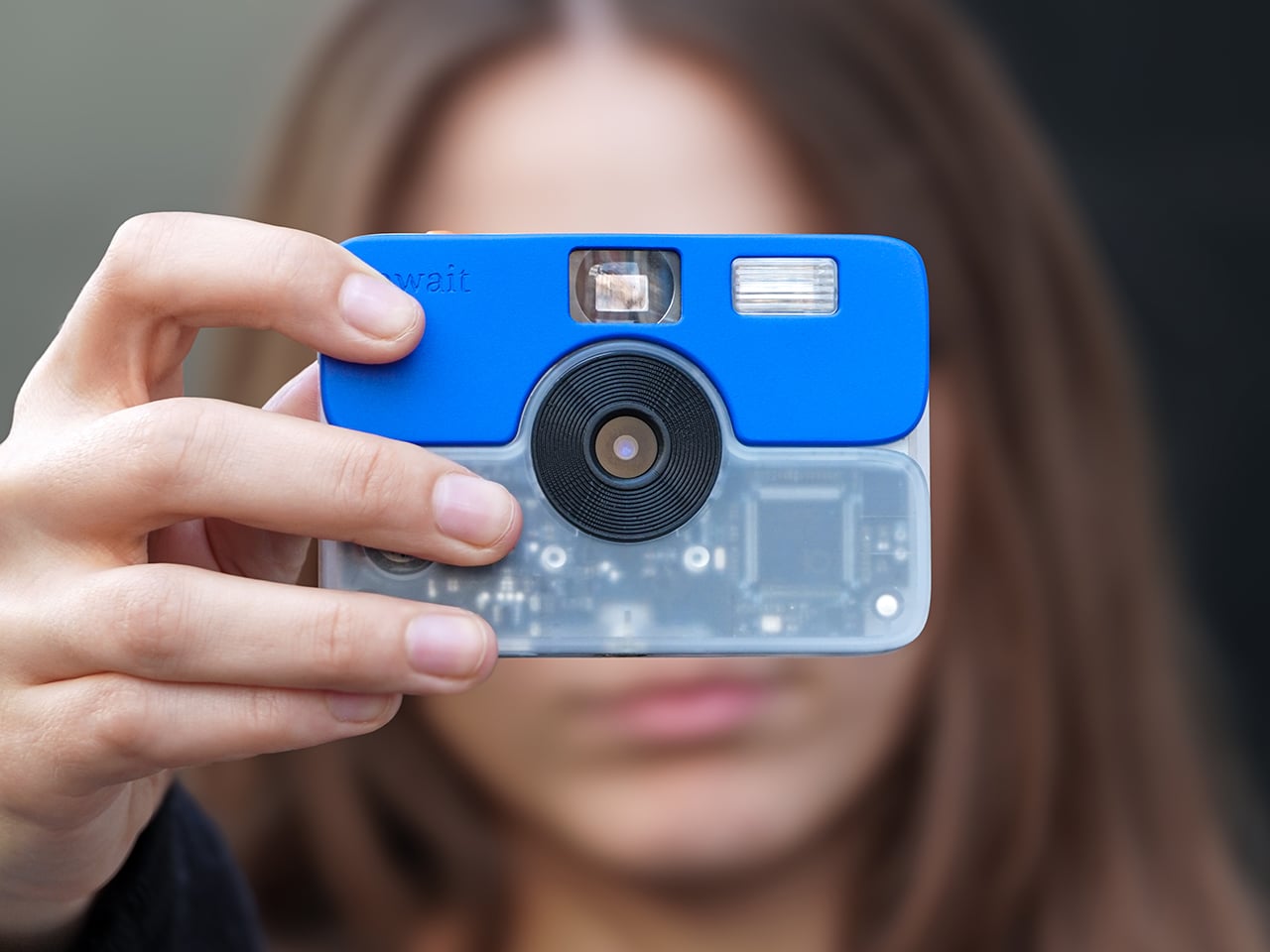
The body is constructed from a frosted translucent plastic that leaves the internal circuit board partially visible, giving the hardware a distinct mechanical charm. Customization is handled via a magnetic front plate, allowing users to easily swap out colors, with options including blue, pink, teal, green, and yellow. Contrasting orange control buttons stand out against the translucent shell, adding a vibrant design flourish to the minimalist exterior.
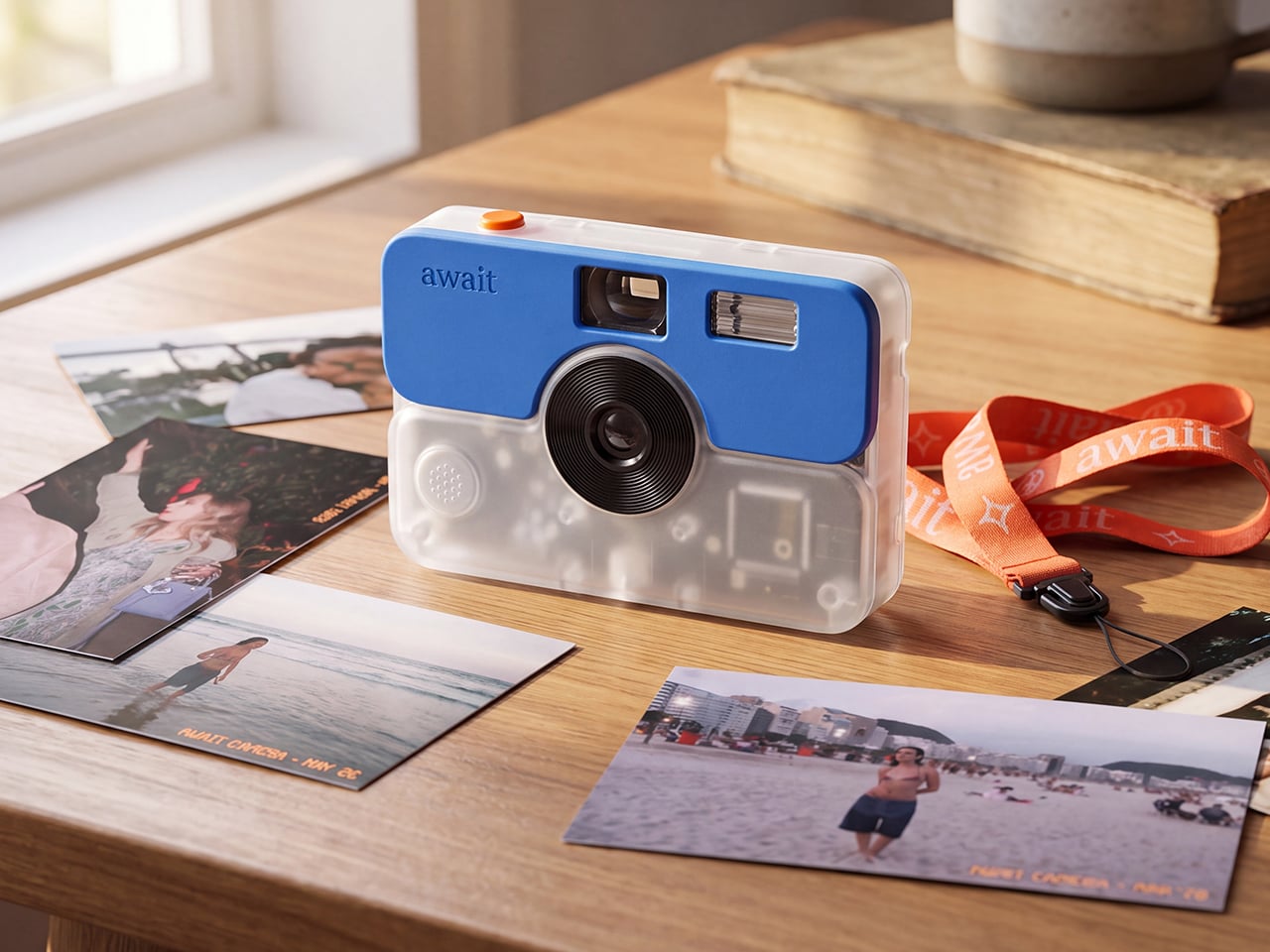
For portability, the camera ships with an orange branded wrist strap, while a longer neck or crossbody strap is available as an optional add-on. Both attach securely through a small cord buckle threaded into side mounting loops. On the base of the unit, a standard threaded tripod mount provides stability for group portraits, working in tandem with a built-in ten-second self-timer.
Unlike many modern consumer gadgets sealed shut with adhesive, the Await features visible Torx screws on its back panel, allowing the shell to be easily accessed. Rolling Square has described the overall architecture as expandable to accommodate future modular accessories. This repair-and-expand philosophy signals an intentional shift away from disposable consumer electronics toward a device designed to be kept, maintained, and used for years.
Eight Megapixels, a Real Xenon Flash, and Two Buttons
At the core of the camera’s imaging system is an 8-megapixel Sony IMX179 sensor paired with a fixed f/2.0 lens featuring a 2.8 millimeter focal length, roughly equivalent to a 26mm lens in full-frame photography terms. This configuration delivers a wide-angle field of view of approximately 65 to 72 degrees, making it well-suited for capturing wide scenes, group gatherings, and dinner tables without requiring physical adjustment.
While 8 megapixels may sound modest in an era of ultra-high-resolution smartphone sensors, it provides more than enough resolution for standard six-by-four-inch physical prints. Framing is intentionally basic, relying on a traditional optical viewfinder—a clear glass window that draws zero electrical power and forces the photographer to compose shots manually rather than checking a digital display.
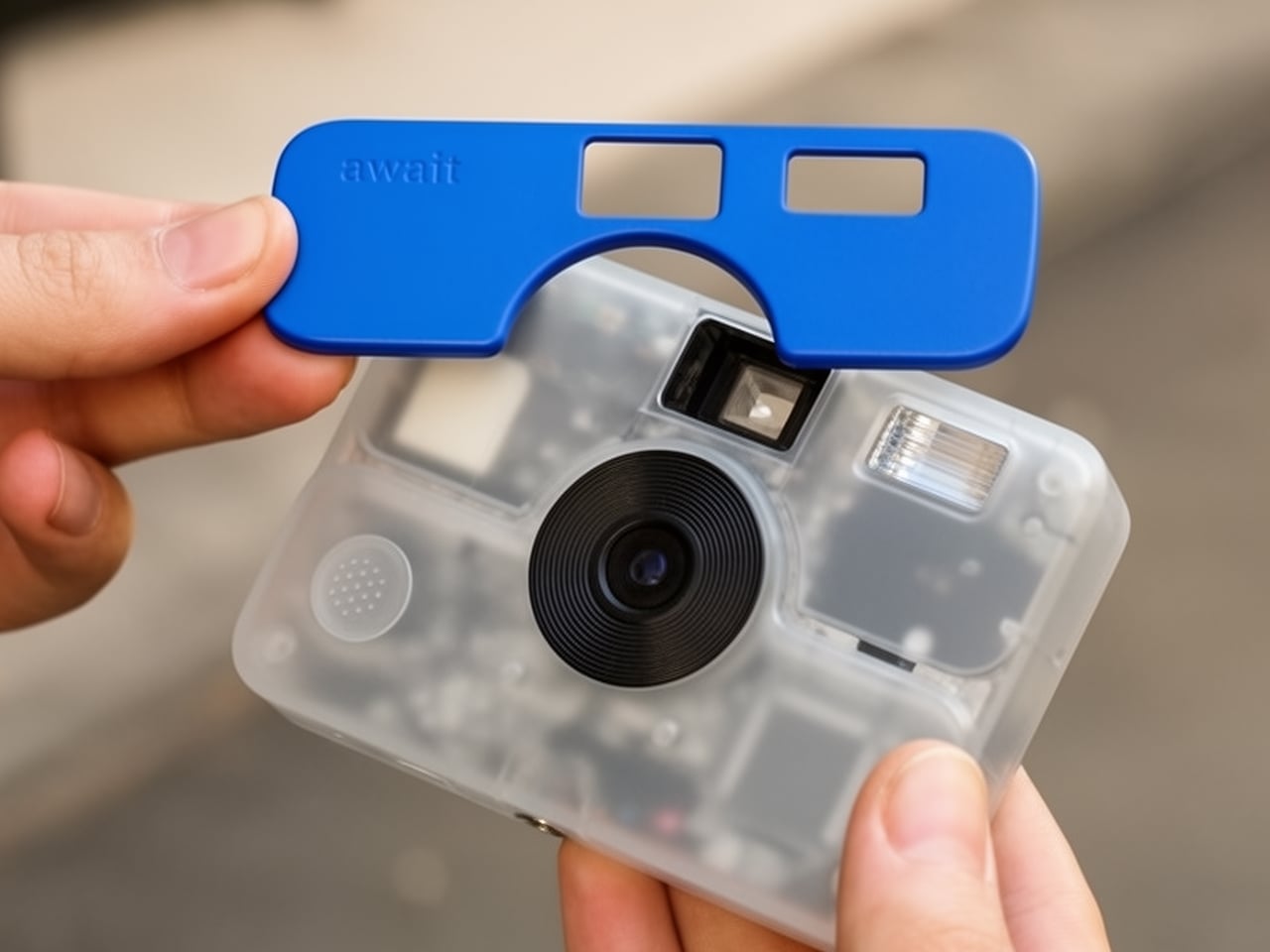
Illumination is handled by a genuine xenon flash rather than a standard LED. As a gas-discharge tube identical to the technology found in vintage film cameras and professional studio strobes, the xenon flash delivers the sharp, high-contrast illumination characteristic of disposable cameras from decades past.
Simplicity defines the user interface, which relies on just two physical controls. The main shutter button captures the image, while holding it down for three seconds powers the device on or off. A secondary function button located on the back panel toggles the xenon flash with a quick tap and activates the ten-second self-timer with a longer hold.
All operational feedback is displayed on a tiny OLED screen that tracks remaining battery life across four bars, flash and timer statuses, remaining rolls, and the exact number of frames left on the active roll. A small internal buzzer provides auditory cues for shutter releases, timer countdowns, and system actions. Power is supplied by a 1,000 mAh internal battery charged via a modern USB-C port, while Bluetooth 5.2 and Wi-Fi handle wireless synchronization with companion mobile applications.
From Sync to Print, and What It All Costs
True to its analog inspiration, the Await camera restricts users to 24 exposures per roll. The device can store up to three complete rolls, or 72 total images, before requiring a wireless sync to clear its internal memory for future use. Once a roll is filled, the user pairs the camera with the free Await companion application available on iOS and Android platforms, which operates without requiring an ongoing subscription.
When a roll is synchronized, the companion app processes the digital files through a proprietary vintage film filter developed after extensive study of historical photographs across thousands of varied lighting conditions. Sample images generated by the system incorporate an orange date stamp to evoke a specific retro aesthetic. For users who prefer untouched digital files, connecting the camera directly to a computer or smartphone via USB-C allows for the extraction of uncompressed, raw files directly from the device storage.
The platform offers two distinct printing workflows. An automatic mode queues each finished roll for a 24-hour waiting period—giving users a deliberate window of reflection before finalizing the order—and subsequently processes physical prints at a cost of $8.99 per roll plus shipping. A manual mode allows users to trigger printing on demand for $9.99 per roll plus shipping. In both workflows, physical delivery yields 24 physical six-by-four-inch prints per roll.
The Await camera launched through a crowdfunding campaign on Kickstarter, with retail pricing set at approximately $146 and early-bird tiers starting around $100. Comprehensive bundles featuring additional faceplates and interchangeable straps are also available. Shipments are slated to begin following the conclusion of the campaign, backed by a standard warranty and return policy, offering a deliberate alternative for photographers looking to step away from endless digital archives in favor of more intentional image-making.