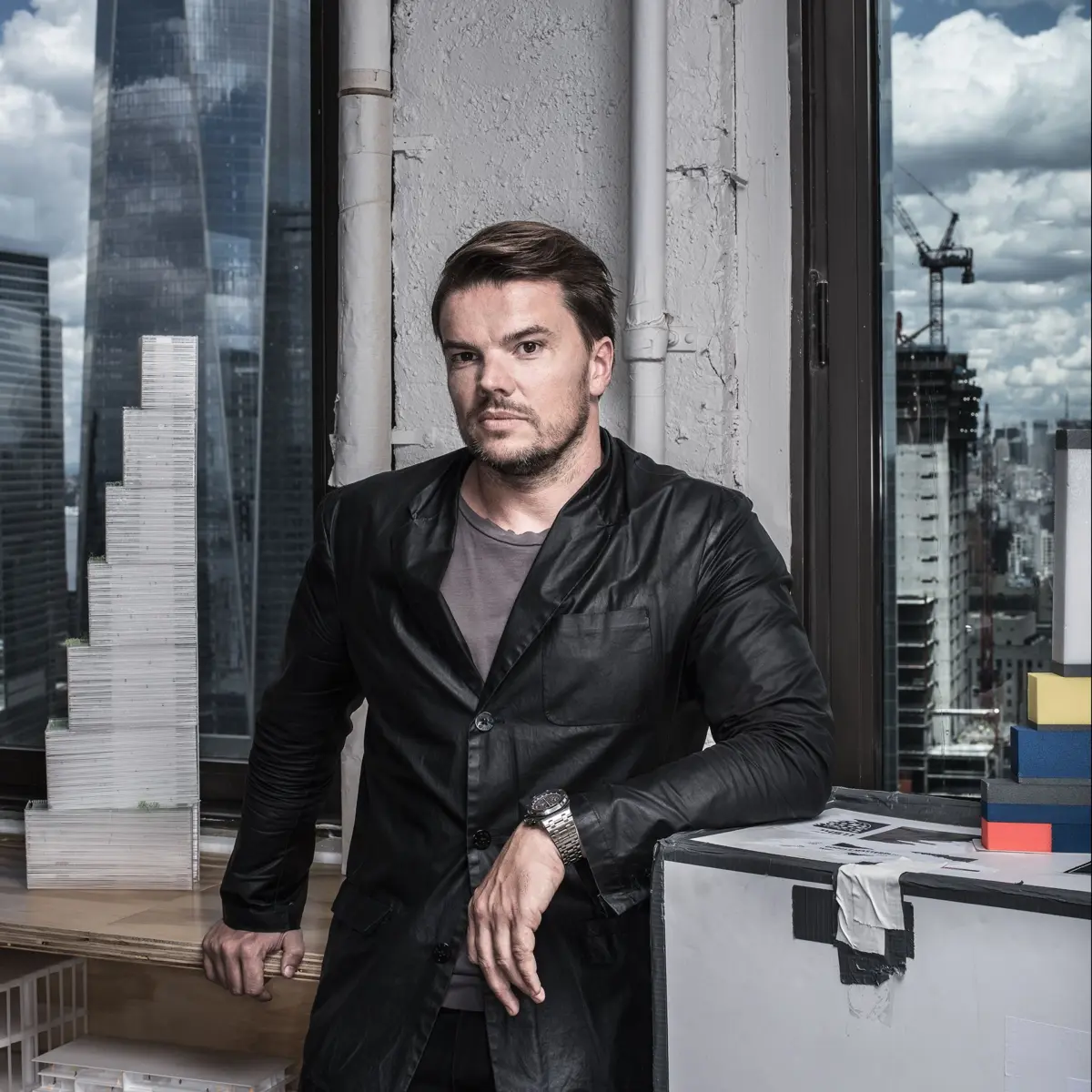
On a misty April day, Bjarke Ingels stands on the roof of an old brick building high above a cobblestoned street in Lower Manhattan, the collar of his black coat rakishly popped. The Danish architect is shooting a promotional film about the most important commission of his young career: his design for the skyscraper known as Two World Trade Center. It remains a work in progress, and his primary client—the imperious media magnate Rupert Murdoch—has yet to formally sign off. Yet the hyper-eloquent 40-year-old does not let doubt stand in the way of his video introduction. Having obsessed over every line and image, he tells his director that he wants viewers to swoon. At this moment, Murdoch’s plan to relocate his media companies is still one of New York real estate’s biggest secrets. But Ingels can hardly wait to shout the news, quite literally, from the rooftops.
Between takes, Ingels points to a void in the densely packed Manhattan skyline, tracing the profile of a skyscraper that only he can see. From this perspective, Ingels’ design resembles a stack of seven blocks, ascending like a staircase toward One World Trade Center, its monolithic neighbor.
"In a way, it is almost like a physical manifestation of the spirit of America," he says. "Out of many, one."
If completed, the tower will stand among the tallest buildings in New York City and mark the final addition to the master plan for the redeveloped World Trade Center. The grand ensemble will ring two cascading pools that pay tribute to the roughly 3,000 people who lost their lives in the terrorist attacks of September 11, 2001. Ingels, however, is not preoccupied with the solemnity of the footprint below; he wants to make his own history.
"The memorial is about the memorial," he tells me. "The tower should be about the living city."
Eclecticism on Demand
Ingels is fond of saying that architecture is "the art of turning fiction into fact." He boasts many talents—as a draftsman, as a salesman, and as the charming cultivator of his own winning image—but his greatest asset is a gift for storytelling: an ability to construct a compelling narrative around practical necessities. Often, his designs careen in fantastical directions. He is currently building a waste-to-energy plant in Copenhagen featuring a slanted roof that doubles as a recreational ski slope, complete with a smokestack engineered to puff a symbolic ring of steam each time it emits a ton of carbon dioxide.
For a proposed expansion of Google’s campus in Mountain View, California, Ingels—along with collaborator Thomas Heatherwick—created a wildly elaborate complex of geodesic domes, envisioning a lifestyle of biking, hiking, and coding inside a sunlit glass terrarium. Such imaginative flights have made Ingels famous, and highly sought-after, at an age considered precocious by traditional architecture standards. But fame can be a deceptive indicator in his profession, where an architect’s work, much like the light of a star, only reaches the eye after a years-long journey.
Ingels’ largest project to date, a striking pyramidal apartment building under construction along Manhattan’s West Side Highway at 57th Street, is just about one-third the size of Two World Trade Center.
"At the moment we are working seriously on one of the most daunting buildings in downtown New York," Ingels acknowledges. "We still haven’t completed a skyscraper."
With Two World Trade Center, Ingels believes he has imagined a way to create a new kind of high-rise work environment—one that transforms a form fundamentally vertical and hierarchical into a space for horizontal interaction. Now comes the laborious part: showing that he is capable of transforming that captivating story into hard facts on the ground.

Playfully calling his firm BIG, Ingels practices an approach to architecture he dubs "BIGamy." Rather than adhering to a single rigid aesthetic, he tailors his ideas to meet client demands, all in service of designs unlike anything seen before.
To realize his design, Ingels has to continually prove its value to a pair of hard-nosed octogenarians: Murdoch and Larry Silverstein, the developer who has controlled much of the World Trade Center rebuilding. Murdoch and Silverstein still have to agree on a long-term lease, which would allow the $4 billion skyscraper to be financed.
"There’s a lot of drama with the deal right now," Ingels says on the day of the film shoot. "I don’t know how worried I should be."
Even if the parties come to an agreement, other hazards loom: a volatile real estate market, the political melodrama inherent in building on a scene of mass murder, and an often irrational government bureaucracy, embodied by the Port Authority of New York and New Jersey, the lumbering transportation agency that owns the land beneath the Trade Center buildings.
For 14 years, these factors have conspired to keep the redevelopment process lurching along unpredictably, leveling many an architectural ambition. Ingels’ design actually displaced an earlier one by Lord Norman Foster. Turnabout is fair play, however, as Foster had previously pushed aside Ingels on a project for a national library in Kazakhstan. To avoid his predecessor’s fate, Ingels must balance the conflicting demands of Murdoch and Silverstein, who will be marketing the top half of the building as office space. At the same time, he must juggle a roster of other important clients who have recently showered business on his rapidly expanding firm. Ingels’ dazzlingly swift rise has inspired awe and envy among his peers, but in architecture, just as one triumphant building can make a reputation, it takes only one disaster to ruin it.
Never short on bravado, Ingels says he relishes the pressure, describing it as a "Zen exercise" in "turning the force of your enemy into your own strength."
Navigating Power and Resistance
The first force Ingels had to overcome at the World Trade Center was inertia. Silverstein thought he had a perfectly good design from Foster—who declined to comment for this article—and the developer expressed serious concerns about Ingels’ early drawings. He worried the stacked structure would look asymmetrical, and even teetering, from certain perspectives.
"He just thought, like, could he see it fit in? No," Ingels recalls. "Was it a nice design for another place? Maybe, but not here."
Silverstein almost rejected the entire deal, until an endorsement from the architects of other World Trade Center buildings changed his mind. But that day on the roof, Ingels confided that he had just learned Rupert Murdoch wanted to review the latest version of the design.
The following Monday, the principals gathered in a conference room overlooking the site. Usually unflappable, Ingels was knocked off balance by the combative Australian media mogul’s rapid-fire questioning.

"It’s almost sort of like kangaroo boxing," Ingels says hours afterward, back at his office.
Murdoch’s deepest concern, according to multiple sources, boiled down to a simple question: Why doesn’t it fall over? With assistance from David Childs, the courtly architect of One World Trade Center, Ingels explained that the leaning effect is an illusion. The unorthodox stepped form of the building results from placing the inner core—which houses a high-rise’s crucial elevator infrastructure—in an off-center position. This layout produces expansive interior spaces for newsrooms, views of the Trade Center plaza from Fox News studios, and outdoor terraces. Murdoch was sold.
"Before you get that story, most people suspect that it’s all just follies," Ingels says. "The more blatantly the architect can explain why things are the way they are, the better."
In his efforts, Ingels could count on at least one powerful ally: James Murdoch, Rupert’s son and corporate heir apparent. It was James, 42, who drove the process of deciding whether to relocate his father’s companies, 21st Century Fox and News Corp., from an aging building near Rockefeller Center.
"It was funny," James says. "We sort of thought, ‘Let’s not hire a starchitect, let’s not build a big tower.’"
He originally wanted to create an open, loftlike, creative workplace. But after an extended exploration of potential sites, he ended up at the World Trade Center—and paired with Ingels, a star who understood his vision.
"We were struck by what a great problem solver he was," James says. "This is someone who can take a set of constraints and create something surprising and effective out of them."
The foremost constraint involved Foster’s legacy, or rather the remnants of his design. As a result of a political compromise between Silverstein and the Port Authority, Foster’s foundation had already been constructed to allow the completion of a $4 billion underground transportation hub. The rest of the tower was to be built once Silverstein secured a major anchor tenant. But James did not think Foster’s stodgy skyscraper suited a media company’s needs, and Ingels was similarly dismissive, calling the design "a generic extrusion with a flashy hat."
Piggybacking a new skyscraper onto Foster’s foundation, however, created tricky structural problems, especially in the lobby and lower floors, which had to be engineered to shift the tower’s weight onto preexisting supports. Whatever Ingels wanted to create high in the air had to connect to what was already set deep in the ground. After winning over the developer and his anchor tenant, Ingels had to convince yet another skeptical audience: Silverstein’s engineers.
Ten days after his meeting with Murdoch, I return to BIG’s offices, where everything is chaotic and half-boxed as the firm prepares to move to a larger space. Ingels, sporting his usual chic dishevelment with mussed hair and light facial stubble, digs up a marker and begins drawing on a whiteboard.

"A lot of towers, as they get over a certain height, tend toward a square footprint," Ingels explains.
This generic form is dictated by cost, marketing—uniform floor plates are easier to lease—and engineering requirements, as a skyscraper must withstand immense forces of gravity and wind. But Ingels believed he had figured out how to shape his skyscraper differently.
"We just redistributed the calories," he says.
Just then, Ute Rinnebach, project manager for Two World Trade Center, hurtles into the office, having just returned from meeting with the engineers.
"How did it go?" Ingels asks.
"Really bad," Rinnebach replies. "I’ve got some horrible news for you."
Ingels’ idea for retrofitting the foundation involved shoring up walls and columns underground within the Port Authority’s domain, which turned out to be strictly forbidden. Like a Jenga block, removing that crucial bit of reinforcement could potentially cause the entire structural scheme to collapse. Ingels darts across the office to consult computer models with his design team. As they start working out solutions, he enters a meeting with a facade consultant, who delivers another crushing blow.
Ingels had developed complex ideas about varying the alignment of the tower’s glass panes and the metal mullions separating them. To bring down the price of the facade—which consultants estimated was running $60 million more than Foster’s version—Ingels thought he could use a thinner product for parts of the building. However, the consultant informed him that New York Police Department security standards require all facades at the World Trade Center to be laminated safety glass, increasing the weight and cost.
"I was like, fuck!" Ingels says later. "Because that’s a piece of information that hadn’t reached me. I just thought I had an ace up my sleeve, which I didn’t, because the building has to be safe from explosions."
With Silverstein and Murdoch navigating a tense juncture in their bargaining, any departure from rote formula carried a steep construction-cost premium.

"Right now," Ingels says, "the architecture is essentially held hostage."
For a few weeks, the fate of the project remained very much in doubt.
"It’s trying to resolve all these issues without totally bastardizing the design," Ingels tells me one day in May, walking briskly toward his Tribeca apartment to pack for a trip to Cannes. He mentions an impromptu visit from Silverstein. "He said, ‘You know, this is a historical moment, we can make this happen. We need to make this deal happen, and to do that, we need to make the design happen. There are these outstanding issues, and you, my friend, are the one who can solve them.’"
Despite the pressure, Ingels managed to avert disaster by agreeing to a number of painful structural changes.
"I think it still sort of looks like itself," he says hopefully.
As we cut across the World Trade Center plaza, the architect stops at the lobby window of Four World Trade Center—the sleek new tower designed by Fumihiko Maki—and admires its lobby sculpture, a 98-foot titanium arc.
"It has no supports," Ingels says. "It just cantilevers like a motherfucker."
At that moment, a group of Silverstein Properties executives walks by to share the encouraging results of a morning meeting.
"I gotta tell you, I gotta give you a hug," says Janno Lieber, Silverstein’s imposing second-in-command. "That was a helluva turnaround that you guys did in the last week."
"Suddenly, the sum of a lot of nudges adds up," Ingels replies.

As we walk away, Ingels smiles.
"That was good, I got a hug from Janno."
Continuing around the site’s eastern perimeter, Ingels resumes our conversation.
"I really like this idea that architecture is the art and science of trying to make everybody happy," he says. "Potentially, somewhere out there, there’s a design that can actually satisfy every dream, by being different."
Passing tourists photographing Santiago Calatrava’s outlandishly expensive transit hub—an infamous example of architecture without concessions—Ingels reflects on the creative process.
"In Darwinian evolution, the animal has two primary instincts, right? Fight or flight. And normally you would associate innovation with plowing through and fighting for your standpoint. But often in evolution it is the moment of flight where you are forced to go another route or climb into the tree. Or you’re the fish that escapes on land. You know, you discover new territory. In architecture, sometimes the eureka moment is actually when you give up a stance and say, OK, we have to try something else."
The Expanding Universe of BIG
This evolutionary metaphor offers an elegant rationalization for an unfortunate truth: an architect must live with continual defeats. In his 2009 manifesto, Yes Is More, Ingels wrote that "most architectural projects either miscarry or die in early infancy," estimating that out of 200 designs produced in his first eight years, only 11 were built. Fame has improved those odds by allowing him to align with clients holding deep pockets and powerful sway. Google, in particular, encouraged Ingels to let his imagination run wild—CEO Larry Page once told him regarding a parking problem, "It’s nothing that $50 million won’t solve." Even so, the city of Mountain View ultimately denied the development rights necessary to build the entire 2.5 million-square-foot complex, proving that even the world’s most influential companies sometimes hear no.
Ingels notes that press coverage of that setback was overblown, as Google proceeded with at least one domed building, and a steady stream of work continues to flow toward BIG. In Manhattan alone, Ingels is simultaneously designing four major additions to the Hudson River skyline and a $335 million hybrid park and flood defense system known as the Dryline along the East River. In Washington, DC, he is working on a master plan for the South Mall campus of the Smithsonian, while other high-profile commissions bring BIG to the attention of clients like an NFL franchise owner who retained Ingels for a stadium project.
"Coming here to America five years ago, we were given the opportunity to try to reimagine the skyscraper, which is one of the great inventions of American architecture," Ingels says. "I think the American football stadium would be an awesome thing to take on."
Having founded BIG in Copenhagen just a decade ago, Ingels’ rocketing trajectory has confounded expectations in an industry where careers usually build slowly through a steady accrual of critical appreciation.

"He has just bypassed all the rest of the avant-garde," says Preston Scott Cohen, an acclaimed architect and professor at the Harvard School of Design, where Ingels has also taught. "No one has done it that fast, with that degree of success. You name them, he has just flown right over their heads."
Because of its complexity and expense—not to mention the egos of many practitioners—museum-grade architecture has long been limited to civic projects, while profit-driven office buildings remained utilitarian domains. Ingels insists he wants BIG to be "both pragmatic and utopian," seeing no reason why artistry cannot be brought to office complexes and stadiums.
"It’s a genre shift, because he’s almost a corporate architect at this point," Cohen says. "But I don’t think those are his ambitions. He did not grow up in that culture."
Ingels is a disciple of Rem Koolhaas, starting his career at OMA in 1998.
"From the very first time I met Bjarke as an intern, he was fearless," says Joshua Prince-Ramus, another Koolhaas protégé. "He does not fear putting his ideas on the table. On anyone’s table."
While Koolhaas set out his ideas in the provocative treatise Delirious New York, he has never built anything of note in the city. His student, by contrast, seeks a more tangible mark.
"Why is it that imaginative architects that do surprising and beautiful and thought-provoking stuff can’t do the really big buildings that matter?" Ingels wonders aloud.
Disdaining modernists for turning office buildings into "a boring box," Ingels is nonetheless fond of a famous Philip Johnson quote: "I am a whore."
"His strength and his weakness is that he is so promiscuous," Ingels says of his style. "Aesthetically and academically promiscuous."
By rejecting the idea that an architect must adhere to a single personal aesthetic, Ingels maintains cheerful flexibility in meeting corporate demands. His first major American commission, the apartment tower on 57th Street known as Via 57 West, combines elements of a New York high-rise and a European courtyard building—what he calls a "courtscraper." Douglas Durst, the property’s owner and a major New York developer, took a risky gamble in hiring Ingels in 2010 when he was still largely unknown in the United States.

"Many architects, when they finish a design, they tell you, that’s it, that’s my design," Durst says. "He likes it when you give him a problem that has to get solved."
Walking through the completed building on a hot summer day, looking down on a courtyard that Ingels jokes "has the same dimensions as Central Park, only 13,000 times smaller," the architect is sublimely satisfied.
"We lost a lot of battles here," he says. "That’s why, in a way, you should really celebrate it as a miracle when something out of the ordinary happens."
Unveiling the Vision
BIG’s new offices occupy the top floor of an early-20th-century terra-cotta building on Broadway, not far from Wall Street. On opening day, Ingels strolls in jauntily, grinning as young architects of all nationalities arrange themselves at long desks in the spare loft space.
"Where did all these people come from?" he shouts.
BIG now employs 170 people in New York and 100 in Copenhagen. Pointing out a window with a clear view north to the World Trade Center, Ingels smiles.
"So, pretty epic."
Epic is one of Ingels’ favorite adjectives, applied liberally to his designs and personal enthusiasms alike. His aura of boyish delight proves useful in wooing clients.
"You want to hire somebody in whose orbit you will enjoy being for the three, four, five years you’re going to be working with them," says Mary Ann Tighe, a top executive at real estate brokerage CBRE. "He embodies that sense of promise: This is going to be great, this is going to be fun."
To welcome his staff to their new home, Ingels calls for a midmorning champagne toast. Someone plays Sinatra’s "New York, New York," and Ingels delivers a speech, rattling off a list of exciting projects, including a second Manhattan skyscraper.

"It’s not every day that you do a 1,200-foot tower in New York City," he quips. "But it feels like every day."
By early June, a tentative deal between Silverstein and Murdoch is in place, and the parties publicly unveil the design for Two World Trade Center. First, however, Ingels must seek a final blessing from Daniel Libeskind, master planner of the World Trade Center complex. Libeskind provides a cautionary example of an architect who was once the toast of New York before running into the unforgiving realities of the development process and opposition from Silverstein.
Despite past tensions, Silverstein executives join the two architects for a presentation in BIG’s conference room. On the table stands a large, glowing plastic replica of Two World Trade Center. Ingels demonstrates how the building respects Libeskind’s Wedge of Light plaza and displays renderings of the lobby, where diagonal columns solve the challenge of aligning structural supports with Foster’s foundation.
"We get an almost Libeskind-esque language," he says, "defined simply by connecting the dots."
Libeskind delivers his verdict with a slap on the table.
"Congratulations, that is a super building," he says, before adding with a touch of mischief to Janno Lieber, "I hope we’re going to see it going up, Mr. Janno."
Initial reviews of the design were largely positive, but as Libeskind notes, that was the easy part.
"Between that first smile and the last stone is the challenge of architecture… this complex space filled with what the city really is: economics, society, power brokers, politicians."
Elements of the tower’s design remain in flux, including minor height adjustments and an unexpected critic in Douglas Durst, who operates One World Trade Center next door.
"I’m very disappointed in Bjarke’s design," Durst says, expressing dislike for the orientation of its stepped gardens. "He turned his back on our building. Not even metaphorically. It’s very disrespectful."

Durst still maintains that Ingels is a genius—though critics might note the developer has an interest in minimizing competition—illustrating the inherent danger of Ingels’ expansive success: every client expects undivided attention.
As BIG expands, Ingels has delegated authority to 11 partners and a talented staff, but the operation remains deeply personalized. Returning from Europe to a stack of crises involving concrete facades for residential towers and concepts for a tech executive’s Palo Alto home, Ingels pivots quickly to waterfront park pavilions and structural cost realities at the World Trade Center. Reviewing lobby designs with Ute Rinnebach, Ingels concedes to cost-saving straight columns over complex sloping ones.
"If we really want the truth, this is the truth. This is the truth in dollars," he says.
Janno Lieber reinforces the point during a visit: "The real issue, Bjarke, is not any design aspect. It’s really just about the cost."
"Nobody wants to pay $12 million to $15 million more for structure," Ingels agrees.
Still, Ingels remains content to work within pragmatic boundaries rather than remaining petrified by practical constraints like some of his starchitect predecessors.
"You must find out which of the ones are actually variable," he says of solving complex architectural equations.
Walking out into the sunny morning down Greenwich Street toward the World Trade Center, Ingels makes a box in the air with his hands and clicks his tongue like a camera shutter.
"Imagine, that’s where it’s going to sit," he says. "I think it’s going to be pretty epic."