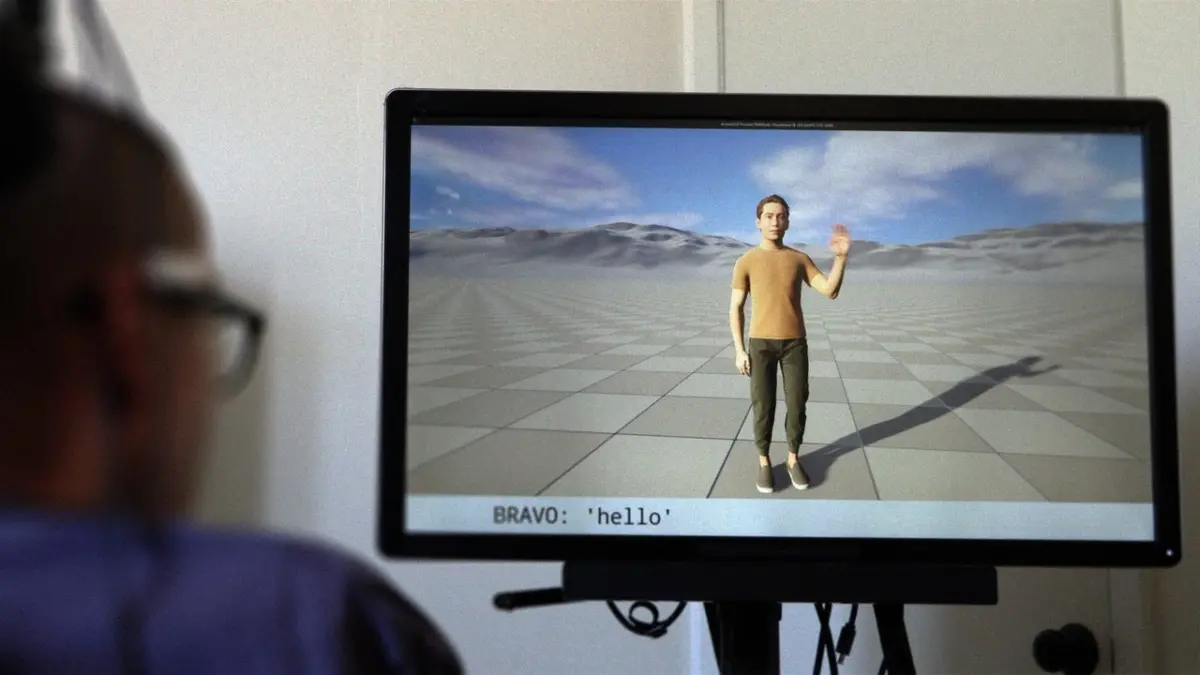
In a major milestone for neurotechnology, researchers have successfully developed a single brain-computer interface capable of simultaneously reading a paralyzed person’s attempts to speak and gesture at the same time, transforming those neural impulses into text and the movements of a digital avatar. According to a research paper published in the journal Nature, the revolutionary device leverages advanced artificial intelligence models to decipher complex brain signals and seamlessly translate them into both spoken language and natural body language.
For years, the field of brain-computer interfaces, commonly known as BCIs, has achieved remarkable success in helping individuals with severe paralysis communicate or interact with their environments. However, existing technologies have been fundamentally limited by a strict operational bottleneck: current systems can decode only one modality at a time. A user could either reliably translate internal speech into text or reliably translate physical gestures, but attempting to perform both simultaneously caused the decoding systems to stumble and fail.
The primary technical hurdle stems from human neurobiology. The specific regions of the human brain involved in formulating and talking about a concept while simultaneously moving hands and arms to emphasize those words partially overlap. Decoding overlapping neural patterns without interference has long presented a formidable challenge to neuroengineers and computer scientists.
Now, a team of scientists from the University of California, San Francisco (UCSF), has demonstrated that their newly developed system successfully navigates this overlap, handling speech and gestures together through the power of artificial intelligence. While the system currently operates under certain constraints—handling only small vocabularies and supporting two participants for simultaneous decoding, alongside imperfect overall accuracy—it represents a profound leap forward in neurotechnology. All human communication relies heavily on multimodal expression; human beings do not converse through language alone, but rather through a dynamic interplay of words, facial expressions, and body movements. Hand gestures are an intrinsic, inseparable part of the human social experience, providing vital context and nuance to everyday interactions.
This technological achievement serves as an important stepping stone toward an even more ambitious future for assistive technology. Samantha Brosler, one of the lead authors of the research paper, outlines the broader vision driving the research team. The longer-term goal of the laboratory is to move toward what researchers conceptualize as a "whole-body BCI"—a single, unified brain interface capable of simultaneously restoring multiple forms of communication and complex physical movement for individuals living with paralysis. In principle, the decoded speech and movement signals generated by such a device could be utilized to control a virtual avatar on a screen, operate various other assistive technologies, or even direct a physical robotic surrogate in the real world.
Brosler, a researcher in the joint University of California, Berkeley–UCSF graduate program in bioengineering, explains that the ultimate objective is to provide people with paralysis significantly greater flexibility in how they communicate and interact with the world around them, rather than continuing to limit them to controlling a single isolated function at a time.
Since the early 2000s, scientists and engineers have made steady progress in developing brain-computer interfaces capable of triggering discrete, predefined robotic arm movements or basic computer cursor clicks. However, Brosler emphasizes that the field is now looking far beyond those rigid, predefined gestures. The next generation of research aims to develop sophisticated systems capable of continuously controlling fluid, natural movements across the entire human body.
Achieving that vision will require substantial technical advancements, including making the decoding of rapid neural signals significantly faster and more precise. Furthermore, researchers must study whether incorporating real-time sensory feedback can make the remote control of digital avatars or physical robots feel increasingly natural, intuitive, and seamless for the user. In Brosler’s view, the newly published study serves as an essential foundational base upon which the flexible, multifunctional control systems of tomorrow can eventually be constructed.