Piloting an F-35 Lightning II over the sun-bleached expanse of the Nevada desert, a Monocle correspondent finds herself attempting a surprisingly effortless barrel roll. Under the watchful eye of a former Marine Corps pilot overseeing the training flight, she executes a few more rolls before her instructor gently nudges the multi-role aircraft toward a simulated adversary. With her finger resting lightly on the trigger, she follows his precise directions and gently depresses a red button, sending a flurry of small dots flashing across the heads-up display toward a vague, distant target.
While sitting at the controls of a simulator for one of the world’s most sophisticated fighter jets offers a surprisingly understated sense of physical drama, the same cannot be said for the F-35’s current standing in international geopolitics. As a fresh wave of procurement orders sweeps across Europe and fierce controversies erupt over potential sales in other volatile regions of the world, this premier symbol of United States air superiority is undeniably having a defining moment.
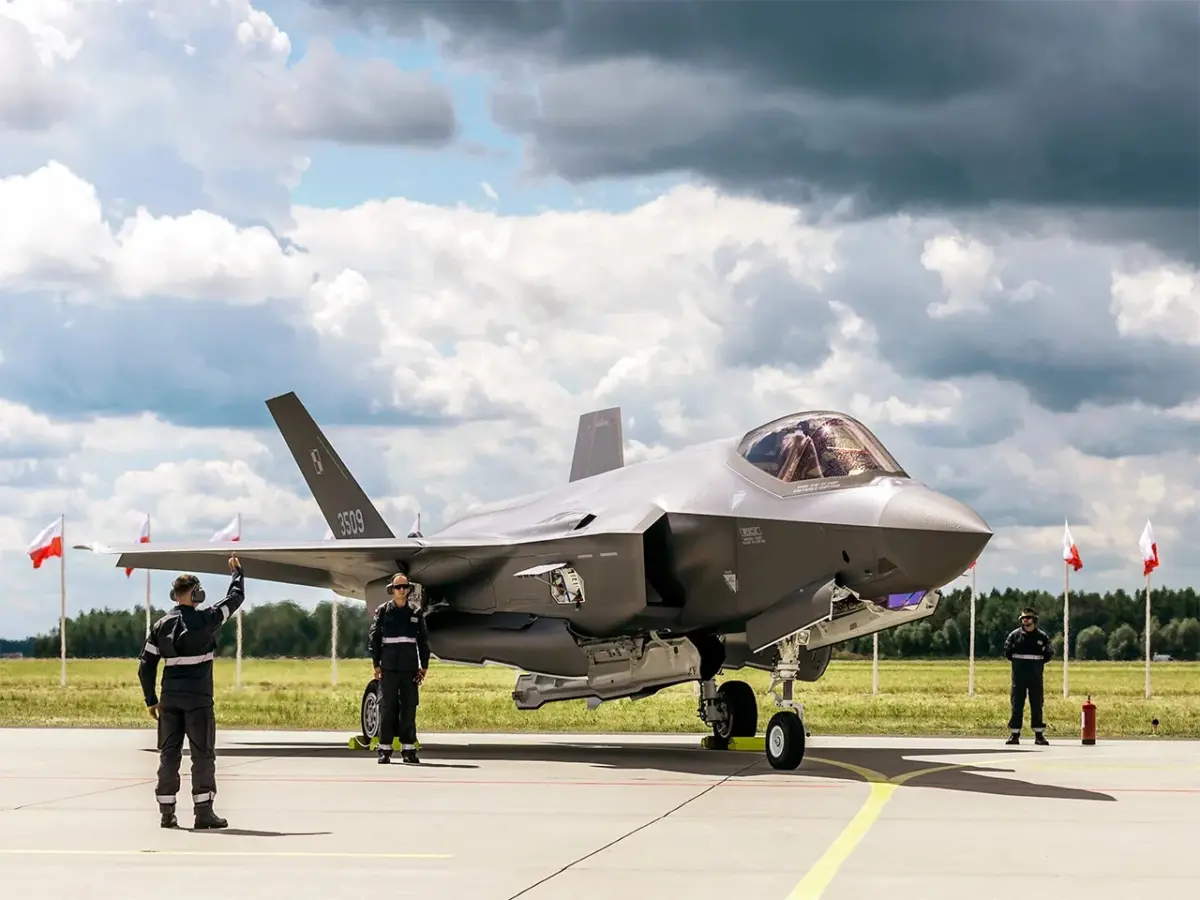
The recent calendar has brought a flurry of delivery milestones for Lockheed Martin, the aerospace giant behind the stealth fighter. In September, the corporation formally handed over Germany’s very first F-35A Lightning II, marking the beginning of an acquisition program that will eventually see Berlin field a fleet of 35 aircraft. Just a week later, Finland officially welcomed its inaugural F-35A as part of a substantial 64-jet order designed to dramatically modernize its northern defenses. Meanwhile, Poland received its first operational delivery of the advanced stealth fighters in May, reinforcing its eastern flank amid mounting regional anxieties.
“We are getting very strong international demand,” says James King, director of the US Navy F-35C programme at Lockheed Martin. King notes that the manufacturing enterprise can currently churn out 156 of the complex aircraft each year, adhering strictly to the production tempo mandated by the Pentagon’s Joint Program Office. “That is what the Joint Program Office wants us to execute. We obviously believe that we could do more. We would like to do more but that’s going to take a consistent demand signal to increase that capacity.”
It comes as little surprise that European capitals are clamouring to secure the finest military technology the United States has to offer. With Russia’s full-scale assault on Ukraine extending deep into its protracted timeline, anxieties have steadily intensified regarding the potential spillover of hostilities into the broader European continent. These fears were sharply underscored when Germany’s intelligence chief warned political leaders that the nation faced a tangible risk of sliding into a direct, violent conflict with Russia, a climate of alarm exacerbated further by a mysterious drone attack targeting Leipzig airport in August.
Echoing these profound security worries, Polish Prime Minister Donald Tusk cautioned last month that Moscow could actively be laying the groundwork for targeted drone and missile strikes against European nations that have steadfastly supported Ukraine. Against this tense backdrop, the surge in F-35 orders is entirely understandable. Widely regarded as the most advanced operational stealth fighter in the skies, the global fleet has already surpassed 1,355 active aircraft distributed across international partners.
Speaking at the Lockheed Martin Global Vision Center in Arlington, Virginia, senior vice-president for global business development and strategy Dan Tenney emphasizes that the nations acquiring the platform are classified strictly as “allies.” However, determining precisely who qualifies for inclusion in that exclusive club rests entirely outside Lockheed Martin’s purview. The sale of F-35 fighter jets is governed by rigorous, uncompromising controls overseen by the US government. Any sovereign state wishing to acquire the sophisticated hardware must submit a formal application to the State Department, initiating a lengthy, exhaustive vetting and approval process.
The F-35A Lightning II was originally developed by the United States with critical financial and industrial assistance from seven international partner nations participating in the Joint Strike Fighter programme: the United Kingdom, Canada, Italy, the Netherlands, Australia, Denmark, and Norway. To date, formal export sales have been approved for 12 additional countries. Turkey was originally a foundational member of the Joint Strike Fighter consortium before being unceremoniously ousted from the program in 2019 after acquiring Russian-built S-400 air defense systems. Nevertheless, political dynamics remain fluid; former US President Donald Trump previously suggested that Ankara might still receive the jets, telling reporters during a NATO summit that he harbored “no concerns” regarding the integrated Russian military hardware.
Complicating the geopolitical chessboard further, the State Department approved a potential $24.3 billion sale of 48 F-35 aircraft to Saudi Arabia. Currently, Israel stands as the sole operator of F-35s in the Middle East, a deliberate strategic arrangement engineered by Washington to preserve Israel’s qualitative military edge in the region. This prospective Saudi arms package has sparked immediate apprehension within political circles in Tel Aviv and generated significant debate inside Washington. Saudi Arabia’s prior joint military exercises with China have ignited lingering fears among lawmakers that sensitive technological telemetry and classified operational data concerning elite US military systems could inadvertently fall into Beijing’s hands. The proposed transaction remains subject to a formal congressional review process, which is currently ongoing.
Lockheed Martin executives consistently decline to comment on the delicate political calculus governing export approvals, deferring entirely to the executive branch and federal regulators. Yet, with persistent, escalating security threats reshaping Europe, and a US administration actively searching for reliable partners in a Middle Eastern landscape thrown into severe turmoil by regional conflicts, James King and his manufacturing teams at Lockheed Martin may soon find their wish for expanded production capacity and a steady stream of new international orders fulfilled.