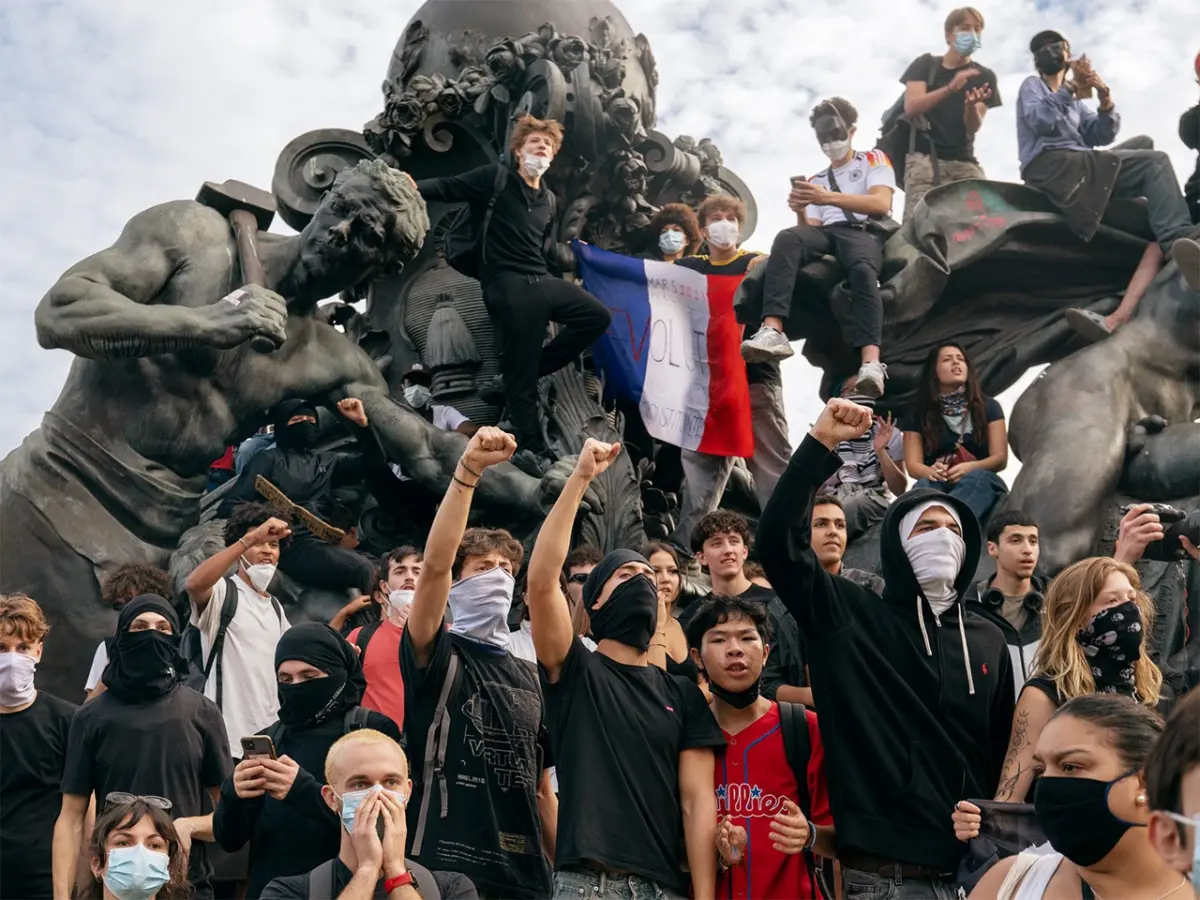
This year’s European protest season has found its most striking headline not in corporate boardrooms or parliamentary chambers, but on the streets outside France’s secondary schools, where teenagers are opting for a remarkably practical course in barricade construction over the theoretical study of philosophical texts. What began quietly as piecemeal demonstrations east of Paris has rapidly metastasized into a nationwide movement. By early October, the unrest had reached a critical mass: roughly one in four of the country’s secondary schools were shuttered or blocked, while an estimated 260,000 students, teachers, parents, and trade unionists flooded public squares and thoroughfares in coordinated demonstrations across France.
For the participants, the grievances are immediate, tangible, and deeply personal. “I’m here because I can’t take it anymore,” said 15-year-old Daniela, standing quietly near the improvised blockade outside her school gates. Her complaints paint a grim picture of everyday institutional decay: a single school nurse serving a student body of 2,000, persistent vacancies left by missing mathematics teachers, a chronic lack of basic hygiene supplies like toilet paper, and crumbling classrooms that routinely transform into stifling, unventilated boxes reaching 40 degrees Celsius during the summer months. Throughout the day of action, teenagers transformed these frustrations into direct collective action, erecting picket lines of overturned bins and school desks, belting out the national anthem, and facing down lines of heavily equipped riot police in tense standoffs.
Across the country, schools have rapidly coalesced around a unified, urgent manifesto of demands. Students and teachers are calling for immediate recruitment drives to fill staggering staffing gaps, emergency public investment to repair crumbling physical infrastructure, and a sweeping overhaul of Parcoursup, the centralized university admissions platform that has long been a source of anxiety and frustration for applicants.
Until recently, France’s upcoming presidential race was shaping up along predictable traditional lines, with campaigns focusing heavily on broader national concerns such as household affordability, public security, and the strain on the healthcare system. However, this sudden, highly visible mass movement centered on the state of public education has successfully caught President Emmanuel Macron’s newly appointed government entirely on the back foot, injecting an unexpected domestic crisis into the heart of the national political conversation.
The government’s initial response only served to pour fuel on the fire. Prime Minister Sébastien Lecornu was quick to characterize the escalating youth-led movement in stark terms, labeling the demonstrations as acts of “urban violence.” Drawing an explicit parallel to the disruptive “yellow vests” protests that paralyzed large parts of the country back in 2018, Lecornu fell back on a tried-and-tested state playbook: deploying one of Europe’s largest and most specialized anti-riot forces to forcibly break the student blockades. Echoing this hardline stance, Interior Minister Laurent Nuñez announced that police forces were authorized to utilize “all crowd-control weapons” at their disposal in order to decisively “put an end to” the mounting public disorder.
That high-stakes gamble backfired almost instantly. Within hours, harrowing videos of violent confrontations between teenage demonstrators and heavily armed riot police began circulating widely on social media, going viral across various digital platforms. As the unrest persisted, reports confirmed that 24 schools had suffered severe damage, having been burned or ransacked during the chaos. Most damagingly, widely shared footage of a 15-year-old student losing his hand when a police stun grenade exploded during a clash sparked widespread public horror and immediate political outrage.
As the political fallout intensified, candidates vying for the presidency in next April’s election rushed to capitalize on the unfolding crisis. Marine Le Pen, the far-right poll leader, doubled down on her familiar platform emphasizing “violence in schools” and the absolute necessity for “more security.” Meanwhile, veteran left-wing candidate Jean-Luc Mélenchon adopted a very different populist strategy, calling for ordinary citizens to form a human buffer between police officers and student protesters, attempting to channel widespread public anger over failing public services directly into future ballot-box support.
Faced with a rapidly worsening public relations spiral that threatened to destabilize the administration entirely, Prime Minister Lecornu abruptly changed his tune. Opening the door to formal dialogue, he promised that the government would deliver concrete “solutions” to the protesters’ demands by the end of the month. Yet, the harsh realities of France’s severe national debt crisis leave the administration with virtually vanishing fiscal room to maneuver, making meaningful new spending commitments exceptionally difficult. Consequently, as the week progressed, the barricades rose once again on Thursday morning.
Yet experts note that France’s deepening education crisis, much like those unfolding across various other European nations, cannot be reduced to a purely budgetary dispute. On paper, education remains one of the French government’s single largest fiscal commitments, with state spending projected to hit an impressive €65.5bn by 2027—roughly €2 billion more than the entire defense budget. However, as ballooning student enrollments and rising operational costs outpace funding growth, headline spending figures can easily mask a severe, continuous squeeze on actual resources allocated per individual pupil.
In France, public spending per student across higher education and research has declined by approximately 20 percent in real terms since 2017. The United Kingdom offers a striking comparative example of this broader regional trend, with recent data from the Institute for Fiscal Studies indicating that spending per secondary-school pupil remains roughly three percent lower than it was during the 2010-2011 academic year.
Across the wider European continent, the steady physical and operational decay of essential public services against a backdrop of stubbornly high living costs appears to be culminating in a collective political ras-le-bol—a colorful French idiomatic expression that vividly depicts a bowl filled precisely to the brim and teetering on the edge of overflowing. The contagion of discontent has already crossed borders; in neighboring Belgium, students have begun organizing and executing their own school blockades, while in Spain, the controversial eviction of an elderly woman successfully mobilized thousands of rent-fatigued citizens onto the streets of major cities.
This wave of youth-led and grassroots protest activity raises a fundamental and pressing question for the continent’s political future: exactly who will manage to successfully channel this simmering public anger into lasting, institutional political change? Both ends of the political spectrum are actively positioning themselves to reap the rewards. In countries like France and Spain, the left is organizing its platform firmly around housing affordability, household costs, and the restoration of public services, while the far right continues to emphasize issues surrounding immigration and national security. Notably, both political camps have recorded significant membership and polling gains among younger voters who feel increasingly disillusioned with the political status quo.
For the teenagers currently manning the barricades, however, intricate electoral calculations and partisan strategies remain far from their immediate thoughts. “I don’t know much about the right and the left,” remarked 16-year-old Jeanne, pausing to listen as another student, dressed head-to-toe in a Spider-Man costume, delivered an impassioned, rallying speech through a battered megaphone. “I just hope that they’ll vote for a president who makes the schools better.”
Regardless of how the upcoming presidential election ultimately plays out, the protests have already achieved a significant political victory by forcing public education back to the very top of the national agenda—all thanks to an impassioned generation of young citizens who do not yet possess the right to vote.