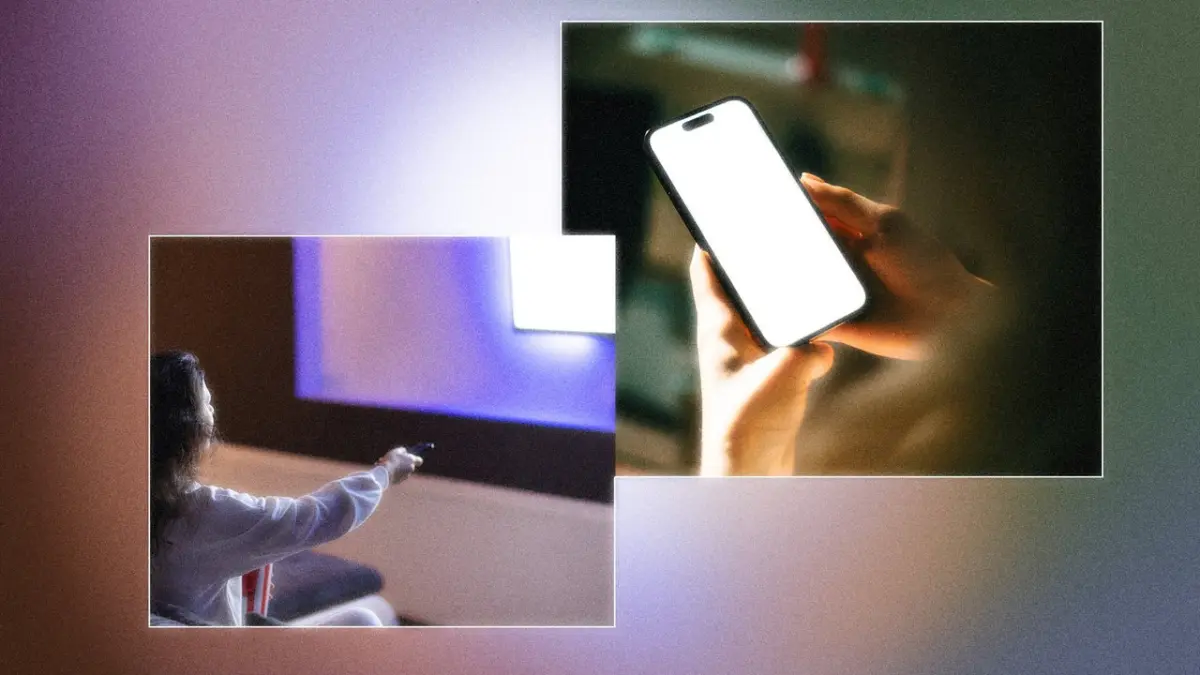
Entertainment companies everywhere are quietly coming to terms with a profound structural shift in how humans consume media. Across the industry, executives are acknowledging that they now have to operate based upon two entirely distinct clocks.
The first of these is the alarm clock—the major premiere you clear your calendar for, the season finale you go to great lengths to avoid spoilers for, and the highly anticipated release that causes you to relentlessly refresh your browser or app at midnight in order to watch or listen the exact second it drops.
The second is the clock that most people fail to realize is even ticking. It is the mindless scrolling that quietly takes up 40 minutes between two tasks you actually intended to complete, the podcast playing softly in the background as you cook dinner, and the endless social feed that flows like a continuous faucet. For the sake of understanding this modern media landscape, let us refer to the first as the appointment clock and the second as the ambient clock.
For the vast majority of television and film history, the appointment clock had been the absolute main concern for media companies. Traditional networks would plan out their entire broadcast schedules with the singular aim of getting viewers to arrange their evenings around a specific time slot. The advent of streaming did not truly destroy this foundational logic; instead, it simply transferred the appointment from a fixed hour of the day to a fixed week or weekend—witness the massive cultural phenomenon of the Sunday night drop or the entire season that releases all of its episodes at once, prompting audiences to rush to finish the narrative before social media ruins the twists.
Alongside this, there was always the ambient clock, mostly manifesting in the form of background radio, rolling news updates, or the kind of generic content you might passively walk by in an airport terminal. This category was treated as background noise and mostly regarded as a second-rate option by the industry. The kind of programming that was strictly appointment-based received the lion’s share of the budgets, the critical prestige, and the massive marketing campaigns for industry awards, while ambient content got whatever resources were left over, or was relegated to a secondary distribution window entirely.
That historical hierarchy has now unobtrusively reversed, revealing a paradox at the very heart of modern media consumption: people are spending more time than ever on the forms of entertainment they never originally intended to set aside time for, and that category is rapidly becoming the new definition of "premium." Ambient consumption is no longer merely taking the scraps of human attention. It is now aggressively occupying hours that used to be entirely reserved for the appointment clock.
Furthermore, the true reason for this shift is not that modern audiences have somehow become worse at concentrating, or lazier, or less insightful than previous generations. That would be a superficial explanation disguised as something profound. The real reason has a specific name and stems from an economic consideration that entertainment executives have never had to deal with before in the history of mass media: coal.
Jevons’s Cousin
To understand how the entertainment industry arrived at this crossroads, it helps to look back nearly 160 years. In 1865, the English economist William Stanley Jevons observed a socio-economic situation that appeared entirely counterintuitive. British engineers had just made steam engines significantly more fuel-efficient, leading many to reasonably assume that Great Britain would use less coal as a result of the technological advancement.
To the contrary, the nation actually ended up using more coal. Because the operating cost of running the engines had been drastically reduced, the overall demand for the resource did not decrease; it increased. This occurred because the historical limitation on coal consumption was never a lack of human desire to use energy, but rather the high cost of utilizing it. As the cost of coal went down, consumption scaled up. In fact, the exact same level of demand was now being fulfilled on a much larger and more pervasive scale. In other words, increased technology made it possible to use fewer resources per unit of output, which ultimately drove total resource consumption higher.
We are seeing this exact economic phenomenon happen with artificial intelligence and modern computing today. We possess more energy-efficient computers and advanced data processing than at any point in history, yet this efficiency has not reduced overall electricity demands. Instead, the world is witnessing a massive, unprecedented expansion in cloud computing, smartphones, and energy-hungry artificial intelligence data centers. Greater energy efficiency has paradoxically led to greater overall energy consumption.
The exact same economic mechanism applies directly to human attention, and as soon as you understand this principle, you cannot stop noticing it operating all across the modern entertainment industry. The more content we are able to consume with ease, the more we actually do consume. While this dynamic has been an absolute boon for technology platforms and social media giants, it is simultaneously what is crushing traditional Hollywood institutions.
For most of media history, content designed simply to pass the time had been expensive to produce and difficult to distribute. Securing a radio broadcasting license, operating a printing press, or buying a cable slot required significant capital and infrastructure. This high cost barrier naturally limited the amount of background content that could be available to the public at any given moment, and therefore strictly limited the amount of people’s time it could possibly take up.
This structural friction played right into Hollywood’s hands, giving studio executives and traditional gatekeepers tremendous power over what society was able to see and hear. However, when modern digital distribution became completely effortless and frictionless—with infinite feeds, endless autoplay features, algorithmic sorting that never runs out, and a supply chain made up of short clips that cost almost nothing to produce and nothing to distribute—the ceiling on media consumption didn’t just rise; it vanished entirely.
Just as Jevons’s coal engines behaved in the 19th century, the cultural response was massive and immediate. Everything, everywhere, seemed to happen all at once. People didn’t just take in a tiny bit more short-form content and then go about their daily routines as normal. Instead, they completely reorganized their days, their habits, and their social capital calculations around it.
Short-form, ambient content became the most important cultural influence of our time. Just as cheaper coal wasn’t used any more efficiently—it was simply used everywhere and all the time, because the friction that had previously limited its use was completely gone—ambient entertainment now dominates our waking lives. It has even gotten to the point where the sum of the individual, bite-sized clips consumed throughout the day is actually greater than the cultural whole of traditional prestige television.
The part of this reality that should cause anyone who is still planning a traditional media budget on the basis of appointment-clock logic to feel deeply uneasy is this: over the past decade, the broader media industry has aggressively removed friction because it was universally believed that removing friction would yield pure, unmitigated benefits. This ideological push has meant more open access, more independent creators, more consumer choice, and greater democratization of tools. But what it has actually done in practice is provide the ambient clock with an unlimited, inexhaustible supply of fuel, enabling it to burn rapidly through hours that had previously been allocated to other parts of life.
The Evidence Is Making the Future Inevitable
You really do not need to accept this abstract economic theory on blind trust alone. You simply need to observe what the traditional industry incumbents are actively doing with their own product road maps and application updates.
HBO Max, a streaming brand historically built entirely on the foundational idea that you should eagerly wait for things because scarcity and prestige were treated as one and the same, has recently introduced a vertical, short-form video feed directly within its streaming application. Major sports broadcasters like ESPN have introduced their own dedicated short-form video features, such as "Verts." More traditional media giants are following suit.
This tactical move by legacy entertainment brands is not merely an innocent attempt at creative diversification or brand expansion. It is corporate survivalism—companies confronting their own obituaries, carefully analyzing their own proprietary attention data, and realizing in real time exactly which kind of clock their own subscribers are actually living their daily lives by. They have been visited by the ghosts of past media industries, warning them of what is inevitably coming for their future.