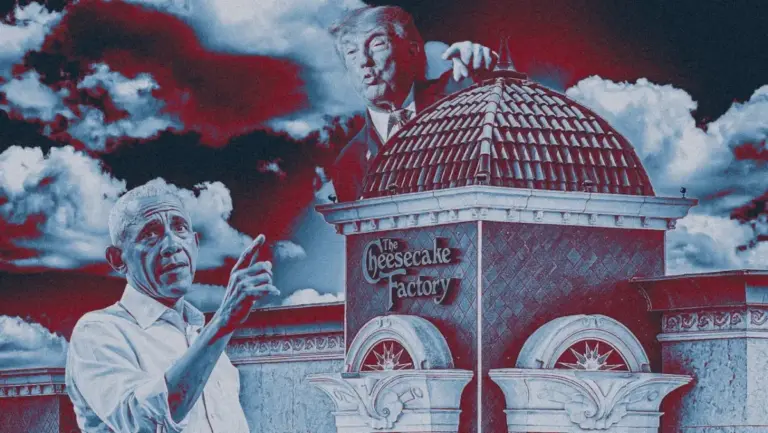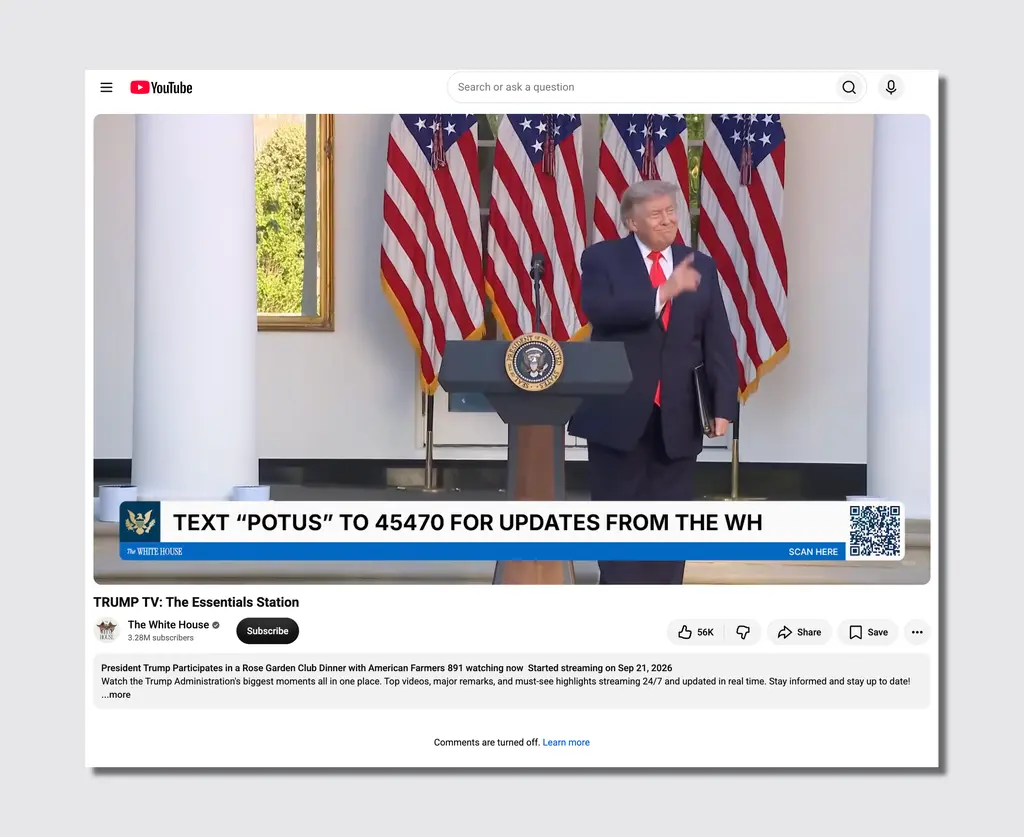
President Donald Trump’s White House this week launched Trump TV, a 24/7 YouTube livestream featuring a continuous loop of new and recycled Trump speeches alongside other administration events. However, initial viewership has been remarkably low, and the content itself has proven far from compelling. This slow and somewhat awkward start illustrates in real time just how difficult it truly is to establish a functional state media apparatus—even for a former reality television producer like Donald Trump.
The Trump administration officially debuted Trump TV on Monday as a self-styled replacement for mainstream news outlets such as CNN, MS NOW, and Politico. The launch came directly on the heels of a major administration crackdown, in which Trump banned those specific news organizations from the White House the previous Friday. The network’s branding bears a striking resemblance to past ventures; its logo features an all-caps wordmark set in a forward-leaning sans-serif font that directly recalls the similarly styled logo used for Trump’s short-lived airline venture. Meanwhile, its promotional sizzle reel treats private intellectual property as though it were the property of the state. The reel runs unauthorized clips from popular, copyrighted television shows such as Seinfeld, SpongeBob SquarePants, Family Guy, and The Simpsons, all while the text “TRUMPTV” flashes and repeats relentlessly across the screen.
Big News, Low Ratings
While the official White House X account aggressively hyped the channel as delivering “the latest and greatest from the administration all in one place,” the actual experience of watching the stream has fallen flat. For viewers tuning in, the broadcast feels less like a polished television network and more like putting videos from Trump’s official C-SPAN profile page on an endless, uncurated shuffle, but stripped of critical context.
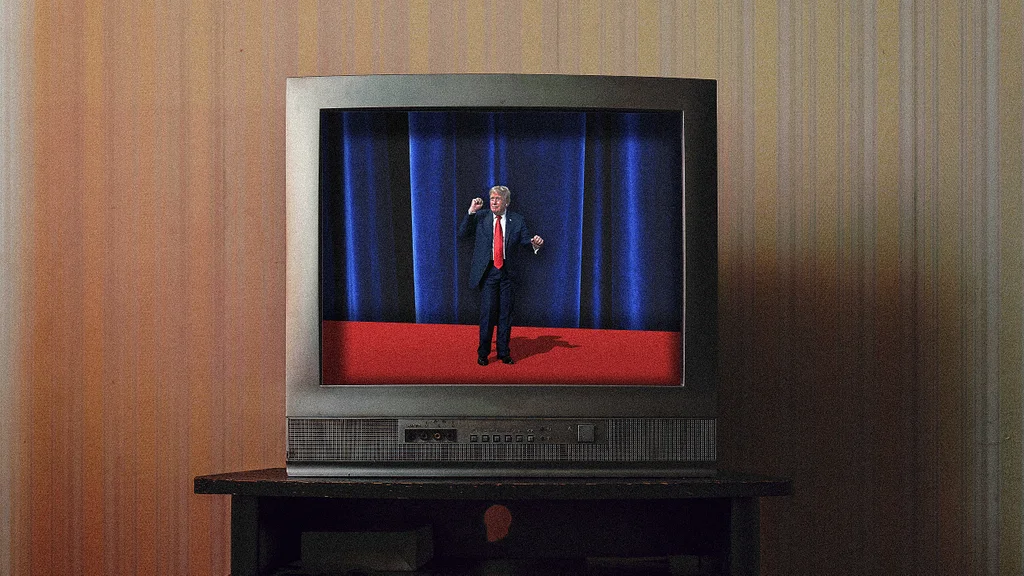
Videos are routinely broadcast without any identifying information regarding when or where they were filmed, leaving the audience largely in the dark about what they are actually watching. Furthermore, unlike an independent, fully functioning media outlet, the channel fails to cut in with live, breaking events as they happen. For instance, when President Trump delivered a high-profile speech at the United Nations General Assembly on Monday, the livestream ignored the live event entirely, opting instead to air footage of Trump’s remarks from the 74th National Prayer Breakfast held months earlier back in February. Similarly, when the president held a high-stakes bilateral meeting with Ukrainian President Volodymyr Zelenskyy on Tuesday, the channel bypassed the live diplomatic engagement to stream a taped bilateral meeting with U.K. Prime Minister Andy Burnham, which had occurred earlier in the day.
Media experts point out that these production shortcomings highlight a fundamental misunderstanding of how institutional state broadcasting operates globally.
“America doesn’t have a state media system, and a YouTube channel by Trump is not the same thing as state media,” explains Sarah Ann Oates, a professor at the University of Maryland’s Philip Merrill College of Journalism. Oates, an expert on media systems, authoritarianism, Russian propaganda, and disinformation, notes that the attempt lacks the foundational infrastructure required for such an endeavor.
Most countries that operate state-backed information systems invest heavily in establishing a professional, institutional broadcaster that is financed directly by the government. Oates points out that while this model invariably creates severe journalistic and ethical problems if there is a political takeover of state media—a phenomenon that happens frequently around the world—such an apparatus cannot simply be improvised or created overnight through a basic video-streaming channel.