If the name MetMo sounds familiar, it is likely because this small, inventive outfit based out of Leeds has forged a stellar reputation by taking old, overlooked mechanical ideas and transforming them into objects that people genuinely want to own and use. Over the years, the design team has captured the attention of makers, tinkerers, and everyday carry enthusiasts alike by reimagining classic hardware. Past projects include the MetMo Driver, which successfully reworked the mid-century ratchet screwdriver; the Fractal Vise, which shrunk heavy industrial clamping logic down to a convenient desktop scale; and the Pocket Grip, a tool that channeled a century-old patent into nearly half a million dollars of enthusiastic support on Kickstarter.
The company’s growing catalog reads almost like a museum of mechanisms, each piece carefully updated with modern metallurgy and high-precision CNC machining. Now, the team is circling back to something much smaller, significantly more delicate, and universally more frustrating than anything they have tackled before. Their next major target is the humble tweezer, an everyday tool that has remained largely unchanged and plagued by the same inherent design flaws for generations. Designed by Sean Sykes and James Whitfield, the newly introduced Precision Grip aims to completely redefine how makers interact with micro-components.
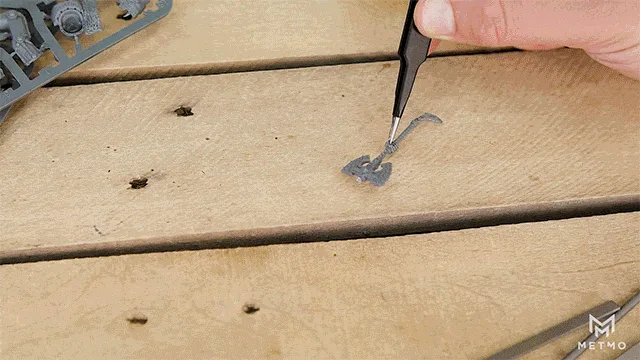
The Precision Grip has been specifically calibrated for an entirely different job than MetMo’s earlier heavy-duty clamping tools. While tools like the Pocket Grip chased an impressive 21 kilograms of clamping force for rugged daily carry tasks, the Precision Grip is designed to max out at 5 kilograms by design, offering the featherlight, highly controlled pressure needed to hold a fragile model part without crushing it. Underneath the hood, it operates using a miniaturized drive screw directly borrowed from high-precision machining equipment. Users can set their desired grip force precisely once, and the jaws will reliably hold that exact position without requiring any further sustained assistance from human hands.
This mechanical advantage addresses the core limitation that traditional tweezers can never truly escape: conventional tweezers hold objects entirely via sustained finger pressure, and the exact moment that pressure wavers or slips, the part is instantly lost. For any hobbyist, scale modeler, or miniaturist who has ever sacrificed a carefully painted piece to the merciless carpet gods, that single drawback is the entire motivation behind the Precision Grip.
For decades, precision hobbyists have been forced to improvise by borrowing tools from completely different disciplines that were never meant for their specific craft. Jewelers often raid surgical supply catalogs for makeshift instruments, while electronics hobbyists rely on soldering tongs that frequently launch tiny components across the room the moment grip pressure drops. Meanwhile, model painters routinely hold microscopic figures between their bare fingers and simply cross their fingers, hoping for the best. MetMo’s core position is that these dedicated creators deserve a tool built specifically for the job. To that end, the Precision Grip features lightly textured jaw tips designed to grip firmly without marking, marring, or damaging delicate surfaces—a crucial distinction that repurposed dental or electrical tools simply cannot reliably deliver.
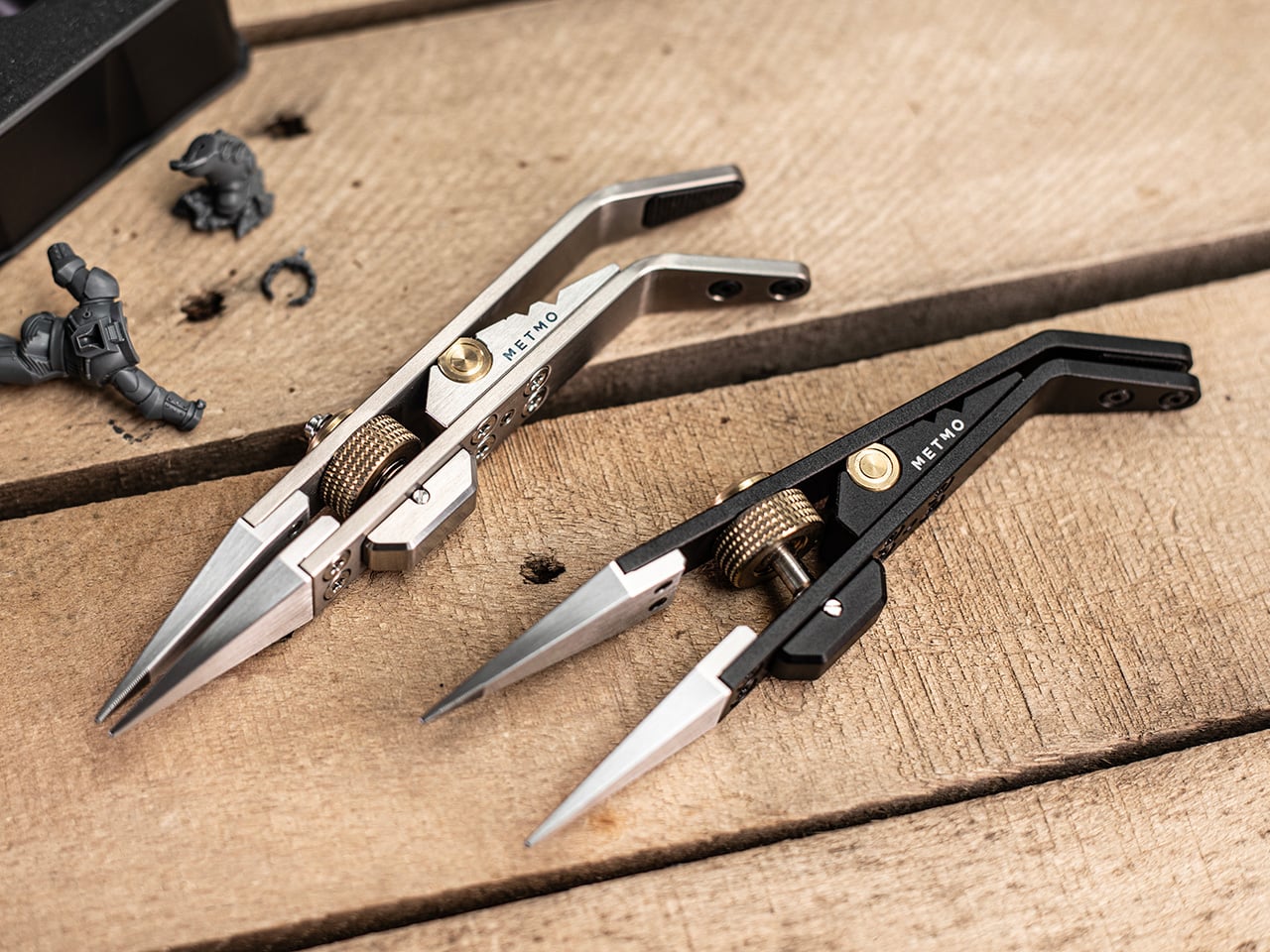
At the center of this engineering feat is a miniaturized version of the drive screw utilized in high-precision machining equipment, a demanding category of hardware that lives and dies by absolute tolerance accuracy. A solid barrel hinge keeps both jaws in near-perfect alignment throughout the entire clamping process, successfully preventing the annoying sideways drift and tip-twist typically encountered with conventional pivot designs. This dimensional stability is precisely what makes the needle-nose tips genuinely usable for pinpoint work rather than mere approximations of it. Users simply turn the knurled screw, and the jaws close smoothly to the exact position set, holding fast with up to 5 kilograms of clamping force. The underlying mechanical principle traces its origins back to 1912, a heritage that MetMo proudly uses as a design tagline for a very good reason: it is a remarkably effective mechanism.
Further enhancing its utility, the jaw tips carry a patent-pending micro-grip texture that MetMo playfully calls "The Gecko’s Finger," a name that feels slightly amusing yet entirely appropriate for its function. Small, smooth parts receive just enough extra friction at the critical contact surface to stay securely in place without requiring the jaws to clamp down any harder, solving the exact right problem when working with fragile materials. Beyond the standard needle-nose stainless steel nibs, the modular system readily accepts silicone soft inserts for exceptionally delicate surfaces, round clamp heads designed for gripping a part’s inner cavity rather than its outer face, and even custom 3D-printed nippers for unusual shapes that no off-the-shelf tip could possibly reach. Furthermore, individual nibs can be swapped out independently if damaged, without ever needing to touch the main body of the tool.
When the user sets the jaws slightly open, a built-in spring-loaded mechanism activates, instantly providing conventional tweezer behavior for fast, repetitive sorting tasks without requiring the user to engage the screw-drive lock every single time. When hands-free stability is required, the Precision Grip can be firmly clamped into a quick-release mount, effectively transforming it into a miniature desk vice that holds a workpiece steady while the user solders, files, or paints. Additionally, three V-grooves machined directly into the body allow creators to cleanly form wire or prop the tool up as a makeshift stand, keeping parts right where they were left when stepping away from the workbench. The entire setup is fully ambidextrous, a thoughtful inclusion that left-handed makers, who have spent years navigating tools designed exclusively for right-handers, will undoubtedly appreciate. All of this extensive functionality is housed within a compact body measuring 134mm in length, 29mm in width, and 16mm in depth.
Users can choose between three distinct material variants, each tailored to a specific type of environment and user preference. The aerospace-grade hard-anodized aluminum version weighs in at 70.3 grams, making it a nimble everyday choice. The Grade 5 titanium variant weighs 83.3 grams, perfectly balancing weight savings with exceptional durability for more demanding environments. Finally, the surgical stainless steel model tips the scales at 114.5 grams and is fully autoclave-rated, constructed from high-chromium steel throughout to ensure viability in professional medical and laboratory settings. All three variants are fully user-serviceable, meaning they can be stripped down to their individual components for routine maintenance or repair using high-tensile screws rather than cheap, disposable fasteners. MetMo frequently speaks of a 200-year product lifecycle goal, and this fully serviceable, robust construction is what gives that ambitious design philosophy genuine credibility.
Pricing for the Precision Grip reflects its premium materials and intricate engineering, running at £89 ($118 USD) for the aluminum version, while the stainless steel variant is priced at £119 ($157 USD). For serious hobbyists and dedicated everyday carry collectors, the titanium Precision Grip is available for £179 ($237 USD). Shipping worldwide directly from the UK, each unit arrives backed by the kind of meticulous attention to detail and long-term repairability that defines MetMo’s approach to toolmaking. The design team carefully balanced the overall weight distribution around the ergonomics of a fine writing instrument, granting the body a comfortable contour that prevents hand fatigue during extended crafting sessions. Even when resting idle on a desk, the tool looks purposeful and striking, functioning almost like an intricate mechanical ornament that naturally invites questions from visitors—a pleasant side effect that MetMo treats as an intentional part of the design brief.