It is easy to fall into the habit of assuming that Italy’s vibrant design ecosystem is composed entirely of Milan and Milan alone. After all, the metropolis is the undisputed powerhouse of the country’s creative industry, serving as the permanent home to visionary creative practices such as Dimore Studio, alongside gleaming, high-end showrooms for heavyweight furniture brands ranging from Cassina to B&B Italia. It is also the epicenter of the global industry’s attention during the frenetic buzz of Salone del Mobile and its sprawling companion, Milan Design Week. For anyone who has spent years reporting on the international design beat, the sheer gravitational pull of Milan can easily overshadow everything else happening across the Italian peninsula.
Yet, breaking away from the well-trodden itineraries, VIP parties, and exhausting trade-show circuits can offer a remarkably refreshing perspective. This truth was brought into sharp focus during a recent visit to the Lake Como Design Festival, which has successfully concluded its eighth edition. Over the years, the independent event has consistently highlighted emerging and established talent while simultaneously showcasing what makes the Como region such a profoundly unique and inspiring setting for contemporary design. Because, when all is said and done, setting matters.
When one spends days marching across cavernous trade fair halls, where commercial deals are hastily thrashed out under harsh artificial lighting and against temporary booth walls, it is remarkably easy to forget the fundamental soul of design: that it is, at its core, a celebration of beauty, function, and enduring craft. One only needs to look at the remarkable success of the Alcova platform in Milan to understand the appetite for a different approach. Alcova frequently stages its daring exhibitions inside intriguing, underused, or semi-abandoned historic buildings—spaces that instantly tell a rich, multi-layered story about the city’s past and present, pulling visitors away from sterile commercial environments and immersing them in architectural atmosphere.
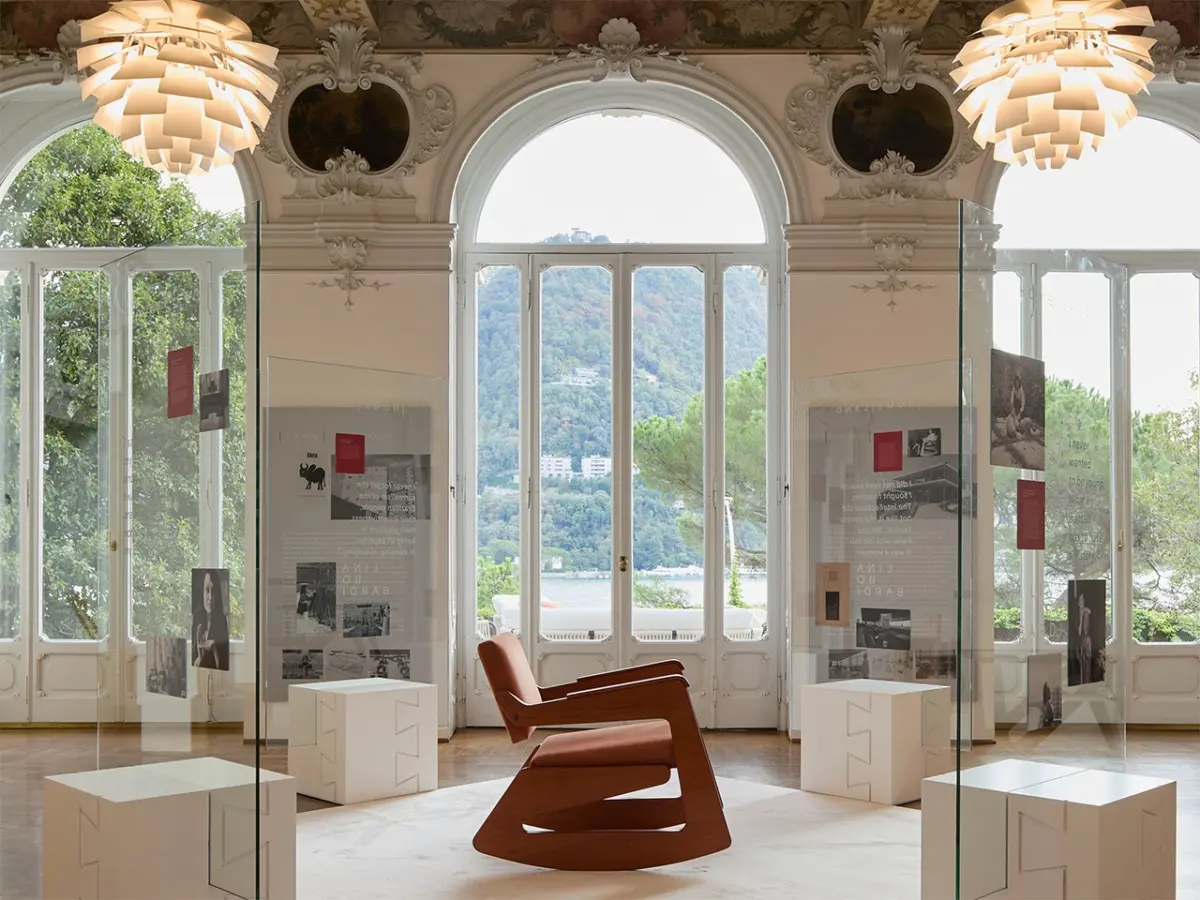
The Lake Como festival approaches the discipline from a similarly experiential vantage point. True to its name, it functions primarily as a celebration of design, ideas, and atmosphere rather than a traditional business-to-business marketplace. In doing so, it serves as a timely reminder that there is vastly more to Como than its sun-drenched lidos and the iconic amphibious tourist planes skimming across the water. One of the greatest aces up the festival’s sleeve is its regular home: the magnificent 15th-century Villa del Grumello. Alongside the brilliant, sparkling light reflected from the lake that pours generously through its historic windows, the villa possesses an architectural feature unique to grand lakeside properties. This is its darsena, a cavernous, subterranean cellar where the water of the lake flows directly underneath the villa, creating a protected, water-veined dock designed centuries ago to shelter boats from the elements.
During this year’s edition, this dramatic, watery grotto provided the backdrop for Luciano Baldessari’s celebrated 1929 Luminator Barcellona—a striking, twisting floor light originally engineered for the Barcelona International Exposition to mimic the fluid, dramatic form of a dancer caught mid-performance on stage. Under the atmospheric, moody red lighting cast across the water and stone of the darsena, the piece took on an almost balletic effect. It was a curatorial triumph and a visual presentation that simply could not be replicated within the sterile confines of a standard commercial showroom or an airless trade-show booth.
Perhaps the most memorable segment of the festival, however, relied entirely on the natural and cultural surroundings of the estate itself. Arranged meticulously along a winding pathway threading through the villa’s lush gardens—with panoramic glimpses of Lake Como continually poking through the mature trees—was a poignant exhibition titled In Nature: Stories of Those Who Have Chosen Another Life. The project, the collaborative work of journalist Paola Manfredi and photographer Selene Magnolia Gatti, captured the festival’s overarching theme of the "Confine," or border. Presented at regular intervals along the garden path were six large-scale photographic portraits accompanied by thoughtful texts detailing the subjects’ lives. These were stories of individuals who had chosen to lead rural, alpine existences deeply and intimately linked to the rhythms of the natural world. Was this strictly industrial or interior design? Perhaps not in the conventional sense. But was the impact profoundly enhanced by the contemplative, outdoor setting? Absolutely.
For design critics, journalists, and industry professionals, it is remarkably easy to become hyper-focused on the minutiae of the latest chair silhouette, the trendiest new colourway, or the industry’s latest high-stakes business acquisition, all while forgetting to simply look around and absorb the broader environment. Great design inherently demands context, even if the curated objects on display might still remain somewhat removed from our own daily, domestic realities—sadly, most of us have yet to acquire a historic lakeside palazzo or a sprawling, Alcova-style former industrial factory.
Nevertheless, the Lake Como Design Festival serves as a welcome annual reminder that our physical surroundings possess the undeniable power to shape how we feel, think, and engage with creativity. If nothing else, it offers a compelling excuse to escape the windowless trade halls of the standard circuit and spend a balmy autumn day absorbing culture by the water.
Ed Stocker is Monocle’s Milan-based Europe editor at large.