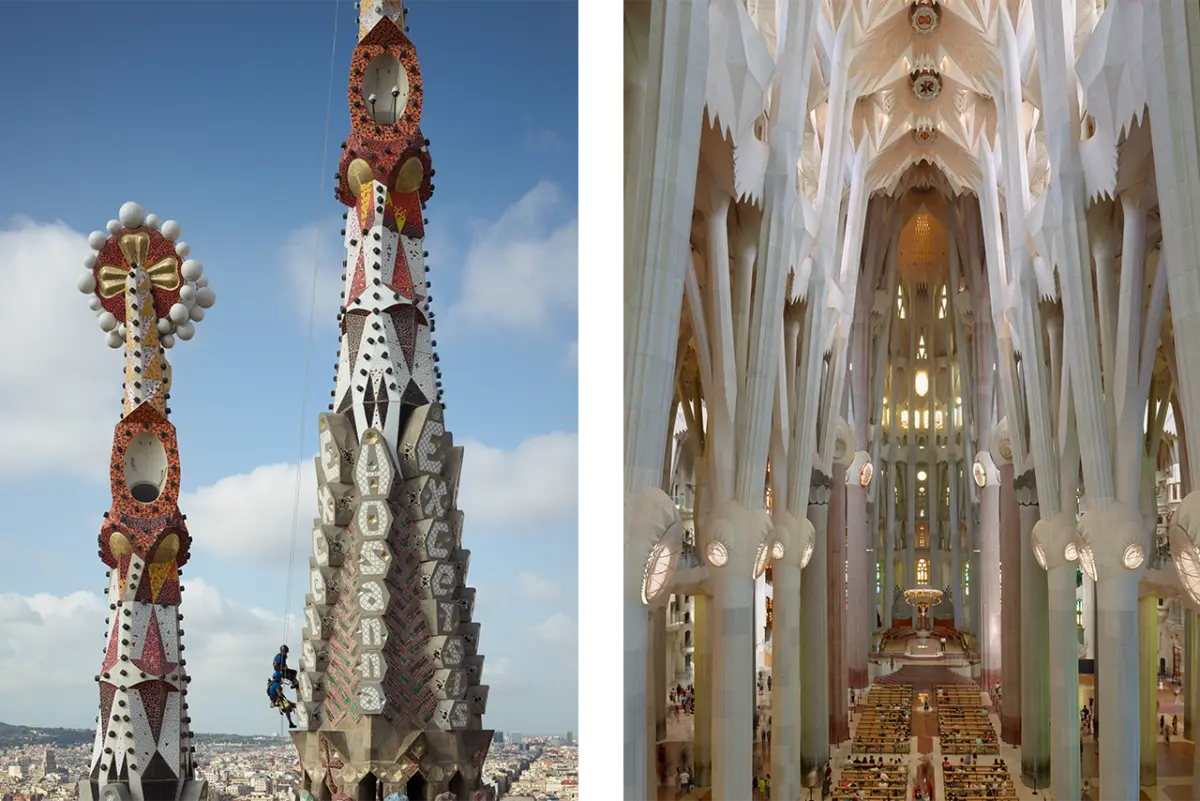
In April 2025, the celebrated Catalan architect Antoni Gaudí took his first formal steps toward becoming a saint when the Vatican announced that Pope Francis had authorized a decree declaring him “venerable.” For admirers of the visionary creator and scholars of his deeply spiritual life, the announcement marks a significant milestone in a long-running campaign to recognize his profound religious devotion. Yet, as the process moves forward, the question remains whether the famously eccentric and singular designer would have welcomed the ecclesiastical honor, or whether labeling him a saint ultimately constrains a legacy defined by boundless imagination.
Following his designation as venerable, the next major hurdle on the path to canonization is beatification. Reaching this stage requires formal proof that the candidate lived a life characterized by heroic virtue, maintained an enduring saintly reputation among the faithful, and is responsible for at least one verified miracle. One might playfully muse that enduring the endless throngs of tourists traipsing up the steep stone steps at Barcelona’s Park Güell or healing the sore knees of weary travelers who have spent hours navigating his masterpieces would suffice as miraculous interventions. In reality, the canonical requirements are rigorous, demanding documented evidence and thorough theological investigation by the Vatican’s Dicastery for the Causes of Saints.
To many observers, the sheer physical and spiritual endeavor of creating the Sagrada Família basilica—a monumental project more than 140 years in the making—should arguably be enough of a monumental life’s work to fast-track a sainthood candidacy. After all, the Vatican’s roster of saints is one of the most exclusive groups in the world, yet the process occasionally moves swiftly for exceptional candidates whose earthly works mirrored divine inspiration. Pope Francis and church officials are undoubtedly mindful of the complex realities surrounding Gaudí’s life. While the architect was an intensely devout Catholic who remained unmarried and subjected his body to rigorous and prolonged fasts as a physical manifestation of his commitment to God, he was, first and foremost, an architect.
Living the life of a pioneering architect while remaining serene, patient, and uniformly saintly at all times is no small feat. Builders, meddling municipal planners, budget constraints, and ill-informed critics have historically been known to push even the most even-tempered creative minds past their emotional limits. Gaudí, whose intense perfectionism and uncompromising vision often placed him at odds with the practical constraints of his era, was no exception. His creative process was deeply intertwined with his faith, viewing nature as the handiwork of God and geometry as His language, yet his temperament was fierce and fiercely independent.

Esteemed writer and broadcaster on Catholicism Peter Stanford has suggested that Gaudí might simply be too complex, rich, and multifaceted a figure to be neatly fitted into the traditional conveyor belt of canonization. Reflecting on the rigidity of the process, Stanford noted that while sainthood certainly reflects an extraordinary life of religious devotion—an element that was undeniably crucial to Gaudí—it ultimately places him in too small a box. For a creator whose imagination knew no boundaries and whose work transcends conventional religious architecture to speak to universal human emotions, a formal ecclesiastical label risks diminishing his broader cultural footprint. In terms of historical figures who deserve to occupy the biggest cultural box possible, or perhaps no box at all, Gaudí stands out as a prime example of an artist whose genius defies categorization.
There is also the poignant historical irony of whether Gaudí would have desired this posthumous ecclesiastical elevation. On June 7, 1926, while walking toward the Sant Felip Neri church for his daily confession and mass, Gaudí was struck by a passing tram in Barcelona. Mistaken for a vagrant due to his impoverished appearance and worn clothing, he was not immediately given prompt medical attention, and he died a few days later on June 10. For a man who dedicated the twilight of his life entirely to the construction of a temple dedicated to the Holy Family, his tragic and abrupt end raised quiet existential questions among his contemporaries about divine providence.
Ultimately, however, whether Antoni Gaudí is formally elevated to sainthood by the Roman Catholic Church matters very little to the millions of people who are already enraptured and mesmerized by his architectural legacy. Travelers from across the globe continue to make secular pilgrimages to marvel at the organic, undulating facades of Casa Vicens, Casa Batlló, and Casa Milà. Above all, they bear witness to an ongoing architectural and spiritual marvel: the ever-evolving Sagrada Família. Long before any papal decree declared him venerable, “God’s architect” had already secured his place as a true people’s saint.