The announcement of this year’s Booker Prize winner has sparked a widespread conversation about the presence of literature in the daily news cycle. Given how frequently literature is relegated to the margins of mainstream media coverage, any moment that places serious fiction front and center is worth celebrating.
Writing from the annual Charleston Literary Festival in South Carolina, the cultural resonance of the literary world’s most prominent awards remains palpable. This time last year, the festival played host to interviews with David Szalay just after he secured the Booker Prize for his novel, Flesh. The narrative follows a young Hungarian boy navigating the stark contrast between a life of poverty and the dizzying heights of London’s super-rich society. Reflecting on that victory during post-win radio discussions, conversations naturally gravitated toward Szalay’s spare, evocative prose, his lived experience straddling multiple countries, and the profound, immediate effect that capturing the prize had on his daily life and career trajectory.
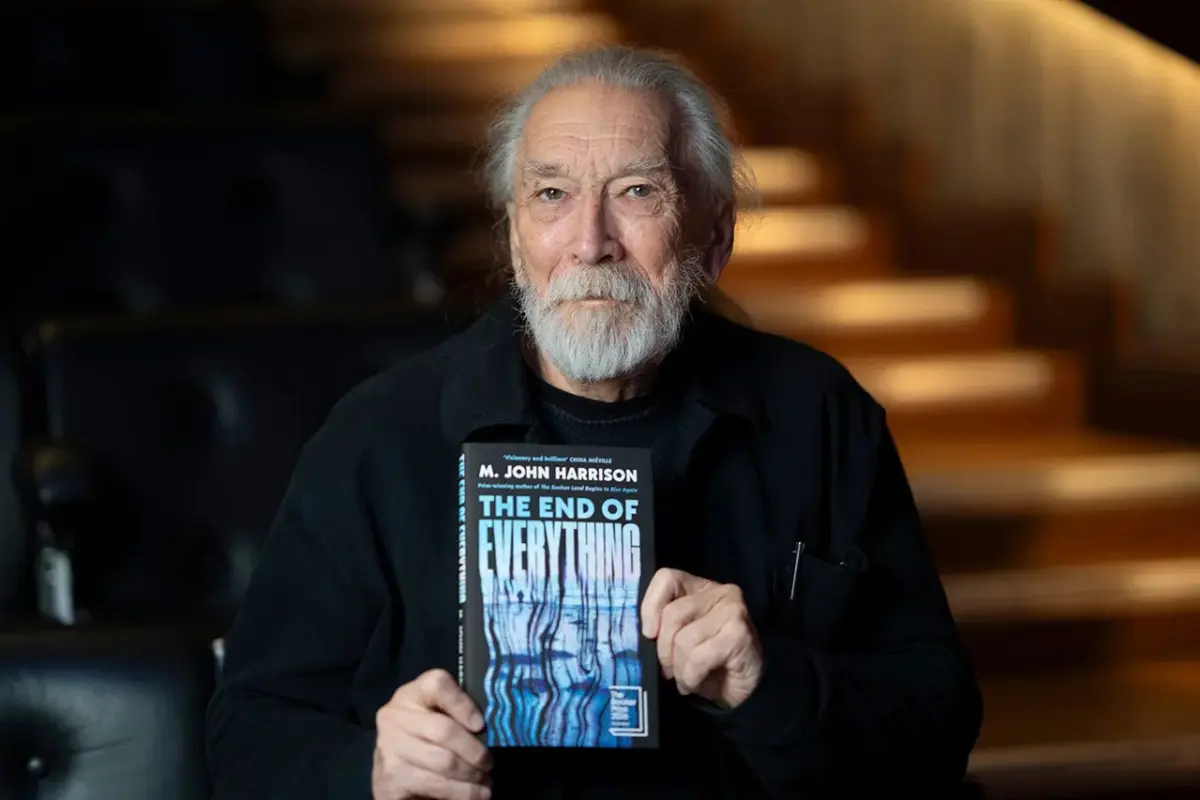
This year, the spotlight has shifted to veteran author M John Harrison, whose dystopian science-fiction novel, The End of Everything, was named the winner of the coveted prize. At 81 years old, Harrison’s victory marks a historic milestone, making him the oldest author ever to win the Booker Prize. Though he has been actively writing for six decades and has published 13 novels—primarily within the realms of science fiction and speculative fiction—Harrison has managed to remain largely outside the realm of household names.
The End of Everything is a sharp dystopian satire set against the backdrop of the south coast of England following a mysterious, unspecified catastrophe. In discussing the genesis of the work, Harrison has explained how contemporary current affairs prompted him to examine what occurs when our established frameworks and explanations of the world suddenly cease to make sense, leaving humanity with no choice but to somehow press on and navigate the routines of daily living regardless.
The novel was brought to publication by Serpent’s Tail, an acclaimed imprint belonging to the independent publisher Profile Books. While five previous titles from the independent publisher have earned nominations over the years, Harrison’s victory marks a historic first win for the firm. Smaller independent publishing houses rarely possess the expansive marketing budgets wielded by the industry’s massive conglomerates, meaning the immense spotlight brought by the Booker Prize carries staggering commercial value.
The financial and market impact of the award is well-documented. Following David Szalay’s victory last year, UK hardback sales of Flesh skyrocketed by an astonishing 1,441 per cent in the single week immediately following the announcement. Furthermore, international translation rights for the novel more than doubled, expanding rapidly into 42 distinct territories worldwide. For independent publishers and authors of boundary-pushing fiction, the prize acts as a vital commercial catalyst.
During Monday night’s gala ceremony, as Szalay formally handed the trophy over to Harrison, he characterized the Booker Prize aptly as an "engine of attention." In a modern media landscape where public interest and audience engagement are so frequently captured through oversimplification and soundbites, the prize purposefully directs a powerful beam of light toward the intricate complexity of contemporary novels.
Classicist and historian Mary Beard, who served as the chair of this year’s judging panel, offered a profound perspective on the place of reading in modern life. Beard noted that she does not think of herself as being in love with the act of reading any more than she is fundamentally in love with eating or sleeping. Instead, for her, reading is an absolute necessity of existence. She offered a thoughtful caution against the modern tendency to package and treat books merely as another accessory for personal wellbeing, arguing instead that literature is fundamental to the very ways in which human beings think and process reality.
Literary prizes inevitably invite debate, and critics and readers do not always see eye-to-eye with the decisions made by judging panels. Plenty of brilliant, deserving novels are overlooked and never even nominated for major awards. However, the true value of these cultural moments lies in the fact that, for a few crucial days, the topic of reading and literature breaks through the noise to join the general conversation. It fosters a sense of public curiosity about titles, themes, and authors that audiences might otherwise have completely missed in a crowded media landscape.
Here at the Charleston Literary Festival, ongoing panel discussions highlight the enduring ripple effects of literary accolades. Conversations are underway with writers such as Ben Markovits, whose novel The Rest of Our Lives was shortlisted last year, and Joseph O’Neill, who has twice found himself on the longlist for Netherland in 2008 and The Dog in 2014. These gatherings serve as a tangible reminder that the intense focus generated by the Booker Prize is not merely a fleeting moment on awards night; it is an enduring wave of attention that can follow a dedicated writer for years, ultimately reaching readers and audiences far beyond the physical stage of the ceremony.