Tiny screws have a unique and frustrating knack for making even the simplest repairs feel surprisingly complicated. Anyone who has ever sat down to open a laptop or service a piece of delicate consumer electronics knows the familiar pause that happens right at the start. Choosing the exact right bit for a microscopic fastener often requires almost as much focus and attention as the actual repair job itself. A wrong choice can easily strip a screw head, turning a routine five-minute maintenance task into an hours-long extraction nightmare.
Addressing this universal pain point for DIY enthusiasts, hobbyists, and tech tinkerers, designers Lau Yin and Xu Yu have created the Arrowspace S1. Billed as the world’s first AI-powered electric screwdriver equipped with both "eyes and a brain," this precision tool aims to streamline the micro-repair process. By combining an integrated optical camera, artificial intelligence identification software, and an intelligent storage case that visually guides the user, the S1 takes the guesswork out of matching miniature hardware with the correct drive profile.
The journey to finding the right tool begins inside the S1’s meticulously organized enclosure, which houses an impressive array of 52 S2 steel bits. S2 steel is renowned in the tool industry for its durability, high torque resistance, and longevity, making it an ideal material for precision work where stripping cannot be tolerated. However, having a massive selection of fifty-two options does not automatically solve the problem of identifying which tiny tip belongs to an equally tiny screw nested deep within a device chassis.
This is where the engineering of the Arrowspace S1 introduces a genuinely novel approach to hardware diagnostics. Instead of forcing users to rely entirely on their own eyesight, magnifying glasses, or trial-and-error matching, the tool incorporates a dedicated scanning mechanism to examine the fastener before any mechanical work begins.
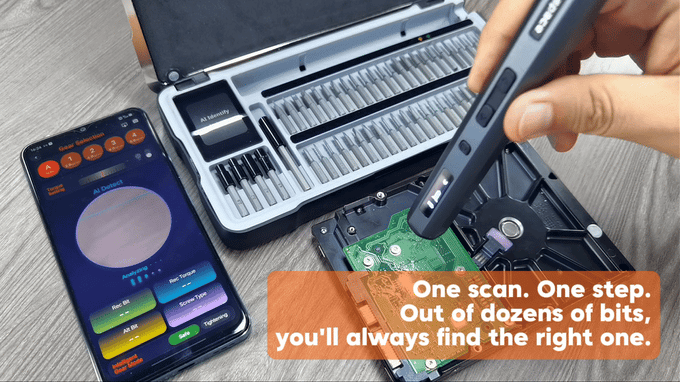
The camera hardware is cleverly positioned at the rear of the screwdriver, situated opposite the driving end, right alongside a physical contact probe. When a user encounters an unfamiliar screw, they simply rest this contact probe directly against the fastener. This physical action establishes a consistent, controlled distance between the camera lens and its subject, solving a major hurdle in optical recognition technology. By standardizing the focal length and distance every single time, the tool gives its recognition software a stable, controlled starting point. The user scans the screw first using the rear-mounted camera system, and then flips the screwdriver around when they are ready to pick up the correct bit and begin driving.
The actual heavy lifting of identification happens via a companion smartphone application that communicates locally with the tool. In an era where cloud connectivity is often forced onto everyday gadgets, the Arrowspace S1 relies on local processing to analyze screw images directly on the user’s phone. This design choice ensures speed and addresses privacy considerations by eliminating the need to transmit image data to external cloud servers.
The software has been trained to recognize twelve of the most common screw-head profiles used in modern electronics, appliances, and hobby gear. Upon scanning, the app instantly identifies the exact profile and size, effectively giving a name to those mysterious little metallic recesses that frustrate so many repair jobs. While the AI identification process functions locally without requiring an active internet connection, the smartphone still maintains a local connection to the screwdriver to relay the data back to the hardware kit.
Once the identification is complete, the workflow transitions smoothly back to the physical workspace. This next step is refreshingly direct and eliminates the usual disconnect between digital data and physical organization. Upon receiving the identification signal from the app, an LED light illuminates the exact bit slot inside the case where the recommended tool is stored. Simultaneously, a compact two-inch TFT display embedded directly into the case shows the identification information, spelling out the precise dimensions and profile type of the screw just scanned.
While the user still physically picks up the recommended bit and fits it into the driver themselves, the system dramatically reduces the mental detective work required. There is no longer a tedious gap between identifying a fastener and finding its matching counterpart in a crowded toolkit. By linking the software analysis directly to the physical storage enclosure, the case transforms from a passive box into an active, intelligent participant in the repair process.
Getting the correct bit into the driver is only part of the challenge when handling delicate modern hardware. Precision electronics are exceptionally sensitive to over-tightening, which can crack circuit boards, strip delicate threads, or damage fragile internal components. To mitigate these risks, the Arrowspace S1 features adjustable torque settings, complemented by an automated mode. When operating in Auto mode, the screwdriver automatically applies a preset torque level that matches the specific screw identified during the initial scan.
This functionality acts as an intelligent starting point, respecting the engineering guidelines established by device manufacturers while keeping human oversight at the helm. It acknowledges the fundamental truth that a laptop’s microscopic fasteners deserve far more careful consideration than simply pressing a power button and hoping for the best outcome.
This deep commitment to control and feedback is equally evident in the design of the screwdriver itself. Built with a slender, ergonomic aluminum-alloy body, the S1 feels balanced and natural in the hand. Physical forward and reverse buttons provide immediate, tactile control over the motor’s rotation, avoiding the clumsy digital menus that plague many modern smart tools.
Furthermore, an integrated OLED display keeps essential operational metrics front and center, displaying the current torque level, rotation direction, and remaining battery status at a glance. To ensure the work area is properly illuminated, high-output work lights surround the magnetic bit holder at the driving tip. This thoughtful layout ensures that everyday adjustments can be managed directly on the object in the user’s hand, rather than forcing them to constantly look away toward a phone screen or computer monitor.
The storage case mirrors this emphasis on premium construction and functional order. Built around a sturdy CNC-machined aluminum-alloy frame, the case brings a high level of professional organization to any workbench or desk. Its custom-fitted interior layout designates exact positions for both the driver and all 52 bits. This organization is critical to the entire ecosystem, as the guidance system relies entirely on the user returning bits to their designated slots so the LED illumination indicators can point to them accurately in the future.
For urban dwellers, remote workers, and hobbyists whose desks occasionally double as temporary repair stations without requiring a dedicated workshop, this clean and orderly approach offers a high degree of practical appeal. Maintaining an organized workspace becomes an effortless byproduct of using the tool, rather than an exhausting chore at the end of a project.
The versatility of the kit shines brightest when dealing with widely varied hobbies. A person might spend one weekend repairing the intricate plastic shell of a retro game controller and the next weekend working on the delicate mechanical linkages of a radio-controlled model vehicle. These diverse projects invariably present entirely different collections of screws, thread pitches, and drive types.
Having automated identification assistance becomes particularly valuable in these scenarios, especially for enthusiasts who have not spent decades memorizing obscure drive profiles and micro-sizing standards. When the battery eventually runs low from extended repair sessions, standard USB-C charging handles the routine business of power replenishment. The seamless combination of organized physical storage and guided digital selection provides a reliable, stress-free starting point no matter how much the nature of the desk projects changes over time.
Despite the sophisticated array of cameras, local AI algorithms, and LED-illuminated storage slots, the core of the repair experience remains firmly human. There is still a person sitting at the desk, aligning the bit, holding the driver steady, and making the ultimate decisions about how to approach and execute the repair. The Arrowspace S1 simply positions its technological intelligence around those human actions, quietly assisting with the small, frustrating decisions that so often interrupt a smooth workflow. With the correct bit instantly identified and handed over, attention can shift entirely back to the device resting on the desk, where there is usually something much more interesting waiting just beneath the cover.