Fast-paced, 3D platformer, parkour, first-person, and racing. Those are the distinct tags affixed to the Steam page for Stuntboost, a title that has proven notoriously difficult to sum up with a clean, singular label when discussing it with fellow gaming enthusiasts. At various turns, Stuntboost functions as a skateboarding game that occasionally features a car, a platformer equipped with a working speedometer, and a loving, nostalgic ode to those shrunken, household-item bedroom maps popularized by early first-person shooter modders.
It is also, quite easily, a favorite gaming experience of the year so far for many who have managed to discover it. Yet, despite its exceptional design, Stuntboost could have easily slipped under the radar of the broader gaming community. Having been available for roughly a month on Steam, it has not yet made a massive commercial splash or dominated the platform’s trending charts, holding a "Very Positive" rating underpinned by a modest 253 user reviews. Many players, including dedicated critics, only found the game through word-of-mouth recommendations, and even upon initial inspection, the visual presentation did not immediately broadcast its true nature or depth.
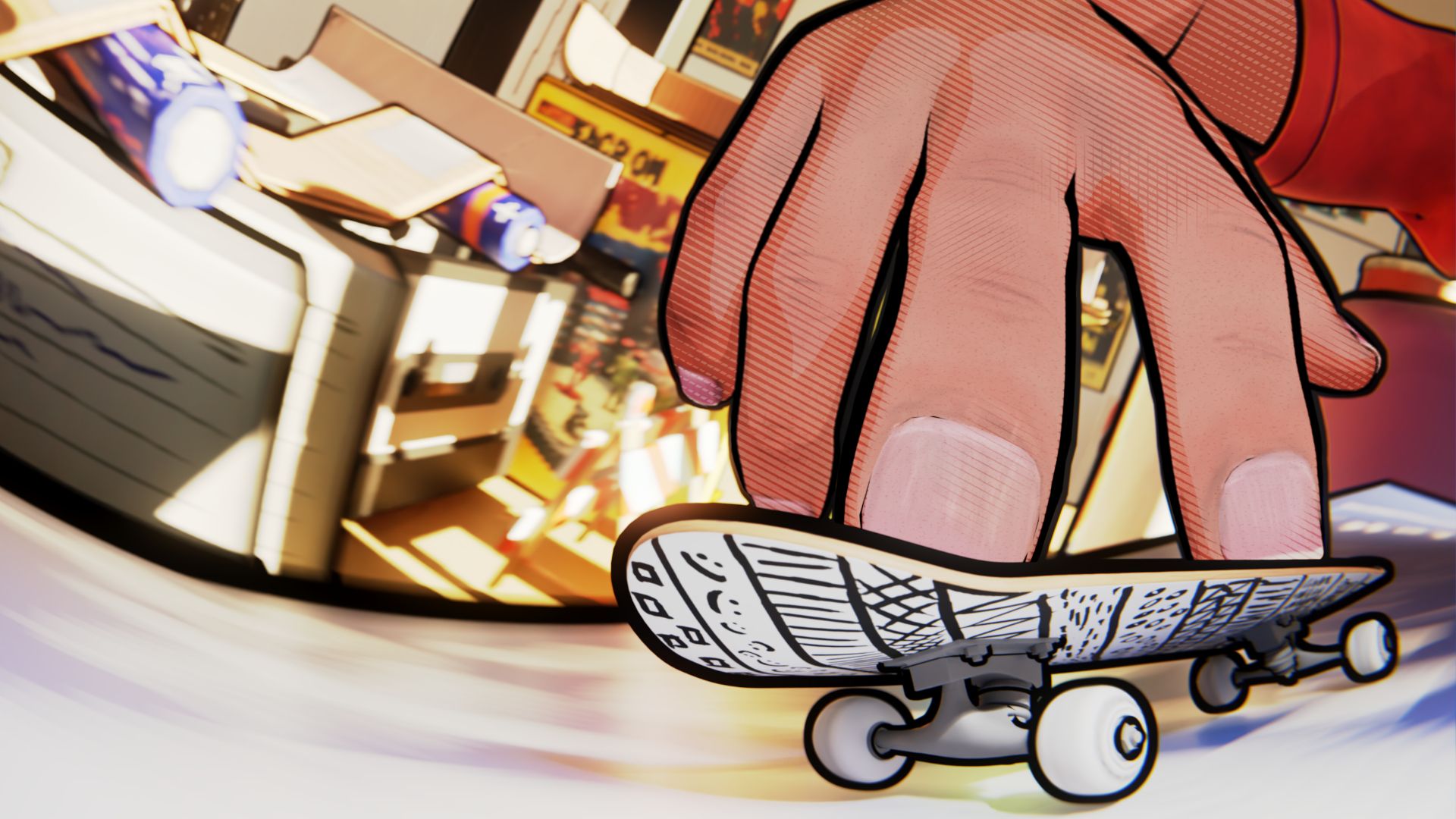
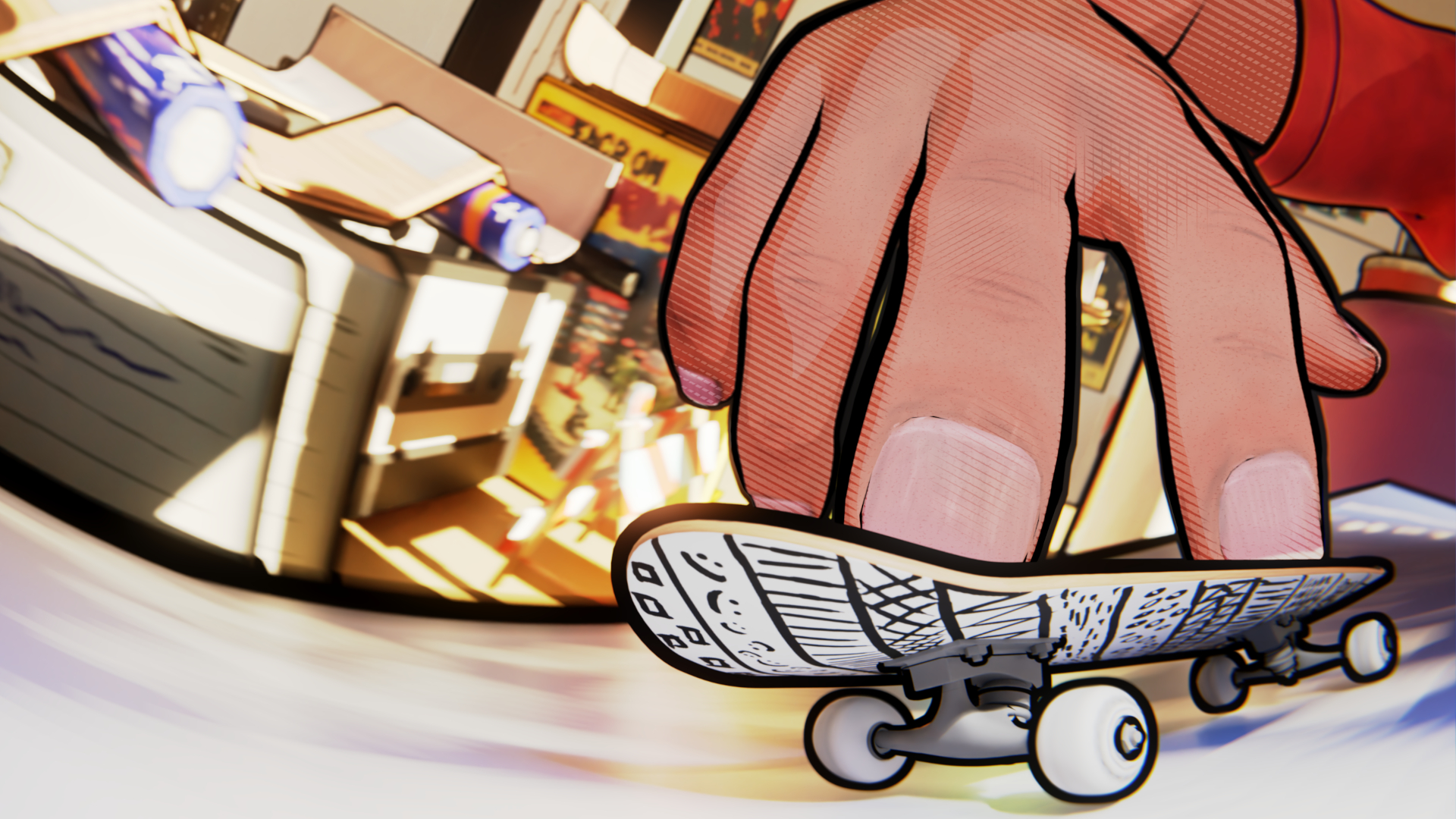
Stuntboost features toy fingerboards and miniature cardboard circuits that give the superficial impression of a chill, Hot Wheels-adjacent racer suited for younger audiences. However, unless the child in question is exceptionally accomplished with a precision mouse and keyboard setup, that casual assumption is quickly shattered. In fact, Stuntboost stands as perhaps the only skateboarding-themed game that carries a specific warning suggesting players utilize a mouse, and the reasoning behind this recommendation becomes immediately obvious the moment gameplay begins.
Once a player manages to learn a few foundational techniques, high-level Stuntboost gameplay transforms into a masterclass in velocity and precision. Despite its unconventional choice of vehicles, the title is fundamentally built for first-person shooter movement purists and enthusiasts—serving as an intense exercise in precise camera control and high-velocity first-person platforming. At its core, it operates as a streamlined three-button game focused entirely on jumping, crouching, and rail-grinding to rapidly gain and desperately maintain extreme momentum. Many of the game’s more than 40 tracks are deliberately designed as non-linear obstacle courses that actively demand players carve out their own unconventional pathways across the environment, with the developers explicitly encouraging the pursuit of creative shortcuts.
For weeks, players have found themselves thoroughly obsessed with mastering these intricate levels, repeatedly replaying tracks and shaving fractions of a second off their completion times in order to secure top-tier medals. Beyond the pursuit of medals, the competitive loop drives players to shave hundredths of a second off their personal bests to capture the coveted number-one spot on friend leaderboards. This dynamic fosters a uniquely dangerous environment for friendly rivalries, where players live in constant fear of receiving a notification that a personal best—honed through hours of grueling repetition—has been decisively shattered.

Yet, this fierce competition is universally welcomed because Stuntboost’s movement mechanics are fundamentally thrilling, and its maps are masterfully engineered to accommodate both standard routes and absurd, physics-defying trajectories. The wide ramps, massive jumps, and daring speeds draw natural comparisons to arcade racing series like Trackmania—specifically invoking a subset of community-built "full speed" tracks that never require the player to hit the brakes.
Furthermore, Stuntboost nails a variety of minor quality-of-life features that are rarely implemented with such polish in games backed by significantly larger budgets. Information regarding a track is revealed progressively to the player: friend times remain hidden until the track has been beaten at least once, while global leaderboards are locked away until the player earns a diamond medal. The spectral ghost of a player’s best time appears automatically upon restarting, but users can also toggle on the ghosts of friends or any other player occupying the global leaderboards. Players can even watch complete, unedited replays of anyone else’s run, provided they have already discovered the same shortcuts utilized in those runs. This smart, deliberate design choice prevents spoilers and actively entices players to explore every nook and cranny of a level to uncover what they might have missed.
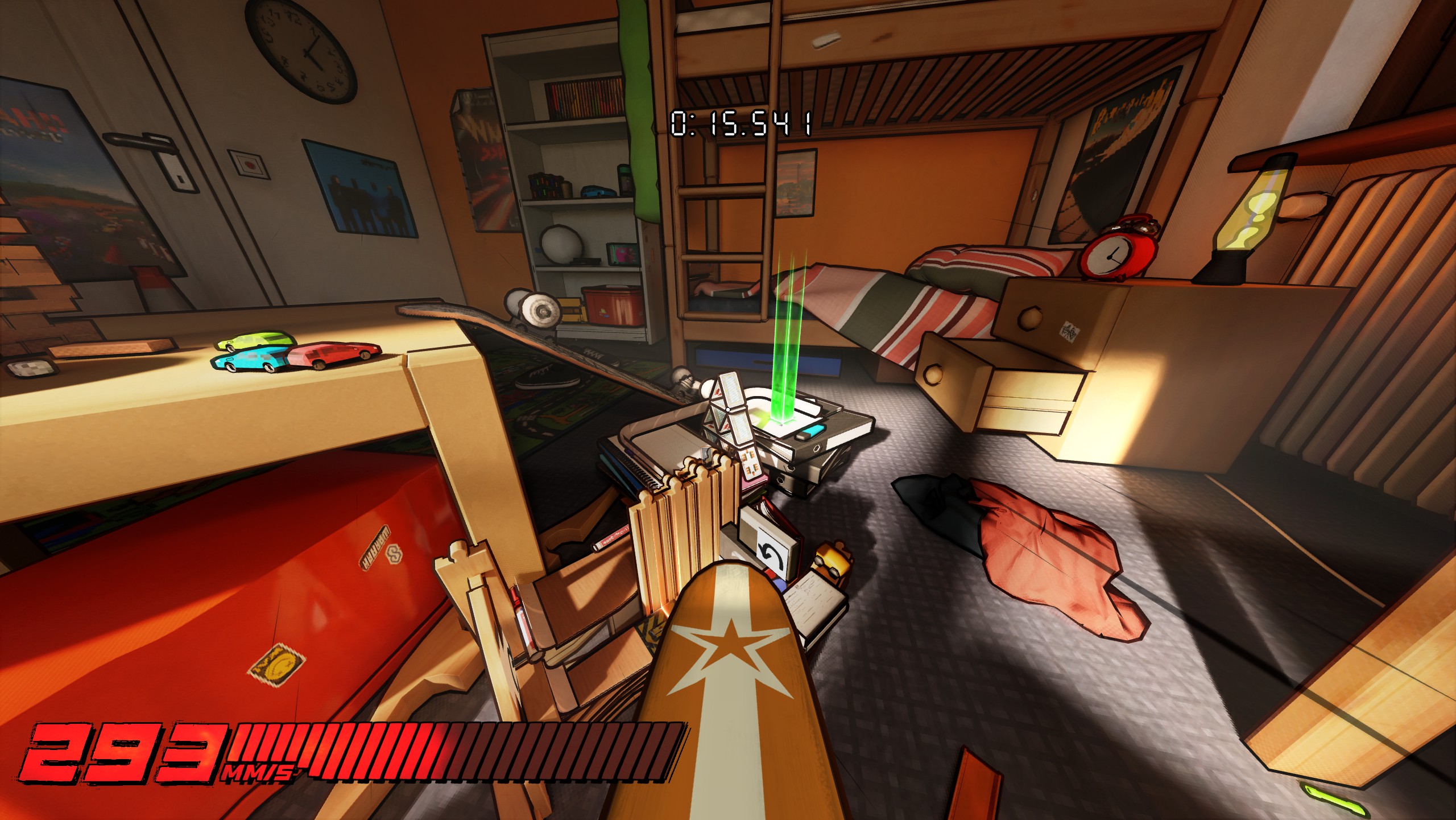
Watching these detailed replays serves as a vital tool for mastering the game, acting as the primary method for players to discover advanced community techniques such as varial kickflips, grind hopping, and sophisticated speed-storage methods. Within these environments, every sloped surface becomes an opportunity to accumulate just a fraction more velocity, while every ramp-shaped household object—ranging from dinner plates and playing cards to massive three-ring binders—transforms into a potential springboard capable of launching the player across the entire map. Consequently, the tactical variability hidden within a single track can be staggering.
As players progress through the game’s later worlds, which visit different rooms of the same overarching house, the experience expands far beyond the initial skateboard. The gameplay broadened to include car-based levels that revolve entirely around high-speed drifting, free-roam scooter levels featuring traditional collectible letters spelling out S-K-A-T-E, and a longboard vehicle that sacrifices the ability to jump in exchange for unique handling characteristics. While some of these alternative modes function primarily as neat palate cleansers, the car levels are particularly spectacular for the way they force players to fundamentally relearn how they handle corners and execute gravity-defying drifts that would be completely impossible on the standard skateboard.

Every single level also conceals a hidden cassette tape that unlocks a free-cam mode, which proves invaluable for scouting track layouts, while also contributing to the unlocking of an expansive set of bonus levels. For dedicated competitors, the package is rounded out by a comprehensive speedrun mode that times a continuous run of the entire game, a variety of cosmetic board skins, and a rotating daily challenge.
Priced affordably, Stuntboost represents a stunning achievement in unique, highly polished, and feature-complete indie game development. The reality that a title of this caliber has not dominated broader indie game discussions highlights a persistent disconnect between breakout commercial hits and niche passion projects. While mainstream attention frequently gravitates toward deckbuilders, auto-shooters, and city builders, the indie titles that truly resonate with movement purists tend to focus heavily on intricate physics and momentum mechanics.
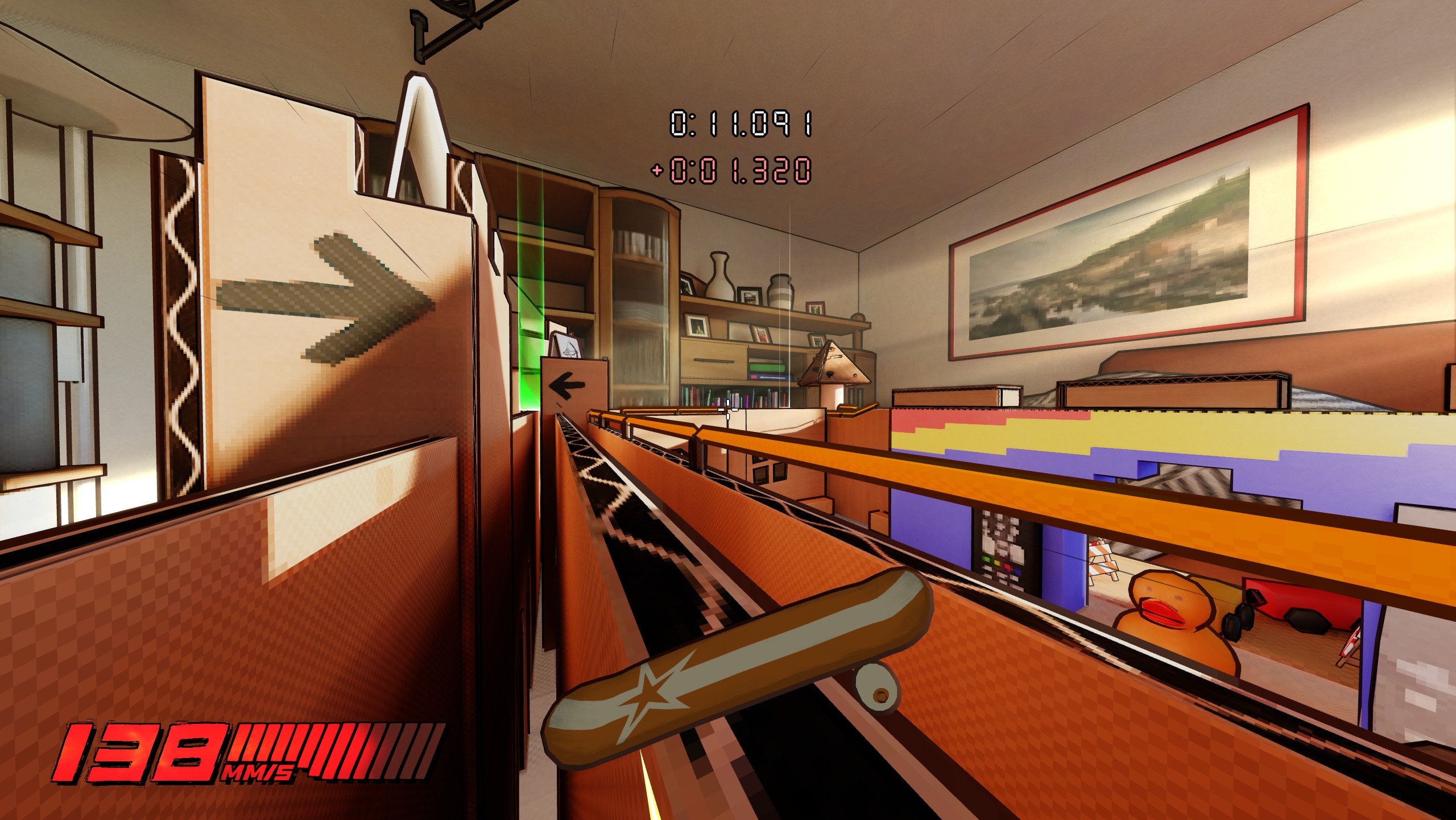
Stuntboost delivers an intoxicating rush characterized by high-speed turns, frantic precision, and heart-pounding near-misses. It offers a visceral gameplay experience that stands proudly on its own merits within the modern PC gaming landscape.