
When ancient astronomers gazed up at the night sky over four millennia ago while the pyramids of Egypt were still rising from the desert sands, the celestial map looked vastly different from the one we navigate today. Back then, the North Star was not Polaris, but a star named Thuban, nestled firmly within the constellation Draco the Dragon. It held that prestigious navigational title for centuries before the slow, stately wobble of Earth’s axis shifted the celestial pole elsewhere. For modern astrophotographers, that very same polar axis has long represented both a gateway and a formidable barrier. Aligning a telescope mount with the celestial pole—a meticulous ritual known as polar alignment—has historically been the mandatory price of admission for capturing long, sharp exposures of deep-space objects. It is a process widely known among enthusiasts for being fiddly, bitterly cold, and performed almost exclusively in the dead of night with a red-filtered flashlight held firmly between one’s teeth.
It is perhaps fitting, then, that DWARFLAB has chosen the name Draco for its newest flagship smart telescope. The entire design philosophy behind the instrument is engineered to allow stargazers to skip that frustrating alignment ritual altogether, transforming what was once an exercise in patience and equipment calibration into a seamless, automated experience. Known previously for developing pocketable, highly portable smart scopes like the DWARF II and DWARF 3, DWARFLAB’s latest hardware release is designed to prove that serious astrophotographers no longer need to sacrifice ambitious scientific reach for everyday convenience.
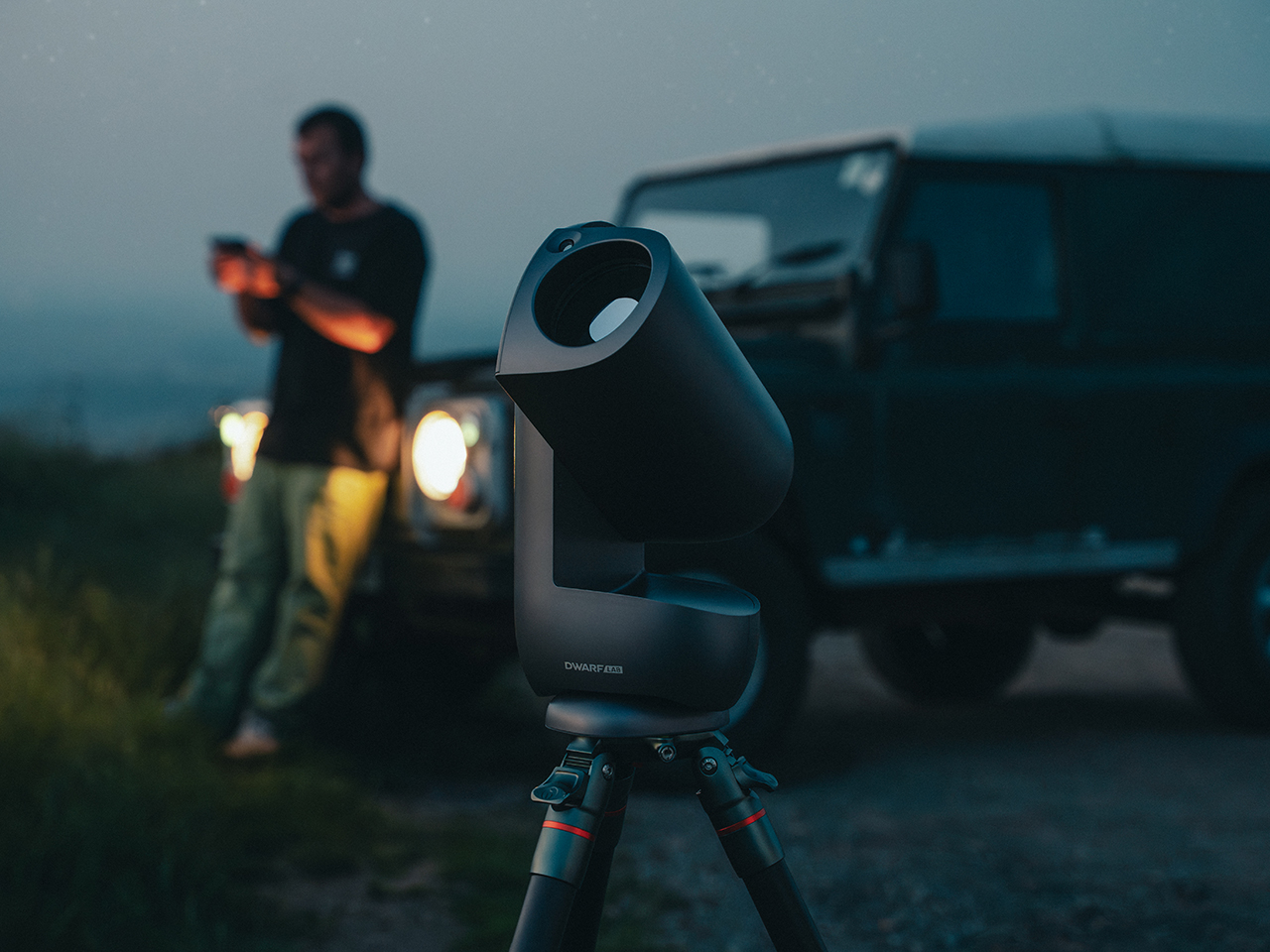
Weighing in at a manageable 12.1 pounds (5.5 kilograms) and easily carried with one hand, Draco is a sophisticated 90mm smart telescope that packs an impressive array of advanced optical and computational hardware into a compact, thermos-like capsule. The system features a folded f/3.8 optical system, a high-resolution 50-megapixel telephoto camera, a secondary wide-angle camera tailored for sweeping Milky Way panoramas, and a dedicated internal guide camera. However, the headline engineering trick that sets Draco apart from its predecessors and many competitors in the market is a physical sensor that actively rotates to counteract the Earth’s rotation. This clever mechanical solution allows the device to capture single exposures of up to 300 seconds on a simple, portable alt-azimuth mount, leaving a companion smartphone application to handle everything from target acquisition to image stacking. Pre-orders for the advanced SHO Edition are currently open at $1,599, while the $1,399 Standard Edition has already sold out its initial allocation.
A Sensor That Spins with the Sky for Five-Minute Exposures
The enduring necessity of polar alignment in traditional astrophotography stems entirely from a phenomenon known as field rotation. When using a simple alt-azimuth mount—the basic up-and-down, left-and-right mechanical configuration utilized by virtually all consumer smart telescopes—the stars in the night sky slowly appear to twirl around the center of the imaging frame during extended exposures. Left uncorrected, this natural motion turns pinpricks of distant starlight into unsightly streaks and smears across the final photograph.
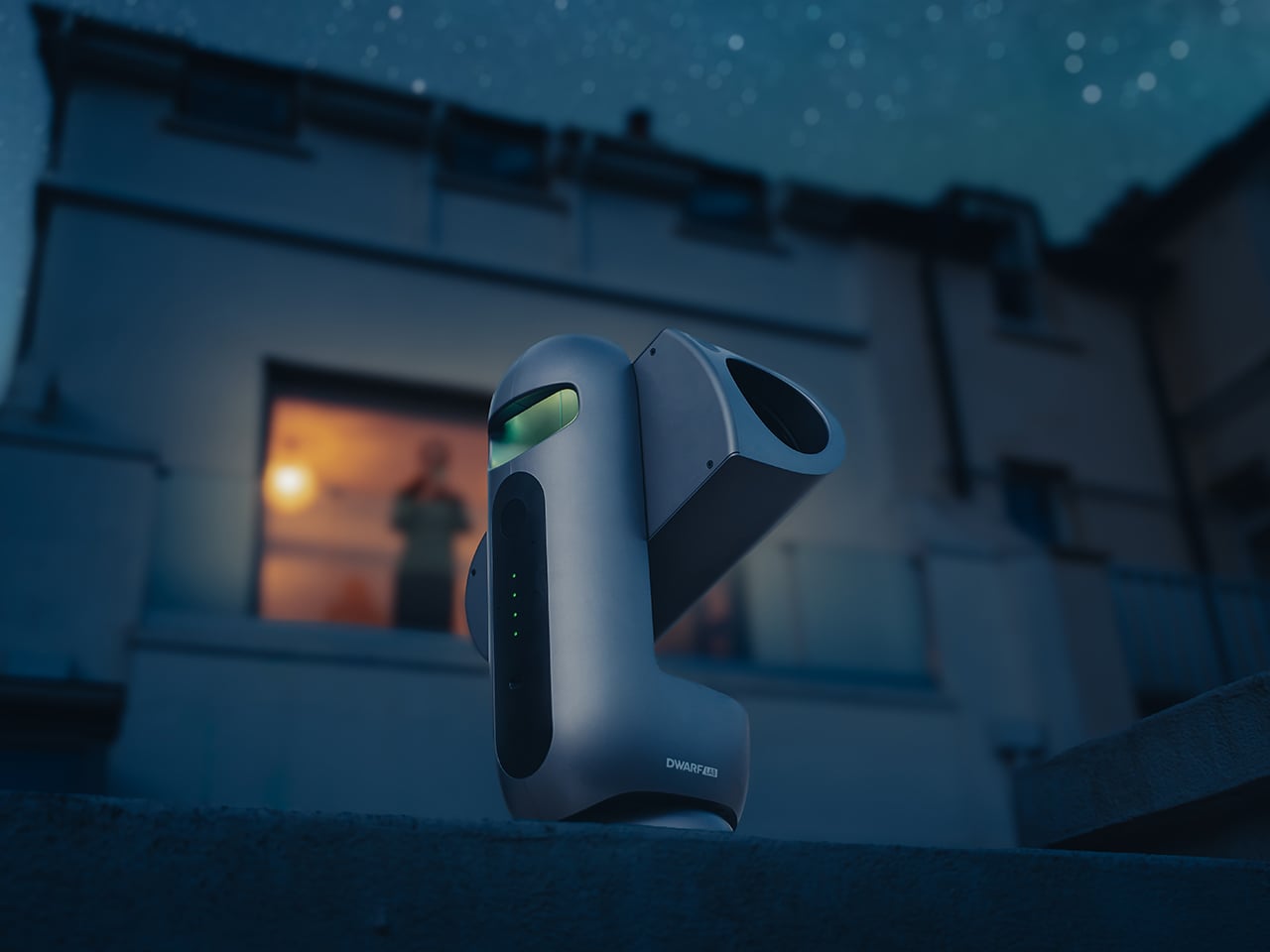
Draco addresses this optical challenge with a remarkably direct mechanical intervention: the internal CMOS sensor itself physically rotates in real time to match the precise angular velocity of the sky. Operating in tandem with this rotating sensor is a separate monochrome guide camera that constantly monitors for tracking drift and applies subtle corrections on the fly. The practical payoff for astrophotographers is dramatic. While most conventional smart telescopes quickly top out at single exposures of roughly 60 seconds before image degradation sets in, Draco extends single frames to as long as 300 seconds. This capability thrusts the portable device firmly into traditional deep-sky imaging territory, eliminating the need for the bulky, complicated guiding gear that typically requires an hour of meticulous field balancing in freezing weather.
For decades, assembling a traditional deep-sky imaging rig has meant compiling an extensive inventory of separate components: an optical tube assembly, an equatorial mount, a polar alignment scope, a guide scope, a separate guide camera, a filter wheel, a dedicated mini-PC, and a chaotic nest of power and data cables. Draco consolidates these disparate elements—optics, mount, guide camera, internal filtration, field rotation mechanics, and onboard computing—into a single, unified 5.5-kilogram enclosure. This radical integration transforms the equipment from a time-consuming technical hurdle into an accessible tool.
While early generations of smart telescopes successfully captured the interest of beginners through short exposures and automated stacking, serious imagers traditionally retained their complex, heavy-duty rigs for faint nebulae and distant galaxies. Draco bridges that gap. For celestial targets positioned nearly overhead, where apparent field rotation speeds up significantly, the telescope’s all-metal base can be manually tilted into Equatorial Mode, with the companion smartphone application guiding the user smoothly through the required angle adjustments. To support this setup without adding excessive weight to field kits, the included aluminum tripod weighs a mere 17 ounces (480 grams) and unfolds automatically to a pre-set angle.
Ninety Millimeters of Aperture and a Sensor That Bins Four Pixels into One
Transitioning from the 50mm aperture size that has become standard across many mainstream smart telescopes up to Draco’s larger 90mm objective lens yields approximately 3.2 times the light-collecting surface area. This optical threshold represents a crucial benchmark for serious astrophotographers who demand greater photon throughput to reveal faint cosmic structures. The telescope’s folded optical design achieves a focal length of 340 millimeters at a fast f/3.8 focal ratio, an optical configuration that gathers light rapidly and allows faint deep-sky targets to materialize much faster on screen. Furthermore, an aberration-corrected optical layout ensures that stars remain remarkably sharp and well-defined from the absolute center of the frame out to the extreme edges. To put this into perspective, competing models such as ZWO’s Seestar S50 Pro retail for $999 with a 50mm, f/5.2 optical train; Draco commands a higher price point in exchange for nearly double the light-gathering aperture.
At the heart of the imaging system lies a large 1/1.3-inch, 50-megapixel sensor designed to operate in two distinct modes depending on the astronomical target. When imaging faint nebulae and distant galaxies, the system employs a 2×2 binning process, merging four smaller 1.2-micron pixels into a single larger 2.4-micron pixel. This hardware-level binning produces cleaner, more detailed 12-megapixel images with enhanced sensitivity to faint light signals. Conversely, when the telescope is pointed toward the Sun, the Moon, or nearby planets, it switches instantly to its full native resolution readout and crops tightly around the target. This high-resolution mode allows users to resolve fine details such as lunar craters, intricate sunspots, the distinct rings of Saturn, and the swirling dynamics of Jupiter’s Great Red Spot.
Operating simultaneously alongside the primary telephoto optics is a secondary wide-angle camera featuring a 23.3mm equivalent focal length. This auxiliary lens covers a sweeping 85.74-degree diagonal field of view, making it ideal for capturing expansive Milky Way panoramas and dramatic star trail sequences. To ensure optimal sensor performance during long imaging sessions, Draco incorporates active thermoelectric cooling (TEC) and waste-heat dew prevention directly into the chassis architecture, integrating thermal management natively rather than relying on external aftermarket accessories.
The SHO Edition Automates Hubble Palette Imaging
In 1995, the release of the Hubble Space Telescope’s iconic "Pillars of Creation" photograph captivated the public imagination, presenting emission nebulae rendered in glowing golds, teals, and deep blues. Ever since, amateur astrophotographers have sought to replicate that distinctive aesthetic, known technically as the Hubble Palette. The complex recipe relies on mapping specific narrow bands of light—assigning ionized sulfur II to the red channel, hydrogen-alpha to the green channel, and ionized oxygen III to the blue channel. Each of these narrow bands is captured through specialized filters that pass only an extraordinarily thin slice of the optical spectrum, measuring just 13 nanometers wide in Draco’s configuration.
The specialized SHO Edition of the telescope comes equipped with an internal filter wheel carrying an H-alpha plus oxygen III filter and a sulfur II plus oxygen III filter. The system runs these narrowband filters in automated sequence and merges the resulting data streams without requiring manual intervention. Traditionally, achieving this look required assembling a separate filter wheel, tethering a laptop to the mount, and spending an entire weekend navigating complex image-processing software. Draco streamlines this sophisticated workflow into a native capability, complete with automated calibration, accessible via a single tap on a mobile device.
Both available editions of the telescope share a standard Astro filter, a mechanical dark-frame shutter, and the H-alpha plus oxygen III filter, which assists significantly in cutting through light pollution when imaging emission nebulae from urban or suburban backyards. The Standard Edition, priced at $1,399, incorporates a built-in neutral density (ND) filter that functions essentially as sunglasses for the telescope, sliding into place with a single tap for safe solar observation. The SHO Edition, priced at $1,599, swaps the built-in solar ND filter for the advanced sulfur narrow-band filter and instead includes a magnetic external ND filter that users snap onto the front aperture before aiming the optics at the Sun. Once engaged, the dedicated Solar System Mode automatically centers, focuses, and locks onto the solar disk or the lunar surface, opening up daytime astronomy to casual observers. Naturally, distant galaxies and faint Milky Way structures still demand dark skies, providing an ideal justification for a weekend road trip away from city lights.
A Portable Capsule Controlled Remotely via Mobile Integration
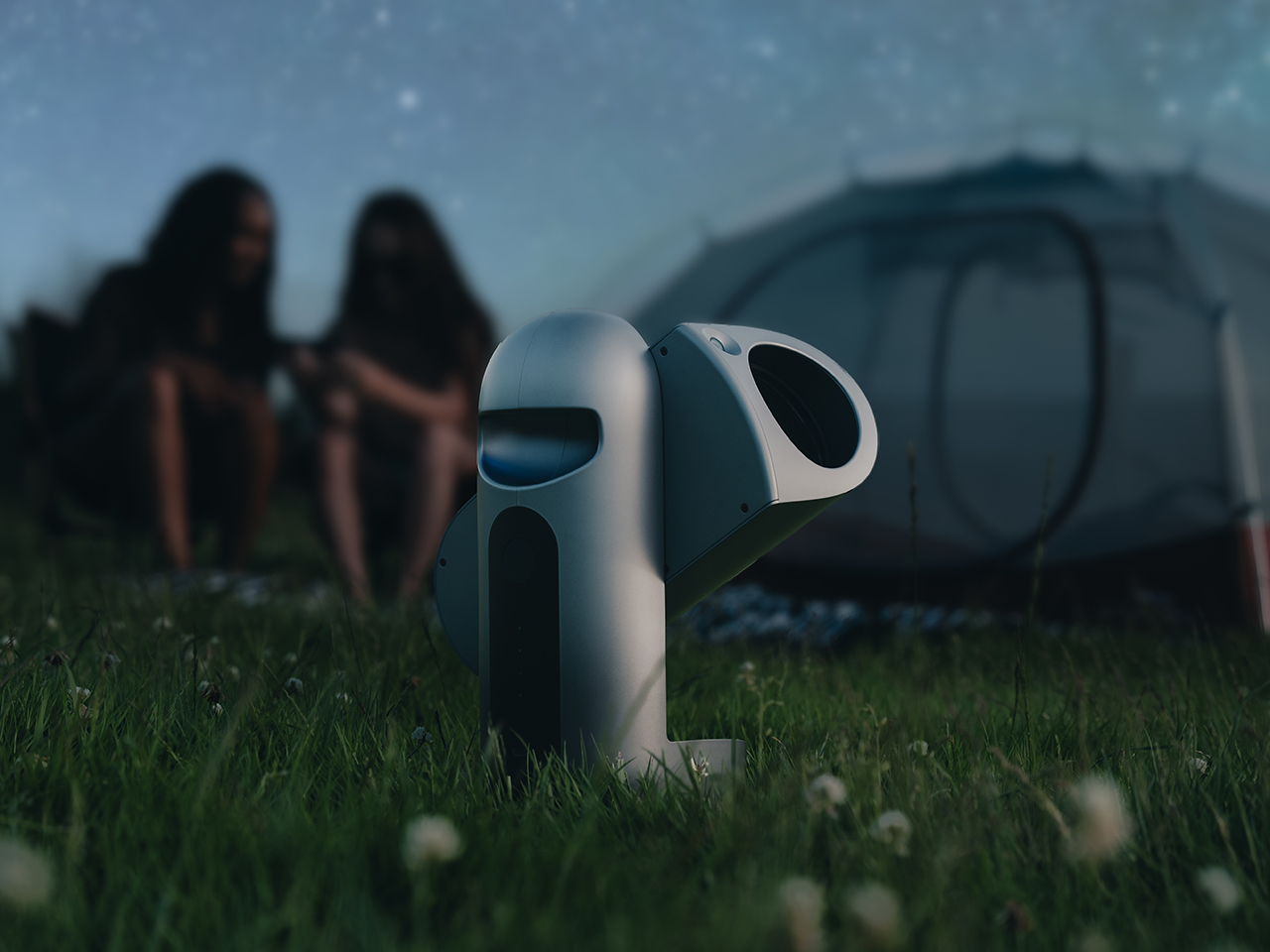
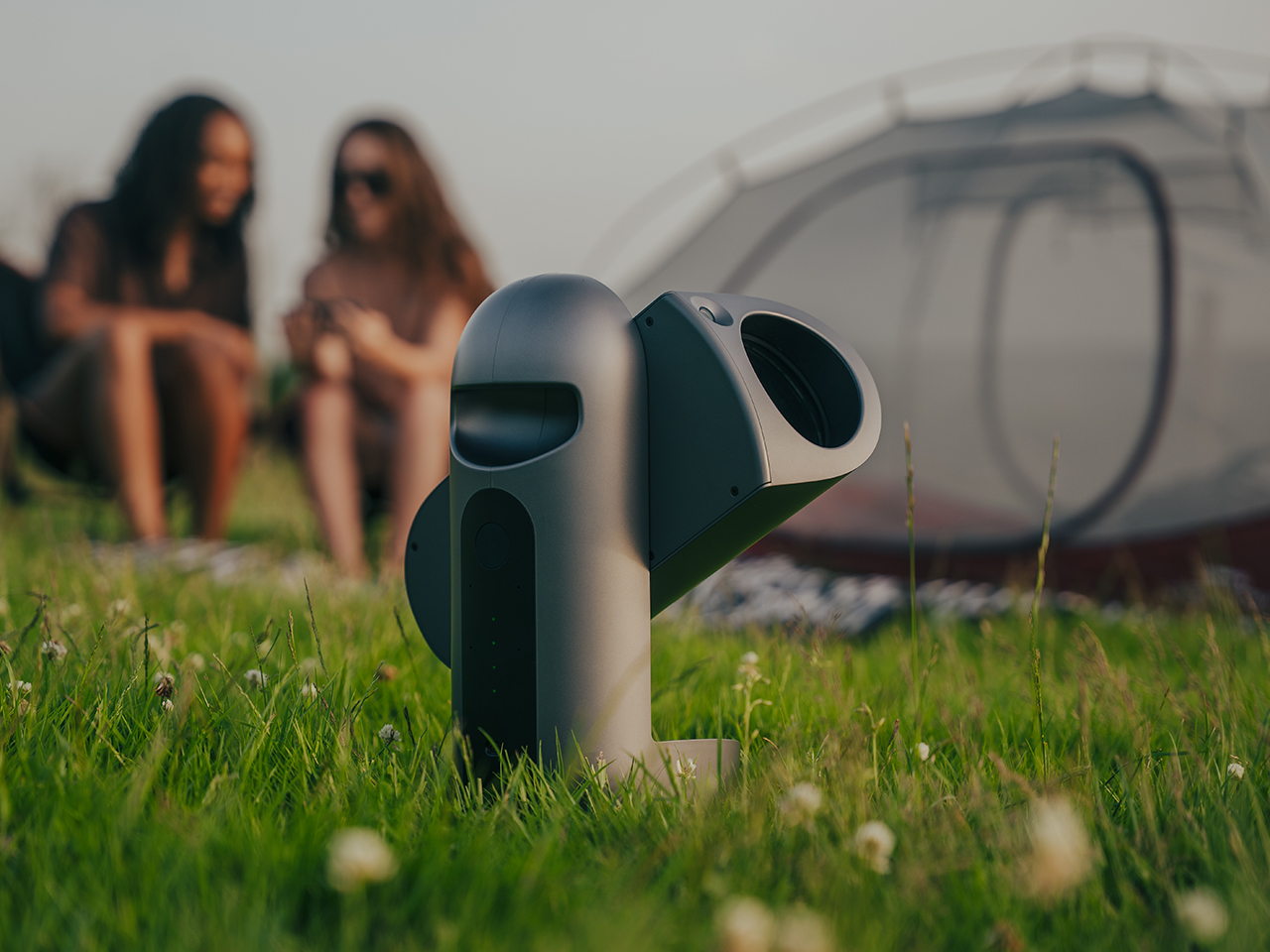
From an industrial design standpoint, Draco presents a smooth, capsule-like column with the optical tube assembly hinged neatly along one side. When fully stowed, the instrument resembles an upscale, high-end thermos. A discreetly recessed carrying grip allows the entire 5.5-kilogram unit to be transported effortlessly with one hand from a residential living room out to a vehicle. Once mounted, the all-metal base secures firmly into a dedicated metal frame, establishing a rigid, vibration-resistant stance atop the included tripod.
Connecting to the device is designed to be frictionless; tapping a smartphone against the body of the telescope utilizes NFC technology to instantly launch the companion application. Within the app, an augmented reality (AR) Sky Finder visually displays which celestial objects are currently visible overhead, factoring in local obstructions such as trees or buildings. Users simply select a desired target, tap a GoTo command, and the telescope autonomously handles focusing, calibration, tracking, and image stacking. Powering the untethered session is an internal 10,000mAh battery capable of delivering approximately five hours of continuous field operation.
For extended deployment, the system supports PhotonLink remote control, enabling operators to manage imaging sessions from indoors through the mobile application, while Ethernet-over-USB connectivity provides a reliable wired data link for permanent backyard observatories. Users can schedule specific targets in advance, allowing the telescope to wake up autonomously, locate the objects, and execute imaging sequences under clear night skies while the operator sleeps. This shifts the operational burden entirely onto the hardware rather than requiring constant user supervision.
Advanced processing features built into the app include Mega Stacking, which combines data captured across multiple separate nights, and Astro Mosaic, which stitches together multiple frames to widen the apparent field of view. Furthermore, Stellar Studio within the application provides automated tools for star reduction, star removal, and instant rendering of the Hubble Palette effect, while full FITS and TIFF file exports remain available for users who prefer to process their raw data through traditional desktop workflows. Pre-orders for the Draco smart telescope are currently active through the manufacturer’s official channels, with the SHO Edition listed at $1,599 and initial shipments estimated to arrive within three months. By automating the mechanical complexities that have historically defined the hobby, Draco effectively transitions astrophotography from a hands-on technical challenge into an accessible visual product.