HYÈRES, France — Marking a significant turning point for its storied history, the 41st edition of the Hyères International Festival of Fashion, Photography and Accessories ushered in a fresh chapter under a restructured leadership team. The milestone event culminated with a prestigious fashion competition juried by some of the industry’s most respected voices, led by Chloé creative director Chemena Kamali. Amid a renewed focus on creative freedom and authentic support for emerging talent, Chinese designer Yui Chen emerged as the standout star, capturing the festival’s highest honor.
Chen claimed the Grand Jury Prize of the fashion competition for her conceptual collection titled “Food Cover.” Joining Kamali on this year’s distinguished evaluation panel were last year’s grand jury prize winner Lucas Emilio Brunner, Harper’s Bazaar France fashion director Elodie David Touboul, Agency Maybe artistic directors Charles Levai and Kevin Tekinel, 10 Magazine editor-in-chief Sophia Neophitou, and renowned photography duo Inez van Lamsweerde and Vinoodh Matadin.
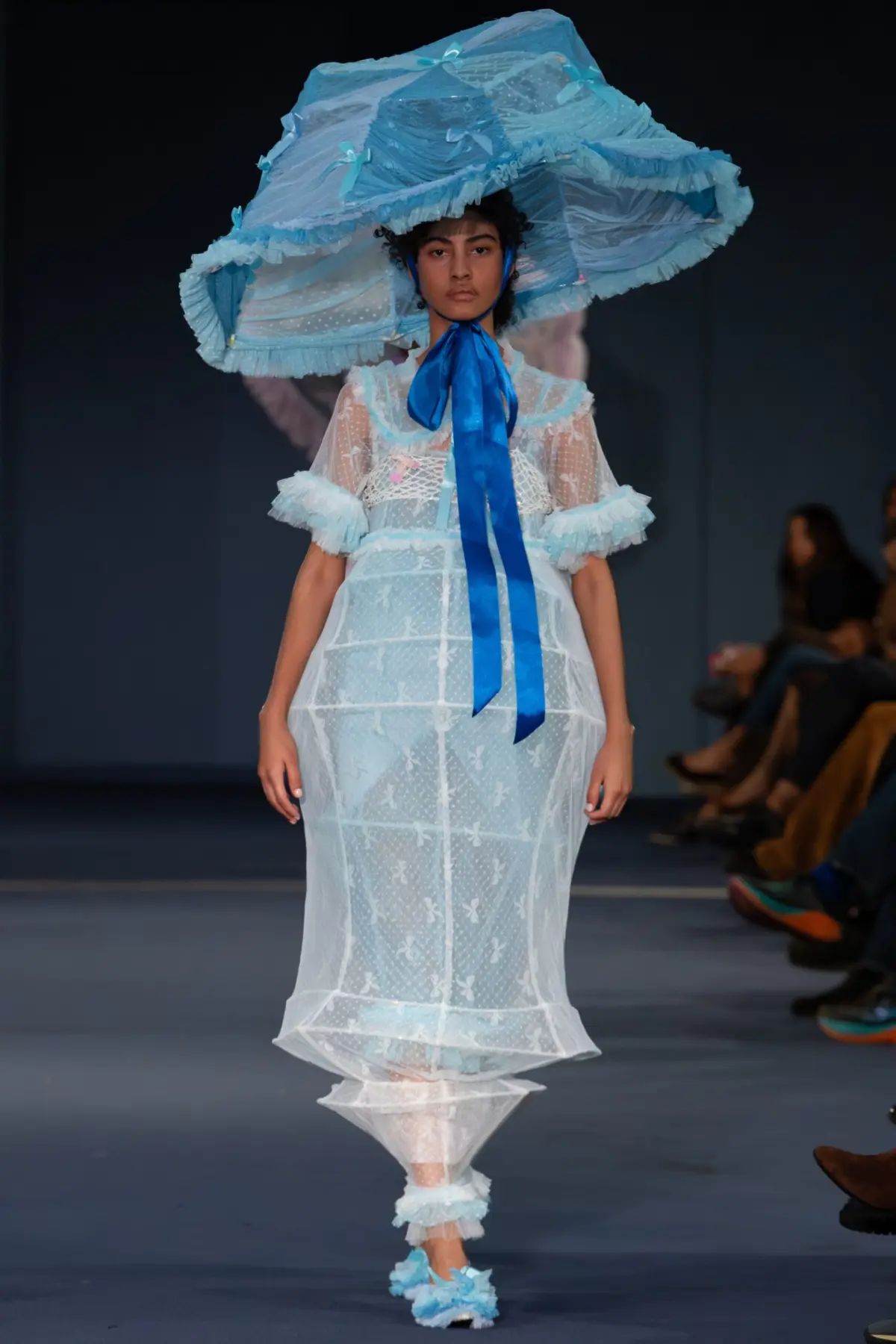
Drawing her primary creative inspiration from the humble, everyday food cover, Chen embarked on a rigorous process of deconstruction, translating its familiar architecture into striking, three-dimensional silhouettes. Her designs boldly challenged conventional perceptions of clothing through sculptural forms, unconventional material experimentation, and a brilliant reinvention of the negative space existing around the human body.
Throughout her winning runway presentation, familiar garments such as sleeping dresses and shirts were repurposed as dynamic vehicles for exploring volume, sheer layering, and foldability, sending pieces down the runway with a distinct sense of physical bounce. Recycled leather was deployed to offer yet another creative approach, highlighted by an all-encompassing coat lavishly covered in delicate bows.
By delicately balancing domestic references with advanced technical innovation, Chen successfully approached every individual garment as a wearable sculpture, often paired with striking protective headgear. Reflecting on her conceptual vision, she explained that her overarching goal as a designer is to take ordinary, everyday items and encourage audiences to look at them through an entirely renewed lens, fundamentally shifting how people perceive the material world.

Expanding Accolades Across International Talents
Beyond the top honor, the festival celebrated a diverse array of exceptional international creators across multiple specialized prize categories. The second annual Supima Prize—which comes complete with a substantial endowment of premium materials and an all-expenses-paid trip for the finalists to the upcoming Supima Design Lab in New York—was awarded to fellow Paris-based Chinese designer Xiao Xu. Xu captured the judges’ attention with her collection, “Uncanny,” which brilliantly examined the tense psychological boundary between domestic familiarity and fetishistic sensuality.
Drawing direct inspiration from the archival book “Dressing for Pleasure,” Xu juxtaposed everyday garments with highly unconventional materials. She cleverly transformed ordinary sweaters and cardigans into latex-based constructions that revealed their jelly-like strangeness only upon closer inspection by the viewer. The collection continually challenged traditional, conventional notions of masculinity by combining commanding, powerful silhouettes with delicate ruffles, gathered details, and intricate ornamental touches. Collaborations with specialized ateliers further expanded her material exploration, yielding knit-like chain structures, embroidered latex, and inflated trench coats. Xu noted that her intention was to offer audiences a moment of pure joy, designing with a spirit that was far more playful than provocative.
Meanwhile, Mexican-German designer Dieter Vlasich Obermann captured the coveted Le19M Métiers d’Arts Prize, presented in partnership with Chanel. His collection, titled “Tiliches,” deeply explored the emotional and cultural resonance of handmade objects, drawing heavily on childhood memories of collecting cherished items that his grandmother had dismissed as mere junk. The collection served as a vibrant celebration of imperfections, raw material qualities, and the undeniable traces of human craftsmanship that impart deep meaning to everyday artifacts.
Collaborating closely with skilled embroiderers from Yucatán, Mexico, Obermann seamlessly wove traditional artisan techniques into contemporary garments. His pieces harmonized recycled leather, highly textured fabrics, delicate beadwork, and intricate embroidery, while the inclusion of naturally dyed raffia introduced rich earth tones and direct references to traditional Mexican folk art. Notably, his collaboration with Le 19M’s Maison Michel successfully reinterpreted traditional hat-making techniques into innovative footwear design.
Paris-based Dutch designer Rachel Luurssen took home the Atelier des Matières prize for her evocative collection, “Pandora’s Box: The Pursuit of Perfection.” Luurssen’s work delved into the complex contradictions between society’s relentless pursuit of aesthetic beauty and the inherent impossibility of achieving perfection. Inspired by Robert Greene’s literary work “The Art of Seduction,” the collection investigated the internal conflict of a woman torn equally between the profound desire to be loved and an overwhelming fear of vulnerability, all set against the idealized, nostalgic glamour of 1950s Hollywood.

By juxtaposing this highly polished fantasy against the psychological distortions of body dysmorphia, Luurssen questioned rigid societal expectations placed upon the female body. Her pattern-making process began directly from the bodily measurements of a plus-size model, after which silhouettes were intentionally distorted to create an outer layer that appeared to slip and warp dynamically around the body.
The jury also extended a special mention to Spanish designer Brais Albor Rodriguez for his squirrel-inspired collection, “Por Mis Santos Cojones,” which additionally earned him the popular public prize. Dedicated to "big boys" who are frequently overlooked within the mainstream fashion market, Albor Rodríguez channeled the workwear aesthetics of tailor Franz Reichelt and the tragic tale of his ill-fated parachute experiment, translating powerful concepts of risk and physical rescue directly into garments. A shirt cleverly evoked the appearance of a parachute, while velvet trousers featured double openings hinting at an interrupted escape. Sculptural hats and accessories further transformed the body’s proportions, while a sustainable green coat combined baby llama and wool, alongside discarded linen-production waste that was dyed and repurposed for the runway.
In the accessories category, the jury was chaired by designer Cecilie Bahnsen, alongside last year’s grand prize winner Amaury Darras, 1ilat founder and editor-in-chief Olya Kuryshchuck, journalist Susie Lau, casting director Emma Matell, and A Magazine Curated By managing editor Jemma Pinueva. The grand prize in accessories was awarded to Sassa Ann van Wyk. Additionally, the inaugural AZ Academy award, established in honor of the late designer Alber Elbaz, was presented to Daniel Cheruzel, who will join the foundation’s prestigious accelerator program. The public prize in the accessories division went to Matteo Artuso.
New Leadership Streamlines and Refocuses the Event
Underpinning the festival’s vibrant creative output was a clear, unmistakable shift in institutional priorities driven by its incoming leadership team. For Valérie Duport, who was elected president of the board of Villa Noailles in July, and Hugo Lucchino, who joined last year as managing director, the core mission involves concentrating vital resources directly onto the designers and photographers at the beating heart of the event, rather than spreading energy thin across a sprawling program of peripheral activities.
"What is important at the center of all this is creativity, freedom, young designers," Duport stated. "The idea was really to focus on the creation, their story, what they propose, and all the organization was done to make this happen and to give them a voice."

Echoing this sentiment, Lucchino emphasized that the team wanted to redirect absolute attention toward the foundational DNA of the Festival d’Hyères. "All the means of Villa Noailles, financial and human, are going back to the finalists and to the creators. So we have a team and partners dedicated to this support, who are really much more important than before," he explained.
This structural shift manifested in tightly curated exhibitions and a focused fashion show, supported by three associate artistic directors working alongside the festival’s artistic director, Magali Guérin. The overarching goal is to afford finalists significantly more time, institutional backing, and professional visibility. The arrival of the new leadership team comes at a critical juncture, arriving as the festival and its parent association, Villa Noailles, navigated previous financial challenges and administrative hurdles that led to the departure of founder Jean-Pierre Blanc.
The practical result for this year’s iteration was a noticeably streamlined and meticulously organized event, featuring fewer side parties and a downtown fashion show integrated directly into the center of the city. For Duport—whose impressive resume includes 27 years at Chanel and eight years at Kering—taking on the role represents an opportunity to channel her extensive luxury industry experience into an institution currently navigating a fragile position, yet serving as an indispensable pillar for the future of creative talent. Paired with Lucchino’s extensive background in public affairs, institutional administration, and museums, including Paris’ Palais Galliera, the duo forms a deeply complementary leadership unit.
The leadership also utilized the festival to make a distinct statement regarding representation, notably appointing three prominent women to head the competition juries: Kamali for fashion, Bahnsen for accessories, and French artist Camille Vivier for photography. Lucchino noted that this decision was an intentional signal to the broader creative industries. Pointing out that the vast majority of art and fashion school students are women, he emphasized the vital need for relatable role models.
Beyond the immediate scope of the festival, the leadership faces the ongoing task of ensuring that Villa Noailles can sustain its support for emerging talent over the long term. Achieving this will require robust, sustained public and private partnerships, with Duport stressing that future collaborators must offer practical, hands-on support—such as technical expertise, materials, and actionable advice—that genuinely reflects the festival’s overarching mission. Furthermore, the team remains deeply committed to preserving the festival’s public accessibility, ensuring that local residents, students, and tourists can continue to engage with exhibitions that remain open long after the festival concludes.

Young Designers Address the Realities of Building a Sustainable Business
As part of the festival’s extended programming, the leadership organized panel discussions addressing the genuine, day-to-day realities of running a young fashion brand. Designers Esther Manas and Alain Paul took the stage alongside 1Granary’s Kuryshchuck and Serge Carreira, director of emerging brands at the Fédération de la Haute Couture et de la Mode, to discuss the shifting retail landscape.
With traditional department stores experiencing widespread turbulence, many emerging brands are actively stepping away from wholesale models. Kuryshchuck bluntly advised young creators against focusing heavily on wholesale, noting that the sector is currently facing a severe structural crisis. She urged designers to evaluate wholesale strictly through the lens of profitability rather than mere sales volume, noting that production demands, delayed payments, and operational overhead often consume immense resources while yielding minimal actual financial return.
Manas shared her own brand’s journey, revealing that she and co-founder Balthazar Delepierre made the definitive decision to abandon wholesale entirely to focus exclusively on direct-to-consumer sales and strategic collaborations. She explained that traditional retail models frequently conflicted with their small team’s operational capacity and creative identity, particularly regarding sizing issues and department store misunderstandings surrounding inclusive, one-size-fits-all concepts aimed at plus-size consumers. Despite the financial and operational risks, Manas noted that moving toward direct engagement via digital channels and selective brand partnerships has allowed them to stay true to their core message.
Conversely, Carreira cautioned against abandoning wholesale prematurely, emphasizing that multi-brand retailers remain essential partners for building visibility, reaching broader audiences, and establishing a brand’s market position. Echoing this perspective, Paul shared that wholesale remains the absolute backbone of his label, generating approximately 95 percent of its revenue through a network of roughly 35 international stores. This consistent revenue stream provides the necessary cash flow to finance new collections and runway presentations, though his label is simultaneously exploring ways to expand its direct-to-consumer reach and foster closer client relationships through bespoke, made-to-measure offerings.