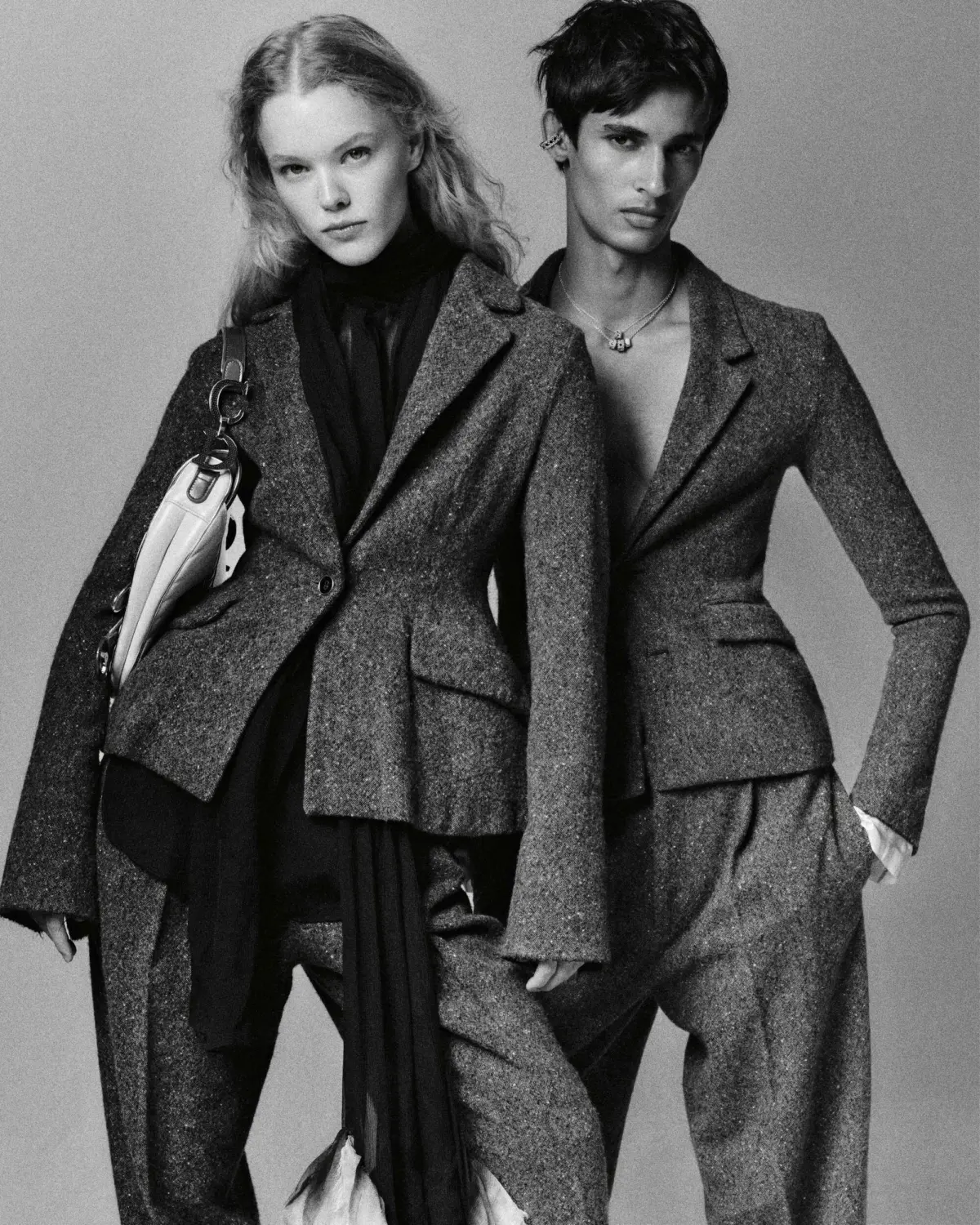
In the turbulent media landscape of 1996, when French fashion and news publications were folding left and right amid a punishing economic climate, industry veterans Tiziana Humler and Christian Ravera made a counterintuitive gamble. Rather than retreating to safety, they decided to launch Mixte, a biannual publication designed to give idled photographers, artists, and writers a radical platform for uncompromised, free expression.
It was an era defined by cultural shifts—the ubiquitous rise of Calvin Klein’s CK One fragrance and maverick designer Jean Paul Gaultier’s pioneering gender-bending runway shows. Sensing a profound cultural appetite for a more fluid approach to identity, the founders decided to anchor their publication around a central, daring theme.
“If we were going to launch a fashion magazine, it had to be different. So the idea was to be unisex,” Tiziana Humler-Ravera recalled in an interview, reflecting on the genesis of the title.
Humler-Ravera brought deep publishing experience to the venture, while her spouse and creative director, Christian Ravera, was a seasoned art director with a pedigree that included working with Vogue Hommes International. Together, they envisioned a publication that would blur the rigid boundaries traditionally separating high fashion, contemporary art, investigative journalism, and youth culture.

Though their forward-thinking concept initially flummoxed traditional advertisers who were accustomed to more conventional, highly segregated editorial formats, Mixte persevered. Nearly three decades later, the biannual publication is still going strong, marking its enduring legacy with a monumental 500-page anniversary issue—the thickest in its storied history. To celebrate the milestone, the magazine is also mounting a multi-disciplinary exhibition in Paris, opening on Nov. 6 for a special three-day run.
Spanning rare photographs, compelling videos, and archival text, the Parisian exhibition is organized meticulously by theme. It is designed to showcase how Mixte has long flown the flag for free creative expression while consistently demonstrating a remarkably prescient antennae for emerging talent.
From its earliest days, the magazine served as an indispensable incubator for creative heavyweights who would go on to shape the global fashion and media industries. Babeth Djian, who would later go on to found the influential Numéro magazine in 1999, served as the editor-in-chief for Mixte‘s trailblazing debut issue. That historic first edition was fronted by the late British supermodel Stella Tennant alongside actor and musician Vincent Gallo, both famously captured by renowned photographer David Sims wearing the exact same pinstriped jacket and sporting matching center-parted hair.
Other foundational contributors who passed through the pages of Mixte on their ascent to greater fashion fame include legendary stylists and editors Carine Roitfeld and Emmanuelle Alt, as well as creative visionary Olivier Zahm and prominent French journalist Loïc Prigent.
Throughout its history, the magazine has continually attracted the world’s most sought-after visual artists. Mixte nabbed supermodel Naomi Campbell for a striking cover as early as 1997. Over the decades, the publication conscripted an illustrious roster of acclaimed photographers, including Paolo Roversi, Peter Lindbergh, Jean-Baptiste Mondino, and Jean-Paul Goude—the latter of whom famously captured visionary Icelandic pop icon Björk for one of his signature, limb-lengthening surrealist collages.

Yet, what truly set Mixte apart from its glossier, strictly commercial peers was its unwavering commitment to substance alongside style. Substantive, deeply reported investigative pieces focusing on pressing social issues became a vital calling card for the publication. An early, hard-hitting feature explored the deeply repressive conditions faced by women in Iran, proving that the magazine’s editorial mandate extended far beyond the traditional boundaries of clothing and seasonal trends. Alongside these socio-political deep dives, Mixte consistently championed groundbreaking talents across music, film, art, and independent fashion.
“Not just the brands that are advertisers,” Humler-Ravera pointed out, emphasizing the publication’s fierce editorial independence and dedication to genuine artistic merit over corporate curation.
This spirit of unscripted curiosity frequently led Humler-Ravera and Ravera into unexpected, headline-making encounters. One of the publication’s most memorable coups occurred shortly after Karl Lagerfeld’s spectacular autumn 2017 fashion show for Chanel, which famously featured a massive, towering rocket ship on the runway. Seizing upon the aerospace theme, the founders conscripted the legendary German designer to conduct a live televised interview with French astronaut Thomas Pesquet—while Pesquet was actively floating in zero gravity on board the International Space Station.
“[Lagerfeld] did a lot of shoots for us, and he shot a series that focused on space and the moon. That’s how we came up with the idea,” Humler-Ravera explained, illustrating the whimsical yet ambitious creative network the magazine has cultivated over the years.
In an era defined by the digital migration of media and the steady contraction of print journalism, Mixte maintains a resilient presence on newsstands. The publication still prints a stable 60,000 copies per issue, with an impressive 40 percent of those copies sold outside of France, demonstrating that a commitment to fearless, uncompromising creativity continues to resonate with an international audience hungry for authentic visual storytelling.