It was an evening dedicated to marking four decades of journalism, a celebration of the newspaper-turned-content powerhouse where I spent close to a decade of my career before eventually making the transition to Project Monocle. The milestone anniversary party was hosted in one of the world’s most prestigious cultural institutions, the British Museum, offering guests a rare backdrop for an already memorable evening of industry reunion and reflection.
Amid the mingling, the clinking of champagne glasses, and the low hum of conversation echoing through the historic galleries, attendees were given a rare and coveted opportunity: the chance to slip away to view the Bayeux Tapestry. This near-1,000-year-old, 70-metre-long embroidery—currently on loan in the United Kingdom from France—is famously difficult to secure viewing tickets for under normal circumstances. Naturally, the answer to the invitation was an immediate and enthusiastic yes.
The display itself is thoughtfully curated. The historic tapestry is laid out flat inside a long, elegant glass cabinet that protects its delicate, centuries-old threads while allowing for an unobstructed view. Running the entire length of the exhibit is a digital screen that highlights key moments from the stitched narrative, guiding viewers through the dramatic historical storyline of the Norman invasion of England in 1066. The room is intentionally kept dark, creating an intimate, atmospheric environment where the ancient artwork is beautifully and precisely lit.
Yet, experiencing such a monumental piece of history in a shared space comes with its own social dynamics. The trouble arises when a fellow visitor is thoroughly determined to take in every single, minute detail, causing a logistical bottleneck that can leave you stuck staring at the exact same panel for an extended period. On this particular evening, the queue ahead of me was populated by some remarkably thorough, almost overly studious art enthusiasts.
Sensing the slow pace, my former colleague Ruth offered a pragmatic editorial solution: why not execute a speed read by simply jumping into the line wherever a noticeable gap appeared? "You know what’s going to happen. Do you really need to see it all?" she asked, demonstrating the instinctive conciseness and efficiency of a seasoned editor who always knows how to trim the fat from a narrative. However, ever the traditionalist when it comes to immersive viewing experiences, I firmly forbade the move and insisted that she remain trapped in the queue beside me. There would be no fast-forwarding through the eleventh century.
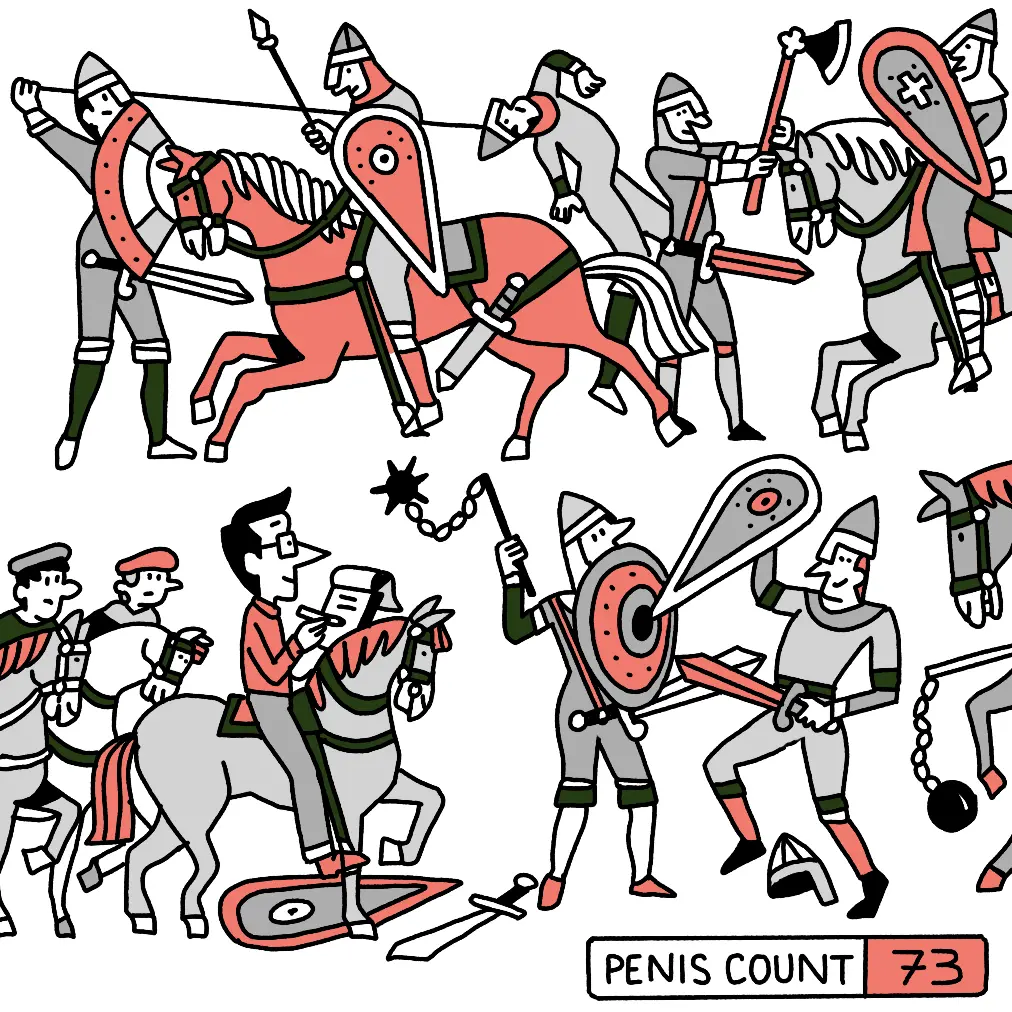
As we inched our way along the magnificent artifact, one striking visual theme quickly stood out from the storied panels: the remarkably large number of penises depicted throughout the embroidery. There were some genuinely prominent illustrations adorning horses, alongside several human figures casually displaying their anatomy with the brazen confidence of medieval flashers.
Standing there in the quiet glow of the exhibition, it was difficult not let one’s imagination wander to the daily realities of the workshop floor. One could easily picture an eleventh-century artisan returning home after a long, exhausting day of crafting the monumental tapestry. "Good day at work, dear?" her husband might reasonably enquire over the hearth. "You won’t believe it; they’ve put me back on horses’ willies," she might sigh. "Today, I had to embroider a real big one, and now my wrist hurts. But they’ve promised me arrows next month. I might even get to stick one in someone’s eye. Any gruel left for dinner?"
While the abundant phalluses certainly demand a moment of modern amusement, the tapestry remains an artistic triumph. Viewed objectively, it is essentially a medieval precursor to a modern streaming boxset—a historical equivalent that one might playfully call "Stitchflix." Through its meticulously stitched panels, viewers are treated to the comprehensive backstory of a high-stakes geopolitical invasion, complete with domestic asides illustrating daily life, chaotic and brutal battle scenes, and just enough bloodshed and violence to keep the contemporary audience thoroughly engaged.
Naturally, the embroidery features several iconic scenes that have transcended history to become household imagery. There is, of course, the famous depiction of King Harold meeting his grim fate with an arrow piercing his eye, as well as the depiction of Halley’s Comet streaking dramatically across the night sky. Though, to my own untutored eye, the historic comet bore a striking resemblance to a modern badminton shuttlecock rather than a celestial phenomenon. Wisely, I chose not to raise that particular observation as a serious academic challenge among the assembled historians.
Returning to the lively atmosphere of the party, champagne glass in hand, I found myself introducing to Grayson Perry, the renowned contemporary artist whose celebrated narrative ceramics and tapestries share a clear, undeniable creative lineage with the Bayeux masterpiece. Seizing the opportunity, I asked him about the embroidery’s distinct bawdiness and its remarkably high penis count. Perry offered far wiser thoughts on the matter than my own superficial observations, leading us into a fascinating discussion about how such earthy humour is an intrinsic part of what shapes British identity and why it should be openly embraced rather than sanitized. From Geoffrey Chaucer’s salacious tales and seventeenth-century satirical cartoons to the traditions of bedroom-farce theatre, a long, uninterrupted thread of cheeky irreverence runs deep through the history of British culture.
Curiosity getting the better of me once I returned home, I conducted a late-night internet search for the exact phrase "how many penises in the Bayeux Tapestry"—an addition that surely makes for an eclectic search history. The query revealed that the topic is actually a subject of serious academic debate and scholarly rivalry. Medieval scholar Christopher Monk famously set the official tally at 94, breaking it down to 88 equine examples and five human appendages. However, a rival academic recently stepped forward with a fresh claim, arguing that a detail previously categorized as a scabbard is actually a sword sheath hiding yet another willy, thereby raising the official count. Monk, fiercely protective of his scholarly research, has refused to budge on the matter. Speaking to the media, he offered a cautionary note to future investigators: "If you are not careful, you might fall into the trap of seeing penises everywhere." It sounds rather like accidentally stumbling into an overly literal academic Finnish sauna.
Yet, beyond the humorous headcount debate and the academic bickering, this earthy absurdity perhaps explains why people—and British people in particular—have responded so enduringly and enthusiastically to the tapestry over the centuries. Within its ancient panels, we see direct echoes of ourselves: not merely a dry, dusty history lesson from the Dark Ages, but a reassuring reminder that fundamental aspects of human nature, humour, and everyday life haven’t changed nearly as much as we might think.