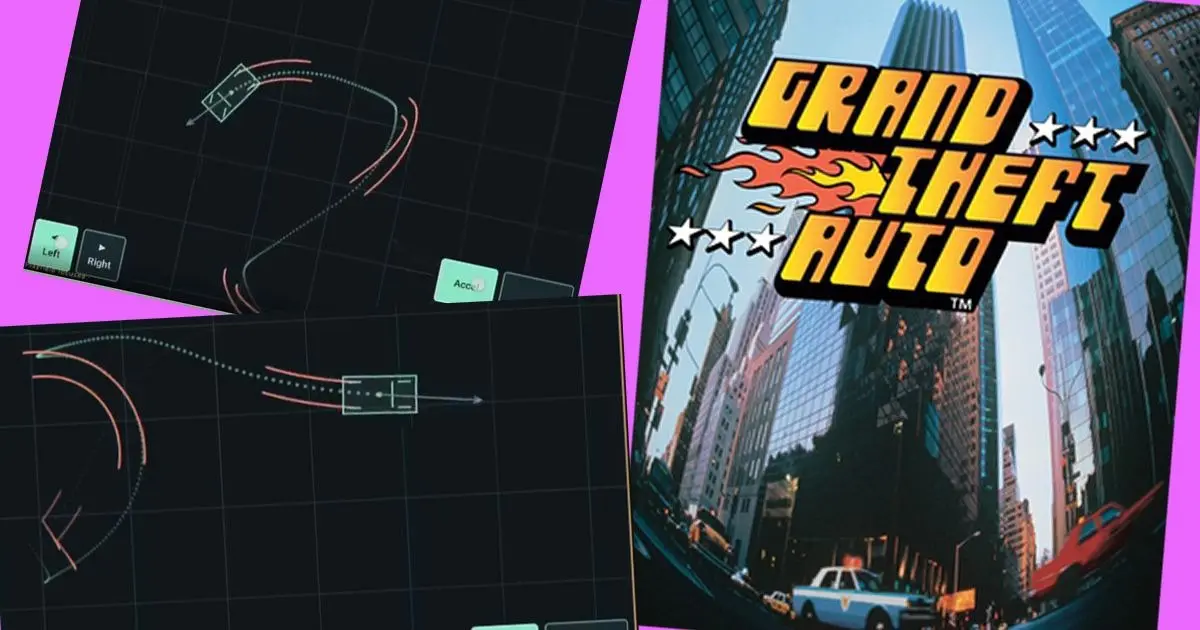
As the global gaming community continues to marvel at the staggering graphic fidelity and unprecedented detail showcased in the teasers for the highly anticipated Grand Theft Auto VI, the sheer scale of the upcoming title has prompted a wave of nostalgia and reflection. Industry observers and long-time fans alike are looking back at the franchise’s remarkable journey, tracing its evolution over nearly three decades. It has been twenty-nine years since the series first made its mark on the interactive entertainment landscape, and the contrast between the hyper-realistic, sprawling metropolitan environments of modern-day Vice City and the franchise’s humble beginnings is nothing short of extraordinary.
When the original Grand Theft Auto debuted in 1997, it was considered a groundbreaking achievement in its own right. Developed during an era when the industry was still grappling with the transition from two-dimensional sprite-based graphics to three-dimensional environments, the game offered an unprecedented level of freedom. It stood out from its contemporaries by featuring a living, breathing virtual city populated by a wide variety of non-player characters who went about their daily routines. More importantly, it pioneered the concept of emergent gameplay, a design philosophy where complex, unscripted situations could arise naturally from the interaction of simple game mechanics.
The original game also represented a major departure from the rigid, objective-driven design structures that dominated the era. For the first time, players were introduced to a virtual playground where they did not necessarily need to follow a set path or complete specific missions to enjoy themselves. Instead, a significant portion of the game’s appeal lay in the simple, unstructured joy of stealing a car, driving around the pixelated streets, and taking in the sights of the top-down world. This open-ended freedom became the defining characteristic of the franchise, setting a template that would influence the entire video game industry for decades to come.
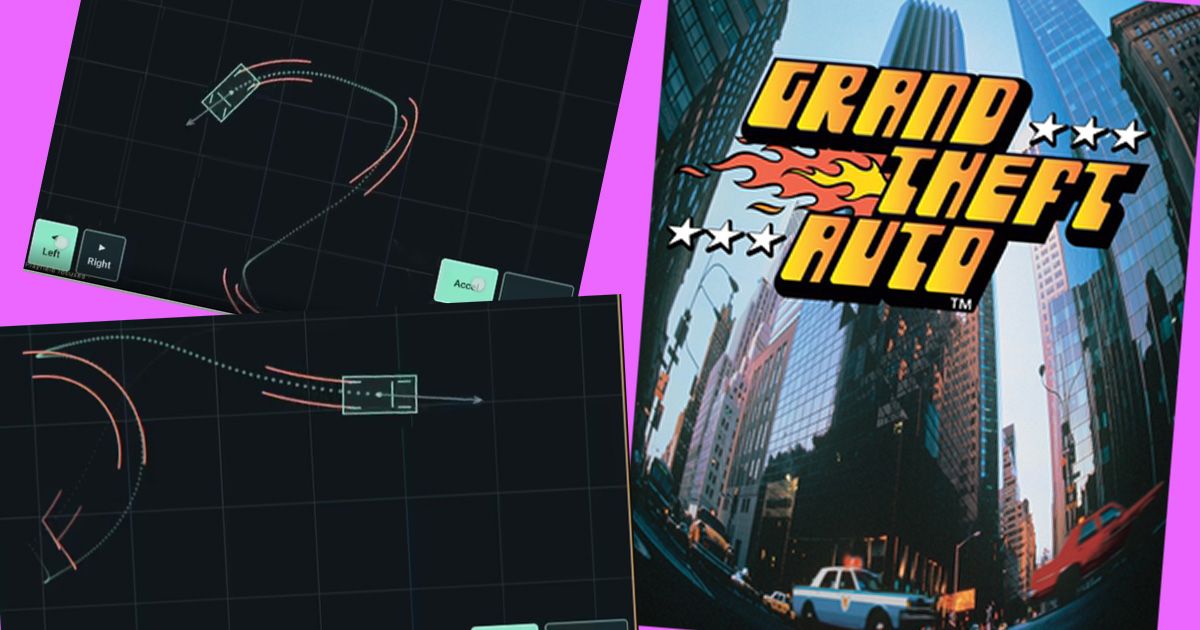
Behind the scenes of this revolutionary title was a talented team of programmers and designers at DMA Design, a Scottish development studio based in Dundee that would later undergo a historic transformation to become Rockstar North. Among those instrumental in shaping the foundational mechanics of the original game was programmer Patrick Kerr. Decades after his work on the project, Kerr has revisited his contributions to the medium by recreating the original two-dimensional physics simulation that served as the direct basis for Grand Theft Auto’s iconic vehicle handling system. In a move that has delighted retro gaming enthusiasts and game design students, Kerr has made this historical simulation fully playable online.
According to Kerr, the journey to creating one of gaming’s most influential vehicle systems began in an incredibly modest fashion. The simulation originally started life as a basic, bare-bones wireframe demonstration written in GFA BASIC on an Atari ST. During the late 1980s and early 1990s, the Atari ST was a highly popular home computer platform, particularly in Europe, and GFA BASIC was widely regarded by developers as an exceptionally fast and versatile programming language dialect. It was an ideal environment for rapid prototyping, allowing programmers to quickly test complex mathematical formulas and physics calculations without the overhead of more demanding development pipelines.
Once the underlying mathematics and physical behaviors of the vehicles were proven and refined within the Atari ST prototype, the system had to be prepared for integration into the actual game. This required porting the entire physics simulation from GFA BASIC into the C programming language. Porting the code to C was essential for optimizing performance, ensuring that the physics engine could run smoothly alongside the game’s graphics, audio, and artificial intelligence systems on the target platforms of the time, which included MS-DOS, Microsoft Windows, and the original Sony PlayStation.
To bring this fascinating piece of video game history into the modern era, Kerr has meticulously recreated the simulation using JavaScript. By leveraging modern web standards, he has ensured that anyone with a contemporary web browser can experience the simulation without the need for specialized emulation software or vintage hardware. While the underlying physics calculations remain faithful to the math that powered the 1997 classic, Kerr has updated the visual presentation, offering a sleeker, cleaner aesthetic that makes it easier to observe how the forces of acceleration, friction, and momentum act upon the virtual objects.
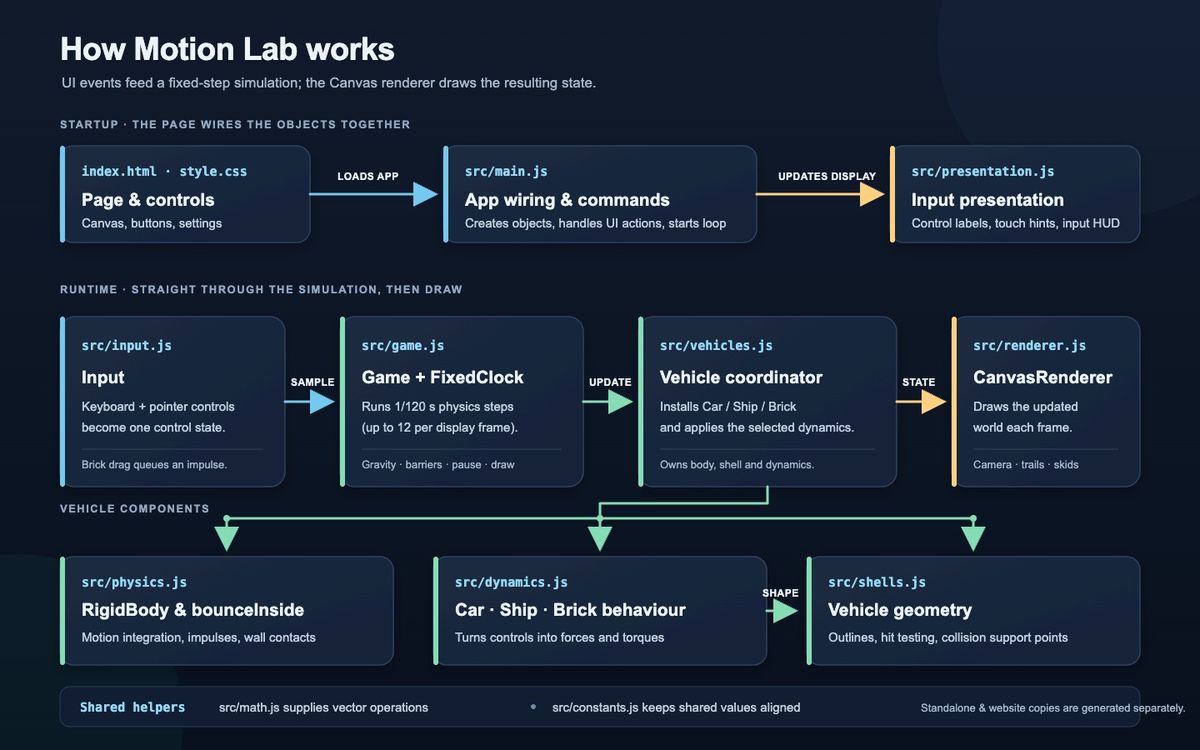
Visitors to the online simulation can interact with the system using a variety of keyboard controls that demonstrate the versatility of the original physics engine. The simulation defaults to Car mode, which can be selected at any time by pressing the 1 key. This mode showcases the standard vehicular physics that defined the driving experience of the original game, allowing users to observe how the simulated tires grip the road, slide around corners, and respond to sudden steering inputs.
However, the simulation is not limited to standard automobiles. By pressing the 2 key, users can switch to Ship mode, which alters the physical properties to simulate the unique drift and drag of watercraft. Alternatively, pressing the 3 key activates Brick mode, which strips away the specialized handling characteristics to show how a simple, unyielding block reacts to the simulated forces.
Kerr has also included several diagnostic and environmental toggles that allow users to dissect the mechanics of the simulation. Pressing the B key toggles the side collision barriers on and off, demonstrating how the objects interact with boundaries and how collision detection was handled in a two-dimensional space. For those experimenting with the Ship and Brick modes, pressing the G key turns vertical gravity on or off, illustrating how gravitational forces alter the trajectory and behavior of the objects as they move across the screen.
In addition to the core movement physics, the demo features controls that highlight the sophisticated camera work of the original Grand Theft Auto. Pressing the Z key toggles the camera’s dead zone, which is the designated area in the center of the screen where the vehicle can move slightly before the camera begins to scroll. This mechanic was crucial for preventing player disorientation during minor adjustments. Furthermore, pressing the X key toggles the speed-based zoom. Just as in the original 1997 game, this feature dynamically pulls the camera outward as the vehicle accelerates, providing the player with a wider field of view to anticipate oncoming obstacles at high speeds, and zooms back in as the vehicle slows down.

For game developers, software engineers, and digital historians interested in the technical minutiae of how these systems were constructed, Kerr has provided a comprehensive explanation of the mathematics and logic behind the simulation in a detailed post on his personal website. The interactive demonstration itself is hosted and fully playable at his online portfolio, known as the Motion Lab.
By making this simulation accessible to the public, Kerr has provided an invaluable educational resource that pulls back the curtain on the early days of game development. It serves as a powerful reminder of how the multi-billion-dollar Grand Theft Auto franchise, which now utilizes some of the most advanced proprietary physics and rendering engines in the world, began as a series of simple mathematical equations running on a 16-bit home computer. As the industry looks forward to the next generation of interactive entertainment with the upcoming release of Grand Theft Auto VI, projects like Kerr’s ensure that the pioneering craftsmanship of the past is preserved and celebrated for generations to come.