At first glance, the new poster for You Can See Everything shares far more DNA with the psychological horror genre than it does with traditional non-fiction filmmaking. It stands alongside some of the most memorable and effective horror film posters of the modern era, employing a masterclass in minimalist design and suffocating visual composition. The poster is both bold and frighteningly captivating, presenting an image that is almost impossible to look away from, despite the immediate sense of discomfort it instills in the viewer. Rather than relying on the bright, clean corporate aesthetics often associated with Silicon Valley documentaries, this key art plunges the audience into a dark, intimate space where the boundaries of reality and performance feel deeply blurred.
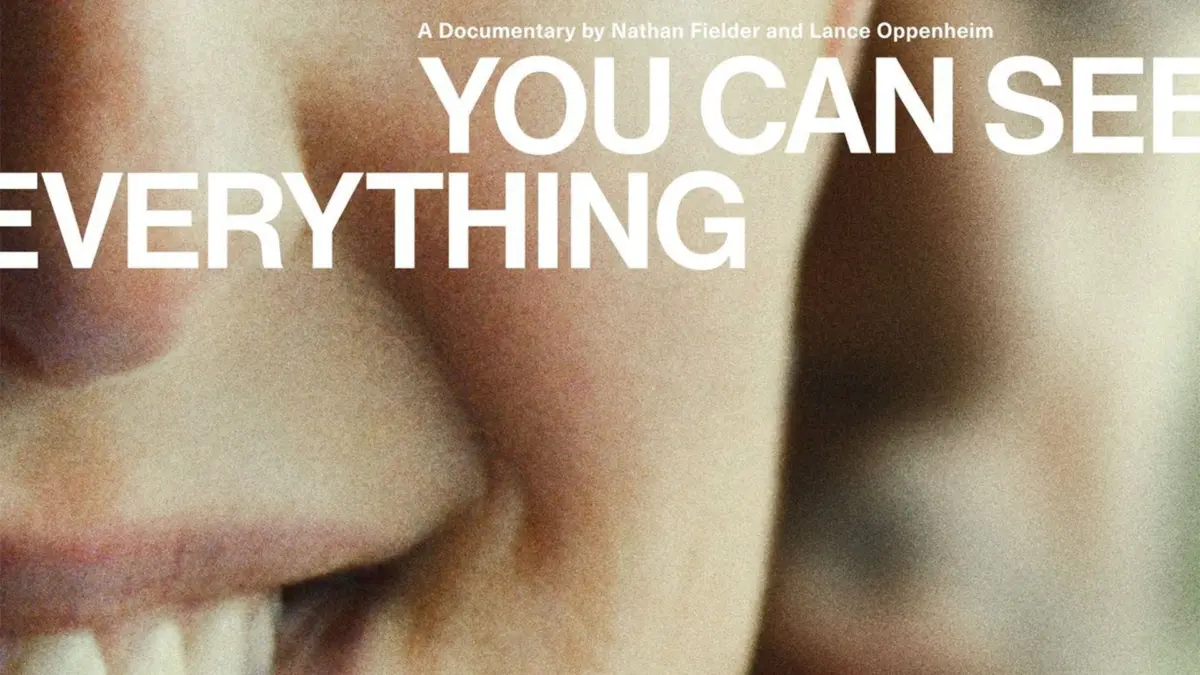
The undisputed focal point of the poster is its subject, Elizabeth Holmes, captured in an extreme, claustrophobia-inducing close-up. The design choices here are deliberate and severe. By spotlighting only half of her face, the poster immediately disrupts the viewer’s sense of balance and completeness. This asymmetric framing forces our gaze directly toward Holmes’ right eye—an almost inhumanly bright, piercing blue eye that appears visibly strained in its extreme wideness. This particular visual choice strikes a chord because it directly references one of the most widely discussed aspects of Holmes’ real-world persona: her habit of staring intensely without blinking during interviews and public presentations, a trait that many observers found deeply unsettling even during the height of Theranos’ success. By isolating and exaggerating this feature, the poster transforms a well-known public eccentricity into a powerful visual motif of hyper-focus and surveillance.
Compounding this visual tension is the lower half of her face, where a partially concealed smile rests. It is an expression that hovers precariously in the "uncanny valley"—the psychological space where something appears almost human, yet just artificial enough to trigger an instinctive sense of revulsion or unease. The smile does not reach the eyes; instead, it remains fixed and mask-like, creating a palpable sense of emotional dissonance. The viewer is left wondering whether they are looking at a candid moment of vulnerability, a calculated performance, or something entirely artificial. This ambiguity is central to the discomfort the poster generates, leaving the audience suspended in a state of unresolved tension.
Adding another layer of psychological complexity to the composition is the figure lurking in the background. Looming behind Holmes, shrouded in a heavy blur, is the unmistakable silhouette of Nathan Fielder himself. Fielder, known for his deadpan delivery and his uncanny ability to manipulate social dynamics in shows like The Rehearsal and Nathan for You, is depicted with a completely straight, unreadable face. His presence in the background introduces an immediate power dynamic to the image. He is positioned almost like a puppet master, a silent observer, or a ghost haunting the margins of Holmes’ narrative. This blurred juxtaposition prevents the poster from becoming a simple portrait of Holmes, transforming it instead into a tense, multi-layered dialogue between the filmmaker and his subject. The contrast between Fielder’s blank, passive expression and Holmes’ intense, wide-eyed stare creates an unresolved narrative friction that practically demands explanation.
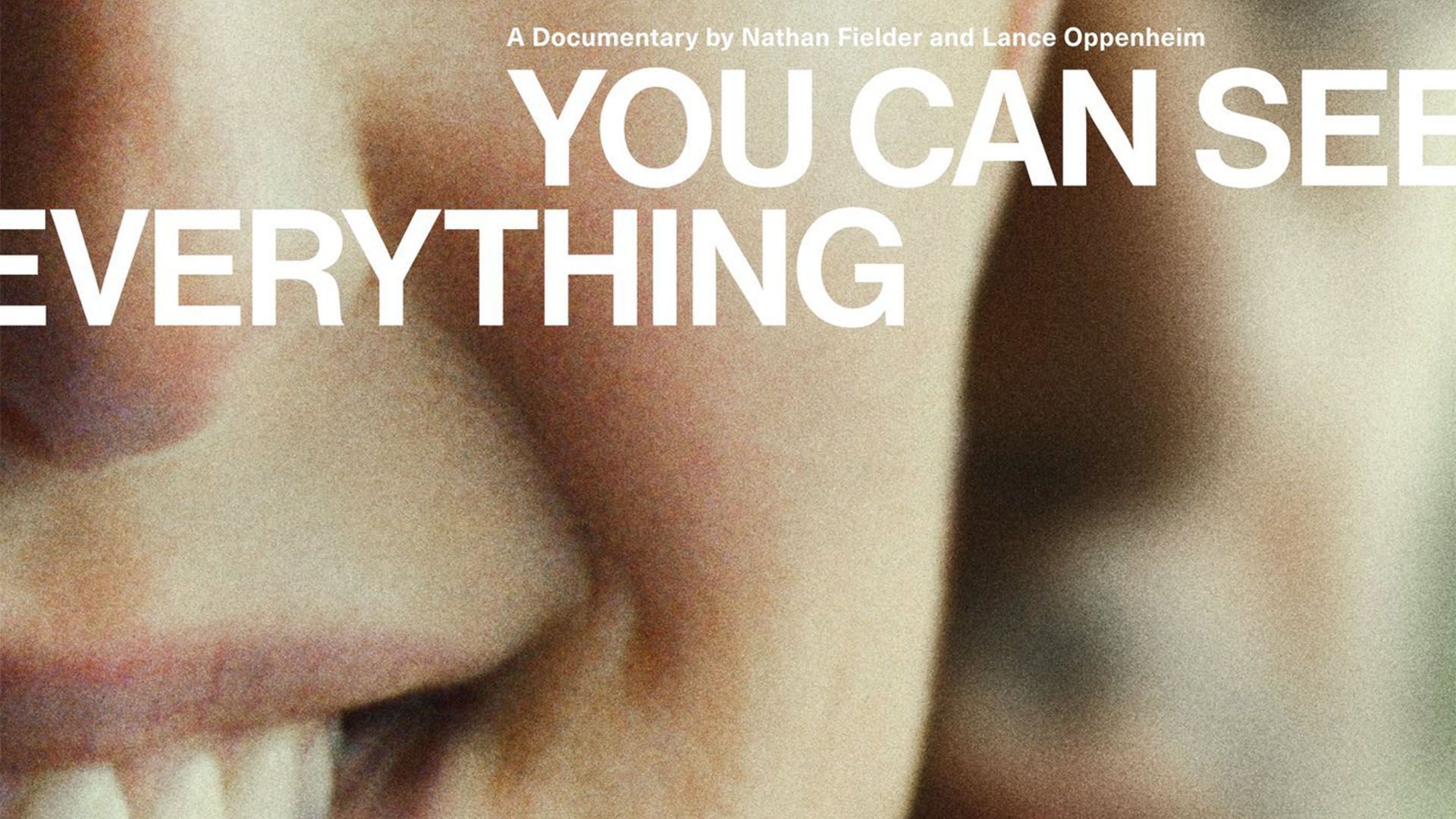
The typographic choices on the poster further reinforce this overwhelming sense of confinement. The title of the film, You Can See Everything, is rendered in a clean, minimalist sans-serif font. However, rather than being neatly centered or comfortably spaced within the frame, the text is pushed to the absolute edges, with the letters slightly cut off on both the left and right sides. This deliberate design choice violates standard graphic layout rules, which typically dictate a safe margin around text to ensure readability and balance. By allowing the frame to slice through the letters, the designers have created a subtly suffocating effect. The title itself feels trapped, squeezed by the boundaries of the poster, mirroring the psychological claustrophobia of the visual imagery. It is a subtle touch, but one that effectively heightens the overall feeling of being enclosed in a space where there is no room to breathe.
The internet’s reaction to the poster was immediate, with many observers quickly pointing out the sheer theatricality and dread radiating from the single image. On the social media platform X, users marveled at the composition’s ability to convey a narrative with so few elements. One user remarked, "The reflection in the eye is doing more acting than most lead performances this year," highlighting the incredible detail captured within Holmes’ wide-eyed stare. The reflection, barely visible yet highly suggestive, hints at a world of intense scrutiny and observation, perfectly aligning with the documentary’s title. Another user summed up the general consensus by writing, "You could tell me this was a horror movie and I’d believe you." This sentiment underscores just how successfully the poster subverts the expectations of the documentary genre, trading the clinical, informative style of typical true-crime key art for pure, atmospheric dread.
This horror-centric approach to marketing is entirely consistent with the brand identity of A24, the studio behind the documentary. A24 has long been celebrated for its ability to redefine genre boundaries, particularly in the realm of horror and psychological drama. By applying the visual grammar of elevated horror to a documentary about one of Silicon Valley’s most infamous corporate scandals, the studio and Fielder are making a profound statement about the nature of the story they are telling. The Theranos saga, at its core, is a story of delusion, deception, and the terrifying power of a single, highly constructed personality. By framing Holmes not just as a disgraced CEO but as a figure of psychological horror, the poster hints that You Can See Everything will explore the deeper, more unsettling truths behind the headlines, moving far beyond the simple facts of the case to examine the very nature of perception, belief, and deception.
In an era where movie posters are frequently criticized for being formulaic, over-crowded, and heavily reliant on predictable templates, the poster for You Can See Everything stands out as a triumph of artistic restraint. It understands that what is left unseen, or only partially seen, is often far more terrifying than what is fully revealed. The minimalist approach forces the viewer to engage actively with the image, searching the shadows and the strained expression of Holmes for clues. It is a design that lingers in the mind long after the initial glance, proving that graphic design remains one of the most powerful tools for establishing tone and generating anticipation in the modern entertainment landscape. By pairing the unblinking, controversial legacy of Elizabeth Holmes with the uncomfortable, boundary-pushing genius of Nathan Fielder, A24 has created a promotional campaign that is as intellectually stimulating as it is visually terrifying.