Adam Savage is clearly overjoyed about his new bag. Known globally as a gear-obsessed designer, former co-host of Discovery Channel’s hit series Mythbusters, and editor-in-chief of Tested.com, Savage is no stranger to tinkering with tools, materials, and mechanical designs. However, his latest endeavor represents a completely different kind of creative output. Meeting at his bustling, meticulously organized workshop in San Francisco, Savage is eager to show off his latest creation: his first-ever carryall utility bag, the EDC One. Alongside the launch of the bag, he has officially established a brand-new enterprise, Savage Industries, specifically created to market and distribute the product.
Exhibiting the exact same childlike glee that has endeared him to millions of fans on camera, Savage flips the utility bag around on his heavy wooden workbench. He opens and closes it, zips and unzips the compartments, and eagerly points out all the thoughtful engineering features he has packed into the design. For someone who has spent a lifetime evaluating, breaking down, and modifying the gear used by fabricators, builders, and makers, designing a carryall from scratch is a natural evolution of his career.
A Masterclass in Upcycled Materials and Clever Engineering
The EDC One is constructed almost entirely out of upcycled cloth sourced from retired boat sails. Because the material has already lived a rigorous life on the water, each bag boasts unique quirks, weathering marks, and subtle variations. Every single specimen that comes off the production line arrives with an authentic, broken-in look right out of the box, meaning no two bags are completely identical.
Savage paid meticulous attention to the tactile and mechanical details of daily use. For instance, the handles are held together by magnets rather than traditional metal snaps or hook-and-loop velcro. Anyone who has constantly fussed with stubborn snaps or caught clothing on exposed velcro strips will find this magnetic closure a remarkably welcome innovation. Users simply need to bring the handles near one another, and they instantly jump together with a satisfying, secure clonk.
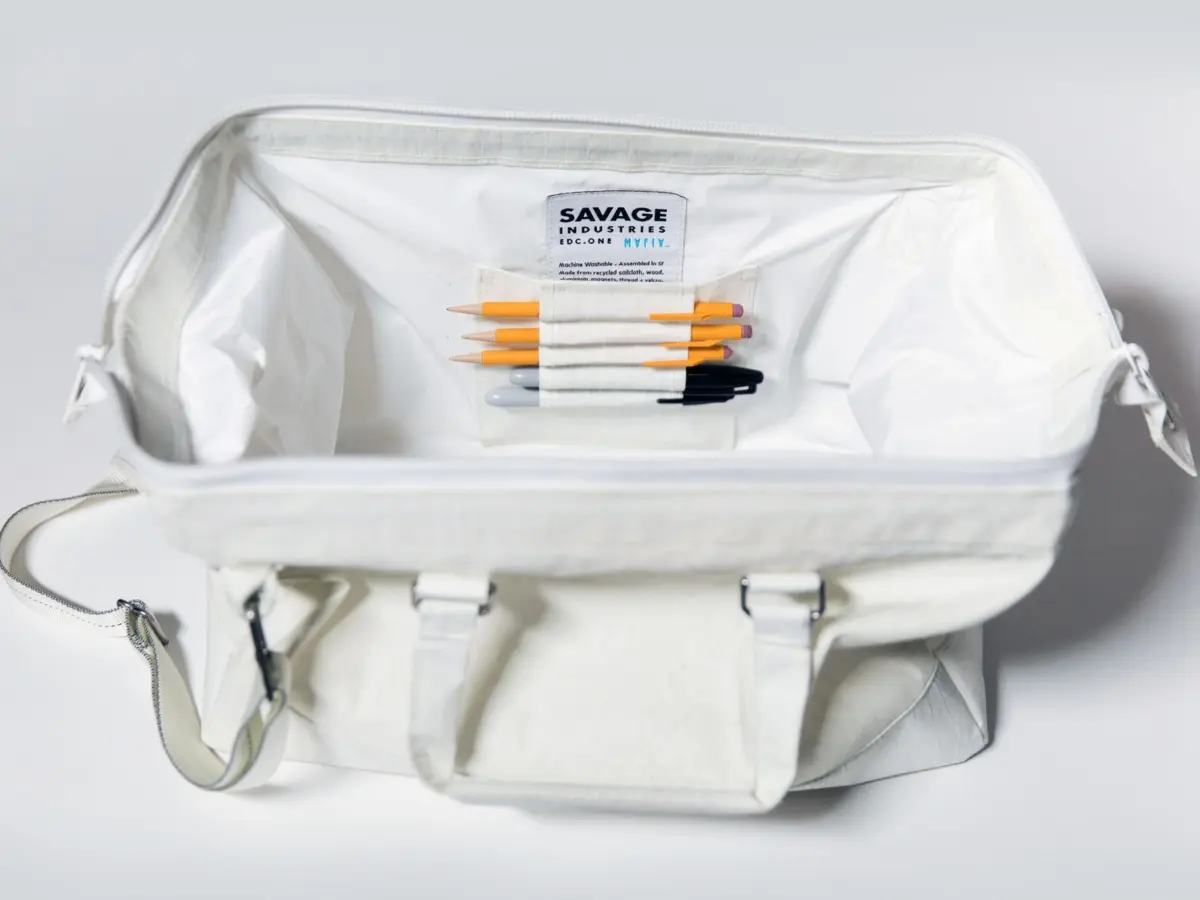
Another clever design choice involves the structural integrity of the straps. They are stiff enough that the clasped handle stays propped upright like a little pup-tent frame, making it easy to grab on the fly. Unzipping and prying open the bag reveals another structural trick: it holds its shape entirely in that open configuration, thanks to a pair of spring steel inserts that run continuously around the lip. This keeps the mouth of the bag perpetually agape, much like the jaw of a whale shark, allowing for effortless one-handed loading and unloading of contents.
The interior is equally purposeful, featuring an integrated pocket designed to hold notebooks. While Savage himself deeply adores Tom Sachs Ten Bullets notebooks, he notes with a grin that the pocket is completely brand-agnostic. Below the notebook sleeve sits a stack of horizontal loops dedicated to keeping pens and pencils organized. Protecting the base is a Kevlar-reinforced bottom adorned with strips of velcro. This particular detail serves as a subtle hint at modular accessories to come, such as padded interior bays specifically tailored for delicate camera equipment or a waterproof, bucket-like insert capable of securely toting a standard 12-pack of beverages.
Historical Inspirations from Industrial Light & Magic and NASA
Savage designed the EDC One to fulfill a very specific personal requirement: it needed to be capable of carrying absolutely everything he requires for a standard day out in the world, seamlessly transitioning from heavy-duty workshop tools to reference books and lunch. When explaining the genesis of the design, Savage points to two distinct historical and professional inspirations that shaped his vision.
The first inspiration comes from the old tool case he relied upon back when he was employed as a model-builder at George Lucas’s legendary special effects company, Industrial Light & Magic. That vintage case also featured a classic clamshell top that flopped wide open, granting the user immediate, unobstructed access to all the goods stored inside. Savage spent years searching the commercial market for something that captured that specific utility and form factor, but he was continually disappointed by the modern options available. Frustrated by the lack of suitable alternatives on the market, he ultimately decided to build his own version from the ground up.

The second major inspiration is surprisingly cosmic: the purse given to Apollo astronauts during historic missions to the moon. Officially designated as the Temporary Stowage Bag, but colloquially referred to by insiders as the McDivitt Purse, this specialized tote was largely forgotten by the public until Neil Armstrong’s widow famously rediscovered it while going through her recently deceased husband’s personal belongings. Savage intentionally borrowed several key elements from this historical NASA design, including the simple geometric shape, the rigid steel closure mechanism, and the near-total absence of external pigment.
A Bold Aesthetic Choice: None More White
True to its NASA-inspired roots, the bag is striking in its presentation because it is entirely white. At least for its initial run, the EDC One only comes in white. For a utility carryall meant for daily use, this appears to be an intensely impractical choice for a product bound to soak up dirt, city grime, and workshop oil. However, Savage quickly sells skeptics on the concept.
He explains that the white sailcloth will develop a natural, hard-earned patina over time, and patinas are inherently cool because they tell the story of the object’s life. Furthermore, from a functional standpoint, Savage points out a common frustration with standard dark luggage: you simply cannot find small tools or stray items at the bottom of a black bag.
By choosing white, Savage also deliberately avoided falling in line with the current fashion trends of "tactical" gear and "urban camo" that currently dominate the market for men’s bags and everyday carry accessories. Instead, a stark white bag stands out as utterly unique. It avoids the aggressively hyper-masculine aesthetic of the ubiquitous Cordura messenger bag, leaning instead into an aesthetic that feels remarkably fresh, clean, and nonbinary.
Craftsmanship, Production, and Future Plans
While Savage has been actively sewing and working with textiles since he was in middle school—frequently constructing his own elaborate costumes and props for public appearances—the heavy lifting and commercial stitching for this project was outsourced to Mafia. Based in San Francisco, Mafia is a well-regarded company that creates a gorgeous line of durable bags primarily crafted out of upcycled, recycled sailcloth.
For this initial launch, Mafia has produced a few hundred Savage bags. Every single unit produced by the workshop receives Mafia’s standard lifetime warranty, ensuring that the upcycled materials are backed by robust structural support.
The bags are officially available for purchase directly through Savage’s personal website, with each unit priced at $225. Because of the limited nature of upcycled sailcloth and small-batch manufacturing, once this first production run sells out, subsequent orders will transition to backorder status until Mafia can catch up with demand. To add a layer of exclusivity for early supporters, each bag in the initial run will be hand-numbered for extra collector credibility.
The launch of Savage Industries marks the beginning of a broader commercial journey for the designer. Savage hints that there is plenty more to come under the new brand umbrella. He is already planning a smaller version of the EDC One utility bag, as well as a larger variant. Even with the larger version, Savage notes that it will be carefully dimensioned to meet all Federal Aviation Administration regulations for carry-on luggage. Beyond different bag sizes, he remains tight-lipped about future products, though he confirms that additional modular accessories designed to velcro directly into the bags are currently in development. Whatever physical goods emerge from Savage Industries next, fans and gear enthusiasts alike can only hope they follow the path of the original and come in white.