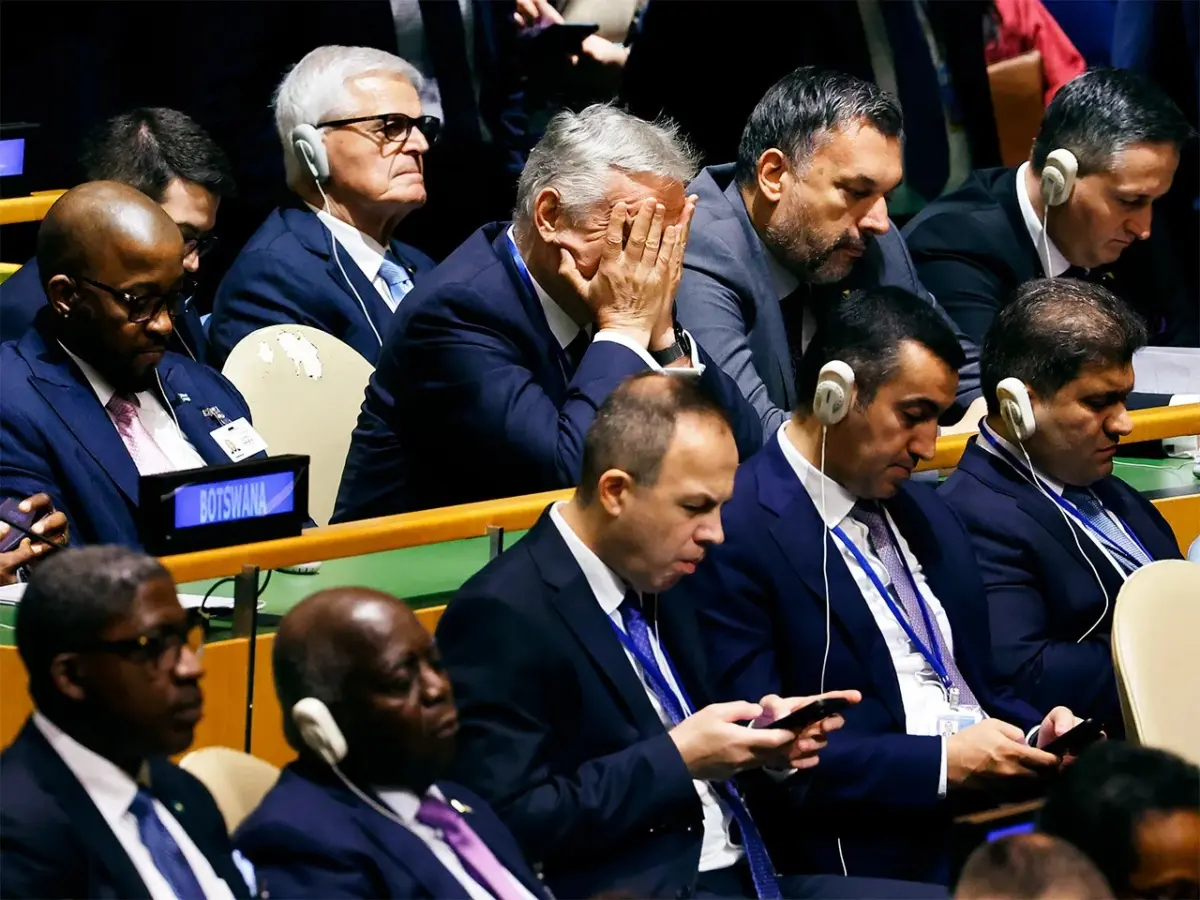
As New York welcomes this year’s United Nations General Assembly (UNGA), the annual diplomatic pilgrimage brings with it a predictable chorus of familiar complaints. Cynics and seasoned observers alike will lament the gridlock, the endless stream of rhetorical grievances, and the sheer theatricality of the proceedings. Yet, dismissing the forum entirely would be a mistake. Beneath the polished veneer of formal speeches and the ritualistic bashing of the UN as an institution lies a uniquely consequential gathering—one that retains its vital importance, particularly when it forces adversarial nations into the same room and encourages dialogue behind closed doors.
For many national leaders attending their very first UNGA, it is theoretically possible to mill unobtrusively around in the background, get to know the sprawling complex, figure out which table to avoid at lunch, and find their footing. A British prime minister, however, does not have this luxury. Stepping into New York for his debut UNGA this week, UK Prime Minister Andy Burnham arrives carrying the immense weight of leading a G7 economy, a nuclear-armed power, and one of the five permanent members of the UN Security Council. Among the tightly packed schedules and high-stakes encounters, his inaugural meeting with Donald Trump stands out as one of the most closely scrutinized diplomatic events of the entire week, instantly thrusting the new British leader into the unforgiving spotlight of international relations.
The general debate sessions themselves represent a punishing diplomatic ordeal. The leaders and representatives of all 193 member states are granted the opportunity to take to the iconic green marble podium and address the UN chamber. Over the decades, this same podium has witnessed legendary spectacles of endurance and provocation. In 1960, Fidel Castro droned on for four and a half hours. In 1974, Yasser Arafat famously approached the microphone wearing a loaded pistol. Decades later, in 2009, Muammar Gaddafi spent an extensive amount of time complaining about his jet lag—though he would find himself facing far graver problems shortly thereafter.
The persistent complaint that these general debate sessions are a colossal waste of time is neither new nor original. Veterans of international diplomacy note that everyone basically knows what the other representatives will say before they even step up to the microphone. It is also widely understood that the primary audience for these speeches is rarely the hall itself, but rather the voters and political rivals back home. Domestic constituencies often appreciate a bit of melodramatic grievance-pitching directed toward treacherous neighbors, repressive hegemons, or whatever convenient scapegoat a government has chosen to blame for its own self-inflicted failings.
The chamber has also frequently served as a stage for dramatic grandstanding and protest. In 1960, Soviet Premier Nikita Khrushchev famously demonstrated his furious objections to a speech by Filipino senator Lorenzo Sumulong by reportedly thrashing his desk with a shoe. More recently, geopolitical tensions boiled over when 77 countries staged a mass walkout during an address by Israeli Prime Minister Benjamin Netanyahu.
Despite all of this theatrical posturing—and the perennial spectacle of political figures beating up on the UN as an ineffectual bureaucracy, which has become a ritual component of these autumn events—the UNGA remains deeply important. In its most crucial respect, it operates like any other major international conference: the real value is almost never found in the speeches, panels, or formal events listed on the schedule tucked inside a souvenir tote bag. Instead, the true worth lies in who a leader manages to speak to informally and in person.
When those potential interlocutors are the very people who govern the world, missing the opportunity to engage with them would be professionally negligent. Even North Korea unfailingly dispatches a representative to the event. This year, Pyongyang is represented by Vice-Foreign Minister Kim Son-gyong, who delivered an address echoing familiar themes from his appearance last year. He dutifully ticked all the usual boxes by blaming the United States for global instability and complaining about Western domination of the UN machinery, before offering the comforting reassurance that "the completion of the five-year plan of national economic development set forth by the Eighth Congress of the Workers’ Party of Korea is definitely within reach"—a pronouncement that undoubtedly brought immense relief to the assembled international community.
The real diplomatic heavy lifting, however, happens far away from the cameras and the main podium. Discussions held quietly in the corridors, private offices, and cafés surrounding the UNGA can produce genuine, real-world effects. This is especially true when the summit serves as a neutral conduit bringing together countries that generally go to great lengths to avoid each other.
History offers several prominent examples of corridor diplomacy bearing fruit in New York. In 2004, Indian Prime Minister Manmohan Singh and Pakistani President Pervez Musharraf held a pivotal conversation on the sidelines of the gathering that lent vital momentum to a tentative peace process regarding the disputed region of Kashmir. In 2019, Egyptian President Abdel Fattah El-Sisi successfully corralled his Somalian and Kenyan counterparts—Mohamed Abdullahi Mohamed and Uhuru Kenyatta, respectively—into a hastily arranged meeting that ultimately restored formal diplomatic ties between Mogadishu and Nairobi. Years earlier, in 2013, US Secretary of State John Kerry and Iranian Foreign Minister Mohammad Javid Zarif held talks that helped clear the path toward an eventual landmark international agreement limiting Iran’s nuclear program.
Tangible results can undoubtedly be achieved at the UNGA, even if geopolitical shifts mean those achievements are sometimes later undone. Yet, a persistent question hangs over every session of the General Assembly, and over the United Nations as a whole: how can more actually get done?
A sweeping reform of the Security Council aimed at reducing the disproportionate power held by the permanent five members remains highly unlikely, largely for the simple reason that those same five nations would have to unanimously agree to dilute their own authority. Similarly, the rigorous enforcement of the voluntary 15-minute speaking limit for UNGA addresses has widespread aesthetic appeal, but the practicalities involved are daunting. Exactly who is prepared to wield a shepherd’s crook and pull the president of a global superpower away from the podium?
Perhaps the most plausible, if provocative, solution—though one guaranteed to prompt screaming fits from exhausted delegates and security teams alike—would be to extend the UNGA by a few days to allow more dedicated time for informal discussions on the fringes. Alternatively, given the increasingly volatile and fractured state of global affairs, some cynical observers might argue for simply locking the building from the outside until the leaders trapped within finally manage to come up with some better ideas for running the planet.