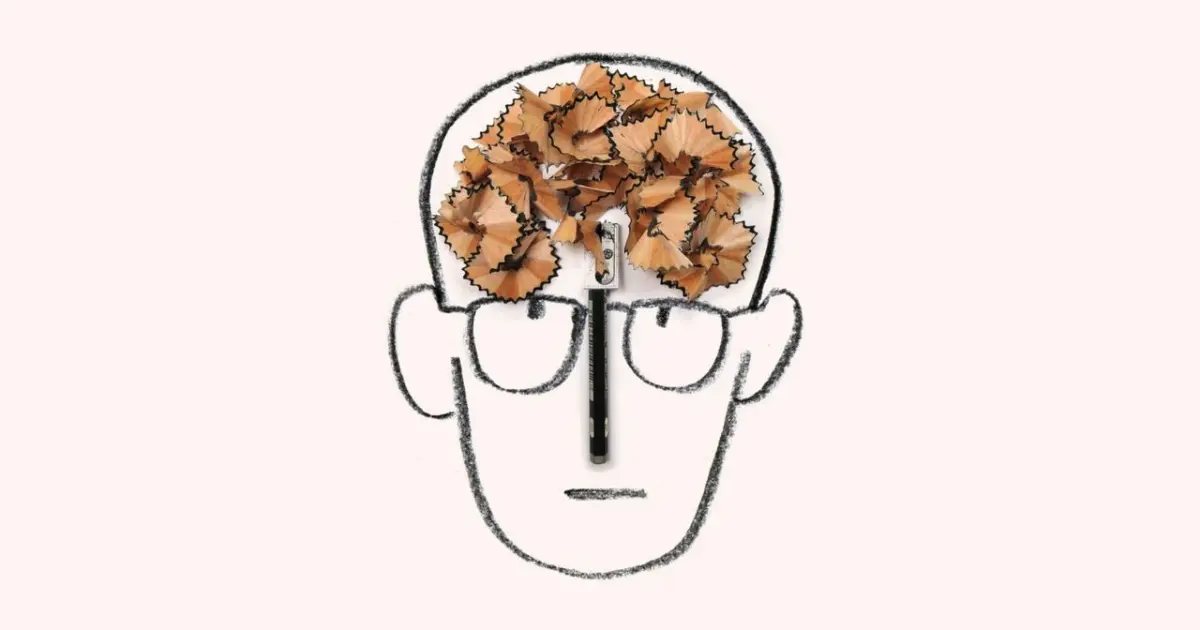
For years, acclaimed artist and illustrator Christoph Niemann engaged in a quiet, recurring Sunday ritual. Sitting down with a blank piece of paper and a random, everyday object, Niemann never quite knew what he was going to create—only that his final drawing would incorporate whatever mundane item happened to be sitting in front of him. Pennies were transformed into delicate scoops of ice cream; ordinary bananas took on the distinct shape of horse legs; and standard office highlighters were cleverly reimagined as humming light sabers.

Over time, Niemann devised hundreds of these playful visual puns. Now, he has collected these fan-favorite experiments alongside a broader retrospective of his celebrated career in a new monograph titled Sunday Sketching. Published by Abrams, the book serves not only as a comprehensive visual retrospective of Niemann’s decades-long career—whose illustrations have graced the pages of major publications including WIRED, The New Yorker, and The New York Times—but also as a thoughtful, candid meditation on the inner workings of the creative process.

Throughout the pages of Sunday Sketching, Niemann relies on his signature witty drawings and disarming breed of humor to tackle notoriously tricky subjects for creative professionals. He addresses the heavy burdens of insecurity, the constant undercurrent of financial anxiety, and the terrifying necessity of changing course mid-career while things are ostensibly going well. The book functions as a timely reminder that even the brightest and most established creative minds face profound challenges when attempting to produce consistently great work in a rapidly shifting media landscape.

At the core of Niemann’s philosophy is a pragmatic approach to daily creation. Relying on craft, discipline, and routine might lack the romantic, cinematic appeal typically associated with the myth of the tortured artistic genius, but Niemann argues that it is an exceptionally effective strategy for maintaining one’s sanity. In his view, even in the absolute absence of raw talent and sudden inspiration, an artist can—through sheer, relentless practice—become so technically proficient that they reliably deliver very good work on a consistent basis.

Great work, however, is a entirely different category. Achieving truly great work requires a massive foundation of skill and technical craft, but it also demands an elusive element that is fundamentally beyond human control. Once a creative professional learns to accept this unpredictable reality, Niemann suggests that life actually becomes considerably easier. For clients commissioning art, it serves as an important realization: all that can reasonably be asked of an artist is very good work, because true greatness is ultimately unplannable.

Yet, focusing entirely on mastering a specific craft carries its own distinct set of professional risks. The primary downside of intense specialization is the danger of becoming completely blindsided by industry shifts. An artist might spend all of their waking energy becoming a master of a specific medium, only to realize too late that the underlying landscape has fundamentally changed beneath their feet. Niemann compares this perilous trap to a dedicated chef who spends night after night perfecting the ultimate hamburger, completely unaware that a cultural shift has suddenly turned everyone around them into vegetarians.

This metaphor hits particularly close to home in the modern media economy. Many of the glossy magazines and print publications that, only a few years ago, employed scores of dedicated art directors and supported entire armies of illustrators have either vanished entirely or been reduced to a mere fraction of their former operational size. While some industry observers might frame this transformation as a natural evolution, the sheer speed and swiftness with which it has dismantled traditional businesses and radiant careers remains terrifying to those who lived through it. Furthermore, Niemann notes that this ongoing media revolution is far from over and will likely continue to accelerate at an even faster pace.

For an independent creator, navigating this turbulent environment requires a delicate balance of financial prudence and creative resilience. Niemann is the first to admit that right now he is blissfully busy with commissions and projects, but he harbors no illusions that the good times can end abruptly. The only reliable way to ensure that his work remains in demand is to focus relentlessly on producing good work.

However, maintaining that creative focus becomes virtually impossible when an artist is simultaneously forced to worry about paying the bills. Considerations regarding budgets and money while in the middle of a creative flow state are, in Niemann’s words, "creative poison." He notes that he has never worked with time sheets, emphasizing that the process of dreaming up ideas is inherently inefficient. Whether a specific concept requires five hours of sketching or fifty has absolutely no bearing on the final quality of the outcome. At the same time, completely ignoring financial realities is simply not a viable option.

To carve out necessary mental breathing room, Niemann has established a disciplined financial safety zone. He regularly calculates his exact monthly living expenses—a figure that has proven to be surprisingly consistent over the years—and strives to maintain a buffer equivalent to six months’ worth of living expenses safely tucked away in the bank. If a worst-case scenario unfolds professionally, this financial cushion provides him with a crucial window of time to figure out his next steps.

Maintaining this buffer has profound, tangible effects on the quality of his daily work. Most importantly, it grants him two critical luxuries: the ability to turn down commercial assignments that are a poor fit for his artistic voice, and the theoretical freedom to walk away from any job, a step he has taken on rare occasions during his career. Niemann makes a point to inspect his financial accounts once a month to evaluate whether he can comfortably continue on his current path or if it is time to genuinely panic. Because life is inherently unpredictable, he admits he cannot always maintain this ideal system, but he remains acutely aware that fear and desperation inevitably bleed into an artist’s work. Financial prudence, however unglamorous, is treated as a vital pillar of his professional practice.

Beyond financial survival, Niemann frequently grapples with the more complex and interesting questions surrounding the long-term creative direction of his career. While he believes an artist must be kind, gentle, and forgiving with their own fragile self-worth during the actual execution of a project, he also recognizes the necessity of occasionally stepping back to evaluate his entire body of work through the unsparing eyes of a cynical outsider.

This self-assessment forces difficult inquiries: Is his work devolving into shallow pandering aimed solely at pleasing an audience? Is he taking genuine creative risks? Is he staying in touch with the cultural currents happening outside his studio, or is he unfairly blaming his audience whenever a piece fails to resonate? Judging one’s own creative missteps is notoriously difficult, and recognizing what one is actually doing right can be even harder.

Historically, Niemann could only discuss these burning questions with a small, trusted circle of friends and professional colleagues. While those relationships remain vital when tackling specific creative hurdles, those peers lack the fresh, uninitiated perspective of someone entirely unfamiliar with Niemann and his artistic history.

The advent of social media has fundamentally altered this feedback loop. Today, Niemann can take almost any creative output—whether it is a polished, finished piece or a rough, spontaneous experiment—and instantly gauge how real-world readers and viewers react to it. With the simple tap of a button, he can gain a rapid sense of whether the broader public deems an idea valuable.

Yet, Niemann maintains a clear-eyed skepticism toward the psychological traps of digital platforms. Any creator who claims they are completely immune to the validation of receiving numerous likes, or who insists they feel zero insecurity when a post falls flat, is simply not being honest. Having experienced a long career that predates the rise of Facebook, Twitter, and Instagram—an era where artists frequently worked in a vacuum with barely any immediate reaction from their audience—Niemann views social media as a fascinating and potentially indispensable tool. At the same time, he warns that social media algorithms are brilliantly engineered to manipulate human vanity and insecurity, making it dangerously easy to unconsciously equate algorithmic engagement metrics with actual artistic quality.

Online approval and viral success are simply too superficial and cheap to serve as true measurements of creative value. While Niemann admits a thrill when a piece generates widespread engagement, he points out that viral cat videos and lightweight internet listicles generate massive responses while ultimately leaving the viewer feeling empty. In an ocean of smooth, fleeting digital reactions, he argues that creators must remind themselves that art which truly moves people is often slow, strange, and lingering.

This digital saturation raises constant questions about which new platforms to adopt. Niemann questions whether he should expand his presence to every emerging app or fad, or if there comes a point when an artist must simply shout for quiet and retreat solely into the work. While he admires artists bold enough to ignore fleeting trends in favor of unwavering vision, he also recalls cautionary tales from his student days in the late 1990s, when peers doubted that computers would ever become essential to design.

Ultimately, Niemann recognizes the danger in romanticizing rejection. Being a maverick feels emotionally satisfying, but when a client rejects a sketch or a social media post fails to gain traction, it does not automatically mean the piece is an unappreciated masterpiece ahead of its time. Sometimes, as Niemann candidly notes, a piece of art is simply bad.