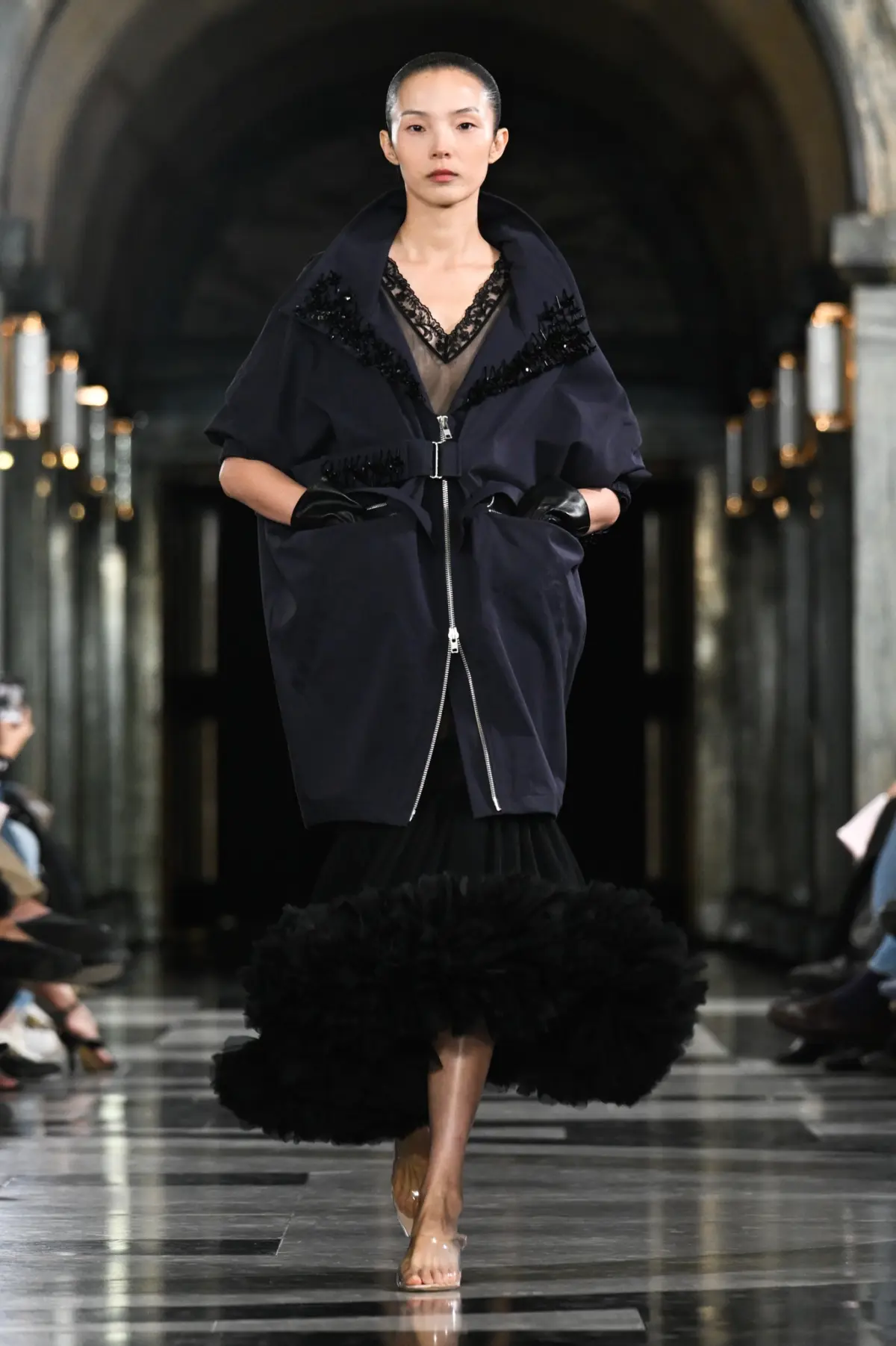
London—Returning to one of the capital’s most arresting and historic venues, designer Simone Rocha staged her latest runway presentation inside the imposing walls of the Old Bailey, London’s historic criminal courthouse. The setting provided a dramatic architectural backdrop for a collection that looked both backward and forward, drawing deep inspiration from a legendary lost-and-found masterpiece of art history: Caravaggio’s "The Taking of Christ." At the same time, the presentation emerged from the designer’s personal desire to step back, clear her creative palate, and cast fresh, unencumbered eyes on traditional silhouettes, breathing new life into foundational garments like the slip dress, the baby doll, grand ballgowns, and classic bomber jackets.
Sunday’s showcase also marked a significant structural shift for the brand’s runway schedule. It was the first time in quite a while that Rocha chose to present a dedicated womenswear collection entirely on its own, following her separate men’s collection presentation at Pitti Uomo in Florence this past June. Freed from the concurrent presentation of menswear lines, Rocha discovered a renewed sense of focus in concentrating exclusively on womenswear, allowing her to approach the garments from a uniquely singular and revitalized perspective.
"I wanted it to feel personal, an expression of dress and femininity. I wanted to do something that felt very authentic to me," Rocha reflected backstage, discussing the intimate genesis of the collection. True to this ethos, the designer engaged in a hands-on, highly physical creative process. She described how she "tucked and touched and pushed" her chosen textiles, pairing and treating fabrics in unconventional and daring ways to challenge conventional garment construction.
This tactile experimentation yielded striking combinations throughout the collection. In one standout look, robust gabardine was seamlessly paired with delicate tulle to form a sweeping long coat. Elsewhere, wispy, translucent dresses were layered daringly over knitted argyle underpants, subverting traditional layers of undergarment and outerwear. In another inventive twist, Rocha transformed floaty, feather-light strips of washed organza into the undulating, voluminous textures of decorative boas, proving her penchant for turning unexpected materials into high-fashion statements.
The artistic lineage of the collection was further anchored by Caravaggio’s signature chiaroscuro palette. Rocha drew heavily upon the intense contrasts and rich tones characteristic of the master’s work, favoring a dramatic spectrum of deep reds, abyssal blacks, and moody petrol blues.
Beyond color, the rich history surrounding "The Taking of Christ" heavily influenced the conceptual framework of the presentation. Previously believed to have been lost to history for centuries, the iconic painting was miraculously rediscovered in 1990 hanging quietly in the dining room of a Jesuit community house in Dublin, Ireland. For years, the local priests who housed it had casually assumed the canvas was merely a worthless imitation or a fake copy. Today, the authenticated masterpiece enjoys a prominent and celebrated home on display at the National Gallery of Ireland.
The improbable and dramatic true story of the painting’s rediscovery inspired Rocha to rethink the philosophy of clothing within a completely new context, encouraging her to piece together looks instinctively and with deliberate unexpectedness. "I like the borrowing of ideas and embellishment and exchanging with the boys," Rocha noted, pointing to the gender-fluid cross-pollination present in her design philosophy. Illustrating this cross-cultural dialogue within the wardrobe, she layered a crisp lavender men’s dress shirt underneath a voluminous, contrasting black-and-coffee-colored ballgown skirt.
The runway was saturated with similar moments of romantic, textural exchange and sartorial dialogue. An oversized gray sweater received a tactile update, meticulously embellished with tiny white shells scattered across the front, merging notions of heavy winter knitwear with delicate marine ornamentation. A sheer shift dress infused with a subtle 1930s sensibility felt instantly less stark and more approachable thanks to intricate, delicate embroidery adorning the front bodice.
Meanwhile, luscious rosettes added a profound sense of richness and physical sensuality to an array of garments. These dimensional floral motifs surfaced everywhere: embellishing simple white blouses, tracing the low, rounded necklines and bare backs of baby doll dresses, and framing the structured collars of silky bomber jackets and heavy leather coats.
Ultimately, Simone Rocha’s message for the season was clear, precise, and visually demanding: Look, and then look again. Through her Caravaggio-infused lens at the Old Bailey, she proved that even the most enduring classics do not need to be reinvented from scratch—sometimes, they simply need a fearless re-framing.