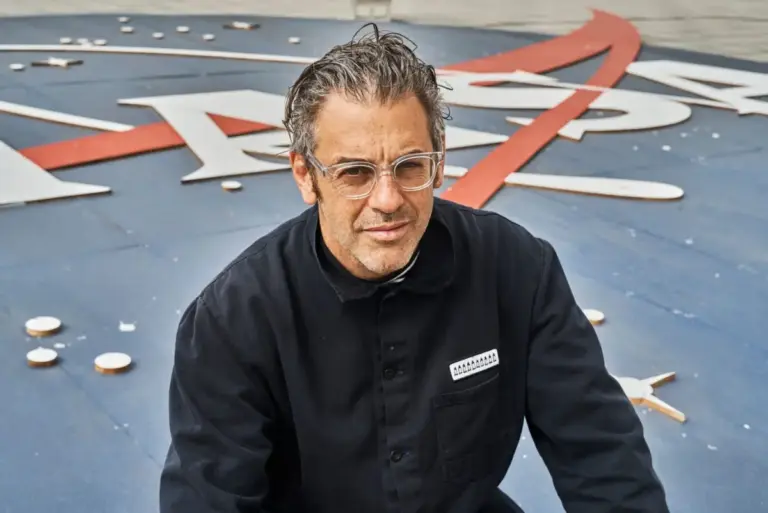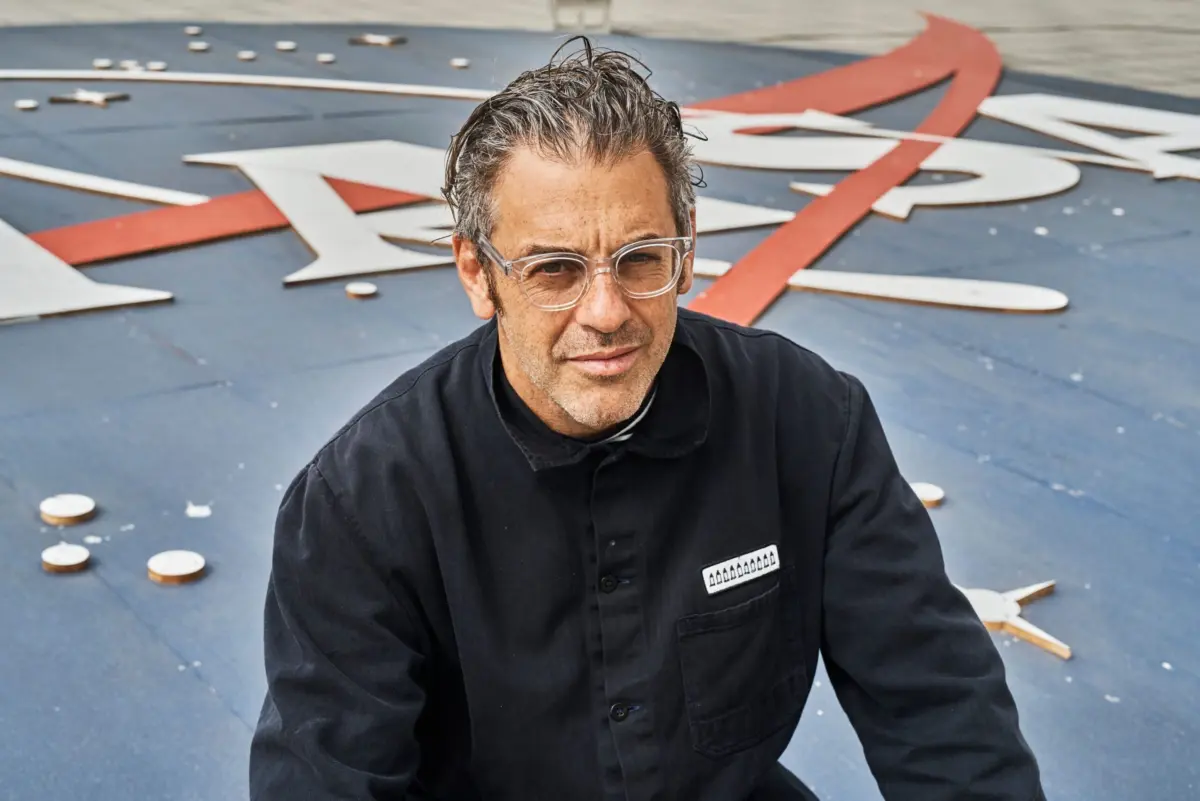
Tom Sachs’ workshop in lower Manhattan is a labyrinth of rooms crammed with customized cabinets, shelves, work tables, and sorting systems. Even the lowly drill press is heavily remade, with two machine lamps spidering off its top, a brush on a retracting cord to clean away debris, and a chuck key and center punch stuck to magnets on the machine’s face. These kinds of rituals, taken together, represent a shop’s philosophy of work.
Sachs is a sculptor, but he prefers to call himself a bricoleur. "It’s someone who cobbles together functional contraptions out of received or collected materials," he explains. A decade ago, contemporary art galleries and curators began taking notice of his provocative works—such as a cardboard hand grenade housed in a mock Hermès box, or a Glock pistol decorated and branded as Tiffany. Today, he and his dedicated 12-person studio team mount ambitious, large-scale exhibits in major museums around the world, and art collectors faithfully acquire his distinctive creations.

On the day of the studio visit, Sachs’ team is frantically preparing for a massive installation at San Francisco’s Yerba Buena Center for the Arts. The upcoming exhibition will send two "astronauts"—played by studio assistants—in a plywood mock-spaceship on a simulated mission to the Jovian moon Europa, a celestial body that scientists believe might harbor alien life. It marks the third major installment in his celebrated Space Program series. As visitors tour the studio, Sachs’ assistant Sam Ratanarat works intently to stabilize a cart that the astronauts will wheel out onto the simulated alien surface, a task requiring her to weld the titanium rods holding the framework together.
Sachs inspects the work, telling Ratanarat that her first weld looks gorgeous. "Talk about material bragging rights," he says with admiration. "Titanium is up there!" However, Sachs expresses his ongoing dissatisfaction with their older MIG welder, noting that the machine is heavily beaten up. "Can we get rid of this?" he asks.

"We use it," Ratanarat replies protectively.
Sachs himself is working on something considerably edgier for the mission. "When we went to the moon, Spyderco made us white Delicas," he notes, referencing the folding knife beloved by knife enthusiasts, which Sachs previously engraved with NASA’s iconic 1970s logo.

Europa, however, demands a completely different kind of tool. "Europa is a mission about imperialism. We go to another planet, find some Europans, and abduct them," Sachs says bluntly. "So what’s the knife of colonialism? A machete!" True to form, he is currently milling his own version from a Japanese lawn-mower blade.
At this juncture, Sachs has three simultaneous shows running in New York, and the Europa landing exhibition is set to open soon in San Francisco. Standing at the peak of a two-decade career, Sachs’ cobbled-together, rough-edged, and joyful contraptions have established him as arguably the most famous bricoleur working in the world today.

Reflecting on his path, Sachs recalls being a peculiar kid. He bought his clothes at Goodwill and had them tailored to fit. He was a solid D-minus student, largely unpopular, unathletic, and ultimately forced to repeat the ninth grade. Somehow, he managed to gain admission to Bennington College, which proved to be a turning point. It was there that he met Babs, a senior who taught him the fundamentals of welding and introduced him to the works of Constantin Brancusi and Richard Serra. He quickly fell in love. "She promptly dumped my ass for a trust-fund kid with dreads," Sachs recalls with characteristic candor. "But she showed me a more complex way of working, to make these objects and talk about them politically, socially, how objects could be used in the rituals of our lives." He nursed his broken heart in the workshop with an angle grinder.
Years later, in 2012, maker and former MythBusters host Adam Savage saw a video of Sachs’ replica Landing Excursion Module on a simulated mission to a fake Mars. Unsure of what he was looking at, Savage sent the link to fellow space enthusiast Tom Hanks. Hanks out-geeked him, revealing that he not only knew the work but was personally acquainted with the artist. Hanks subsequently introduced Savage to Sachs.

By the time Sachs and Savage connected by phone, Savage had familiarized himself with Sachs’ extensive catalog. He had reviewed the previous Space Program exhibitions—the moon at the Gagosian Gallery in Beverly Hills in 2007, and Mars at the Park Avenue Armory in New York in 2012. There were the blue Tiffany Glock and orange Hermès hand grenade, alongside a Chanel chainsaw, a Prada toilet, and a foam-core R2-D2 that Savage had collected pictures of as inspiration for his own DIY droid a decade earlier.
The two creators discovered they had a remarkable amount in common. They are both obsessive organizers who build detailed replicas, and whenever they find themselves in the shop without a specific project in mind, they build infrastructure—stands, shelves, and benches. Sachs noted that he had even cribbed construction ideas from MythBusters. Today, Sachs uses Savage’s West Coast workshop when he travels, and Savage uses Sachs’ Manhattan studio when he is on the East Coast. Their respective wives jokingly describe their relationship status as "dating."

When Savage looks at Sachs’ workshop, the tools are familiar, but what resonates even more deeply are the rituals—the tangible signs of how Sachs transforms prosaic objects and materials into high art. Savage’s own long-standing obsession involves building meticulous replicas of iconic objects from movies and television shows, such as the pistol from Blade Runner, the spacesuits from Alien, and the mecha-glove from Hellboy. In doing so, he feels he is conversing with his 10-year-old self, constructing items that child would have desperately wanted, yet executing them with enough realism to convince his adult self. He pulls these items from beloved narratives to immerse himself within those worlds.
When Sachs replicates objects for gallery exhibition or sale, Savage believes he is also talking to his inner 10-year-old child, albeit in a different manner. Sachs is effectively gifting that kid an endless supply of art materials and granting him complete freedom to play. While Savage tells stories through objects by layering on narratives via a patina of age, wear patterns, and historical use, Sachs builds narratives directly into the raw construction itself. The exposed edges of plywood, visible screws, marks left by greasy hands, and stray tool marks remain proudly evident. Observers always know an object is explicitly made. Sachs’ pieces transcend ordinary fabrication because his manufacturing rituals tell compelling stories about the artist himself.

This collaborative creative spirit extends beyond the studio and into unique public performances. At the Noguchi Museum in Long Island City, just outside Manhattan, Sachs constructed a teahouse out of plywood and resin. There, Sachs hosted a ceremonial tea gathering for Savage alongside a group of high-profile museum donors, serving as the designated tea master.
In a classical Japanese tea ceremony, guests shed unnecessary items like keys, coats, and shoes, putting on traditional tabi footwear. At Tom Sachs’ tea ceremony, attendees instead have their sneakers cut into makeshift sandals, while their smartphones and wristwatches are locked inside a Faraday cage. Sachs executes the ceremony earnestly, frothing tea powder and pouring water, but the performance is thoroughly unconventional. Guests smoke from a handmade pipe, drink sake from vessels made of stacked plywood circles coated in resin, and eat Oreos followed by Ritz crackers with peanut butter.

"People are into tea for three reasons," Sachs explains. "Spirituality, like Zen. Sensuality, like the tea itself, the smell, the charcoal, the caffeine high. The third reason is the architecture—the teahouse, the kimonos, the bowls, the whisks." He pauses before adding, "Obviously, I’m into it for that."
The sentiment mirrors Sachs’ lifelong fascination with NASA and space exploration. "Some people are into astronomy because they’re into navigation. Others are interested in where we come from, where science and religion meet," Sachs notes. "And then other people are into it for things that go boom, and space suits and rovers and rockets, and it’s all about the hardware."

"It’s the ritual," Savage observes.
"I think if I were to be honest with myself, I’m more about the hardware," Sachs replies. "But it doesn’t mean anything without the ritual."

NASA itself has embraced these artistic endeavors, frequently providing reference materials and imagery to the studio. Even when Sachs’ landing vehicles incorporate unconventional additions like tequila bars and drug paraphernalia, the core engineering reflects authentic spaceflight mechanics. Dave Lavery, a NASA roboticist, notes the appeal of going beyond the rough plywood edges and semi-worn paint to discover that all technical details are genuinely traceable back to actual spaceflight hardware. The missions are playful, but they are not parodies.
Executing these complex exhibitions requires immense logistical effort. Sachs’ materials are far from ideal; the spacesuits are difficult to keep cool, and the custom switches and hatches are prone to breaking. Transporting the components across the country and assembling them takes weeks of grueling labor, all culminating in just a few days of live performance. Yet this arduous process is central to Sachs’ philosophy. While he cares deeply about the broader philosophical questions behind space travel, the endeavor ultimately feeds his fundamental drive to build things with his hands. "I love getting my hands dirty. I only feel good if I have a cut somewhere," he says. "If I have a little burn, it means that I’m probably doing something right."

That shared dedication to physical making recently led Sachs and Savage to collaborate on a replica of the lunch box carried by character Heywood Floyd in Stanley Kubrick’s 2001: A Space Odyssey. Savage initially built a prototype from foam core to establish proportions, subsequently creating a pattern from styrene and aluminum, which was then molded, cast in fiberglass, fitted with machined hinges and locks, and insulated with Mylar bubble wrap sourced from NASA. It functioned less as a replica of a movie prop and more as a physical realization of Floyd’s actual lunch box from the narrative.
Sachs constructed his own version using plywood, exposed screws, and resin, letting the wood’s natural color bleed deliberately through the white paint. The result was unmistakably a Tom Sachs artwork. After each creator built two, they traded pieces.

When Sachs insisted that Savage’s creation was also true art, Savage expressed hesitation. "Your Blade Runner gun is totally a piece of art," Sachs countered.
"But I couldn’t sell it at a gallery," Savage replied. "I guess I could make another one, but it would kill me to let this one go."

"It feels like that every single time," Sachs concluded. "That’s when you know it’s good." When an artist cobbles together found materials into a bricolage of a prosaic object, and parting with it causes genuine pain, that is the definitive marker of making art.